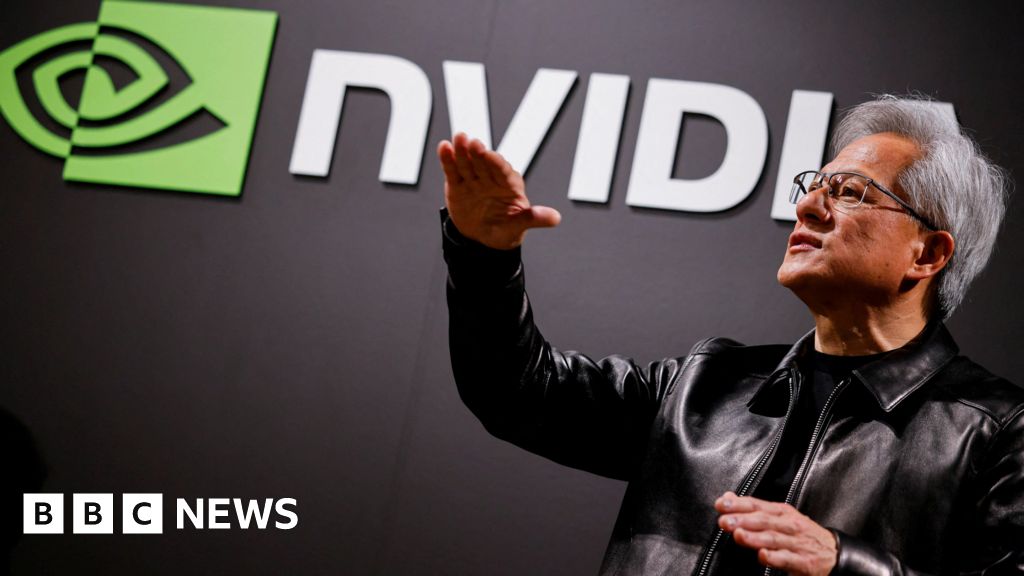
Nvidia has partnered with six major Wall Street firms and investors to raise $500bn for AI infrastructure projects, treating compute hardware and infrastructure as an investable asset class for the first time.
The capital will fund data centre construction and chip manufacturing to support demand from major technology companies that have collectively spent over $1tn on AI projects and infrastructure in just three years.
What happened
Nvidia has partnered with Apollo, BlackRock, Blackstone, Brookfield, Goldman Sachs, and KKR to raise $500bn in capital for AI infrastructure projects. The funding will support Nvidia's own initiatives and those of its partners, including construction of data centres and manufacturing of AI chips.
Why it matters
Major technology and AI companies—including Google, Meta, Amazon, Microsoft, SpaceX, Tesla, OpenAI, and Anthropic—have collectively spent over $1tn in just three years on AI projects and infrastructure. This new capital pool treats AI compute (hardware and infrastructure) as an investable asset class for the first time, enabling these companies to finance the expansion their services demand. Nvidia's stock market value has risen fivefold in three years, driven by demand for its chips.
What to watch
The financing agreement marks a shift in how AI infrastructure is funded, with major institutional investors now treating compute as "mission-critical" infrastructure. However, concerns remain about whether all these projects will deliver adequate returns, as investment in AI continues to accelerate.
Nvidia announced on Monday that it had secured $500bn in capital from six of Wall Street's largest financial institutions and investors—Apollo, BlackRock, Blackstone, Brookfield, Goldman Sachs, and KKR—to fund artificial intelligence infrastructure projects. The partnership marks the first time these investors are treating AI hardware and infrastructure, commonly called "compute", as a dedicated asset class. CEO Jensen Huang framed the shift in strategic terms: "In AI, compute is revenue. We are bringing the world's leading long-term capital providers together to independently underwrite AI infrastructure." The capital will support both Nvidia's own projects and those of its partners, with funding directed toward construction of new data centres designed to house, operate, and cool large volumes of stacked computer chips that process AI data, as well as toward building new factories to manufacture the AI chips needed to power those systems and expand availability to buyers.
The scale of this commitment reflects the explosive demand for Nvidia's graphics processing units (GPUs) across the technology sector. Essentially every major technology and AI company relies on Nvidia's chips to power their services, platforms, and chatbots—including Google, Meta, Amazon, Microsoft, SpaceX, Tesla, OpenAI, and Anthropic. These companies have collectively spent over $1tn on AI projects and infrastructure in just three years, with significantly more spending anticipated. That sustained demand has driven Nvidia's stock market value up fivefold in three years.
Investor confidence is evident in statements from the partners. Jim Zelter, president of Apollo (which manages more than $1tn in assets), called modern compute "a scarce, mission-critical asset class" positioned to "drive significant long-term economic growth and productivity gains." KKR's co-chief executives Joe Bae and Scott Nuttall emphasized that "as we've scaled our approach to digital infrastructure, we've learned that delivery, not ambition, is the hard part"—underscoring that execution, not just strategy, will determine success. However, Jane Sydenham, senior investment manager at Rathbones, voiced a note of caution: while acknowledging Nvidia's dominance and the criticality of its chips, she warned that "the worry is that more and more money is going into these projects. Are they all going to earn the right return for the future?" Recent examples of AI infrastructure financing illustrate how the sector is structured: BlackRock entered into a separate deal with Meta last month to finance and take a majority ownership stake in one Texas data centre, while Anthropic recently partnered with Macquarie Asset Management and GIC (a sovereign wealth fund in Singapore) for AI infrastructure investment, citing that its popular chatbot Claude's demand "requires significant new compute."
Nvidia's partnership with major institutional investors represents a watershed moment in how AI infrastructure is financed. Previously, capital for compute projects came primarily from the tech companies themselves; now, Wall Street is treating AI hardware and data centre infrastructure as a distinct asset class worthy of long-term institutional capital. This shift reflects the scale of the opportunity: companies including Google, Meta, Amazon, Microsoft, SpaceX, Tesla, OpenAI, and Anthropic have committed over $1tn in just three years, and demand shows no signs of slowing—Anthropic, for instance, recently highlighted that its Claude chatbot had become so popular that "demand requires significant new compute." Nvidia's own position underscores the bottleneck: its graphics processing units (GPUs) are used by essentially every major technology and AI company, and that centrality has driven the company's stock market value up fivefold in three years. The $500bn commitment suggests institutional investors believe the returns on compute infrastructure will justify the capital, though one investment manager quoted in the article flagged a legitimate concern: whether all of these projects will ultimately earn adequate returns for investors.
AI-summarized, only the topics you pick — one digest a day via Email, Slack, or Discord.
Free · takes 30 seconds · unsubscribe anytime
Ask AI anything about this article. Q&As are published on this page for other readers too.
Tech companies are raising unprecedented sums for AI infrastructure—$194 billion so far in 2026 by just four f…

Nvidia has signed letters of intent with Apollo, BlackRock, Blackstone, Brookfield, Goldman Sachs, and KKR to…

Anthropic has signed the EU AI Act Code of Practice and will embed invisible watermarks in Claude-generated te…

Anthropic has agreed to pay $9.1 billion over 20 years to Riot Platforms Inc., a Bitcoin miner turned data cen…

Samsung is accelerating efforts to qualify its Taylor, Texas fabrication plant for 2-nanometer chip production…
Nvidia has partnered with six major investment and financial groups to mobilize more than US$500 billion in th…
The AI news that matters, in one minute each morning.
Sign up free