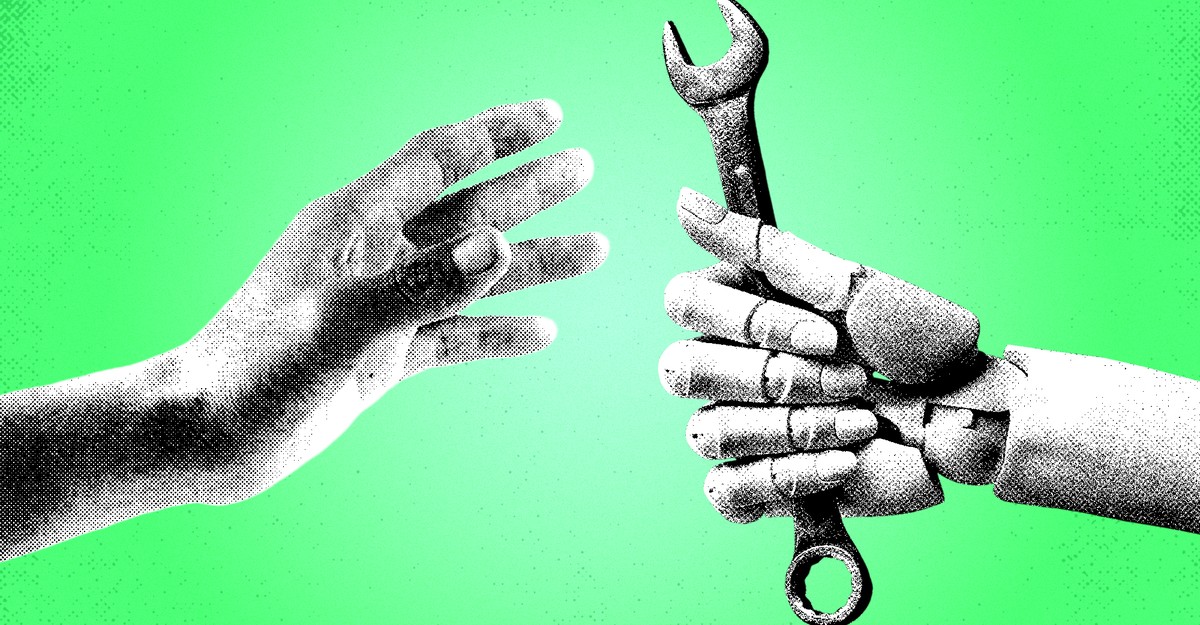
An essay by economist Daron Acemoglu argues that generative AI does not have to repeat the inequality and job losses caused by four decades of digital automation. Instead, AI can be deliberately designed as "pro-worker AI"—specialized models that amplify workers' skills (such as helping electricians diagnose equipment or teachers personalize lessons) rather than replacing them. Realizing this future requires policy shifts: tax reforms that level the playing field between automation and labor, government incentives for pro-worker AI development, antitrust enforcement to break tech monopolies, and a labor movement that advocates for capability-enhancing AI rather than resisting wages alone.
Summaries like this, in your inbox every morning.
Sign up free →What happened
An essay argues that generative AI, unlike the past 40 years of digital automation, can be designed to augment rather than replace workers—through specialized models that help electricians troubleshoot equipment, teachers personalize lessons, and health aides perform broader tasks. The author, economist Daron Acemoglu, calls this "pro-worker AI" and contends it is technologically feasible and already partially proven.
Why it matters
The past four decades of automation increased productivity but deepened inequality and eroded shared prosperity, destabilizing liberal democracies. Without deliberate intervention, generative AI risks repeating that pattern by automating jobs across white-collar and skilled blue-collar work. Pro-worker AI, by contrast, could restore the link between productivity growth and good jobs while creating new service roles for workers without college degrees.
What to watch
The essay identifies several policies to shift incentives toward pro-worker AI: international AI agencies offering grants and competitions, tax code reforms that currently favor automation over labor, worker retraining programs emphasizing flexibility, enforcement of antitrust laws to reduce tech monopoly dominance, and a strengthened labor movement that advocates for pro-worker AI investment rather than merely resisting wage pressures.
Economist Daron Acemoglu's essay, adapted from his new book *What Happened to Liberal Democracy?*, argues that generative AI can either deepen the inequality wrought by four decades of digital automation or be redirected toward benefiting workers instead of replacing them. Over the past 40 years, digital technology increased overall productivity but enriched only some groups—mainly capital owners and knowledge workers—while impoverishing many others. This widening gap has not only collapsed shared prosperity but exacerbated crises of liberal democracy in the developed world. Now, generative AI threatens to supercharge these inequities unless society deliberately charts a different course.
The alternative, which Acemoglu terms "pro-worker AI," is technologically feasible and in some cases already proven. The concept rests on a 1960 insight by computer scientist J. C. R. Licklider, who predicted that computers could one day augment human cognition by delivering highly processed, context-sensitive information. For the following six decades, digital technology could not fulfill this promise because while search engines could quickly retrieve countless results, humans had to process them slowly and sequentially. Generative AI has now realized Licklider's vision: it can find the most relevant answers and summarize them almost instantaneously in digestible form. This capability forms the basis of pro-worker AI, which can increase wages, employment, and productivity simultaneously if widely adopted.
Pro-worker AI is not limited to knowledge workers drafting emails or slide decks. Electricians—in high demand across many industries—could benefit from specialized AI models trained on niche, high-quality data, drawing on targeted knowledge bases, past use cases, and site-specific inputs like sensor data, photographs, and written reports to help identify equipment faults. A global company is already developing such products for field technicians. In education, AI models trained on curricular material could help teachers spot patterns in test results and tailor lesson plans for groups of students making the same mistakes, making education more cost-effective and personalized while driving up demand for teachers and their wages. In healthcare, specially trained models could enable lower-skilled workers to perform a broader range of tasks, particularly those relying on physical exertion and social interaction, creating good service jobs for workers without college degrees and beginning to uproot postindustrial inequality.
However, these promises will not be realized without dramatic shifts in how governments, corporations, investors, and workers think about AI. Silicon Valley today chases automation because it is lucrative—automation reduces payroll and decreases labor dependence—while models that compete with humans for tasks attract disproportionate hype, with "reaching human parity" as a key metric of success. The global AI race centers on artificial general intelligence, which in theory could take over human labor across all sectors, including white-collar work and nonroutine skilled tasks. Even sub-AGI models could eliminate untold jobs, leaving the few remaining high-wage positions to an elite few.
Accemoglu proposes several policy levers. The United States and Europe should create AI agencies offering grants and public competitions to incentivize development of capability-expanding models. Tax code reform is crucial: in the United States, a $100 wage incurs roughly $30 in tax and spending obligations, while $100 in automation equipment carries less than $5 in tax burden—a gap that encourages automation even when human workers are more productive. Removing this distortion would level the playing field. Governments must also invest in adaptive worker training that builds on existing expertise rather than demanding unrealistic career switches. Enforcing antitrust laws against technology monopolies—rarely applied in tech—could foster innovation by pro-worker AI startups that larger firms currently discourage. Finally, a stronger labor movement must shift strategy: instead of merely bargaining for higher wages (which prompts automation), unions should advocate that corporate investments in pro-worker AI benefit both labor and management by boosting worker productivity and company profitability.
At stake, Acemoglu argues, is a core principle of the liberal economic order: that jobs and wage growth remain available to workers of different skills and backgrounds. The past 40 years have jeopardized this promise, but they have also produced capable technologies—most importantly AI—that can help workers rather than sideline them. The choice, he contends, depends on whether society decides that automation will not be the north star of the AI age.
The essay frames a critical juncture in AI development rooted in a four-decade historical precedent. From 1980 onward, digital automation increased overall economic productivity but concentrated gains among capital owners and high-skill workers while eroding wages and job security for many others. This widening inequality, the author argues, has destabilized liberal democracies across the developed world. Generative AI now presents a choice: it can either amplify that pattern by automating away entire job categories (white-collar cognitive work, skilled blue-collar tasks, nonroutine problem-solving) or be intentionally designed to augment human capability.
The technological foundation for pro-worker AI already exists. The essay traces this to J. C. R. Licklider's 1960 prediction that computers would augment human cognition by providing processed, context-sensitive information. For six decades, Licklider's vision remained unfulfilled because search engines could retrieve data but humans had to process it slowly. Generative AI has now fulfilled that prophecy by synthesizing relevant answers and summarizing them instantaneously. This capability, the essay suggests, can be channeled into specialized, high-quality models tailored to specific professions and tasks—electricians diagnosing faults, teachers spotting learning patterns, healthcare workers performing a broader range of care tasks.
The central obstacle is not technological but economic and political. Silicon Valley's funding landscape, tax codes, and market competition all favor automation because it reduces payroll and shareholder risk. Breaking that bias requires coordinated action across government (international AI agencies, tax reform, antitrust enforcement), labor (unions advocating for pro-worker AI rather than mere wage defense), and education (adaptive worker retraining that builds on existing expertise rather than demanding radical retraining like "turning coal miners into computer programmers"). The essay stakes this dispute as fundamentally about preserving the liberal economic order's promise that jobs and wage growth remain available to workers of different skills.
AI-summarized, only the topics you pick — one digest a day via Email, Slack, or Discord.
Free · takes 30 seconds · unsubscribe anytime
No comments yet. Be the first to share your thoughts!
Log in to join the discussion



Get curated AI news from 200+ sources delivered daily to your inbox. Free to use.
Get Started FreeFree · takes 30 seconds · unsubscribe anytime
