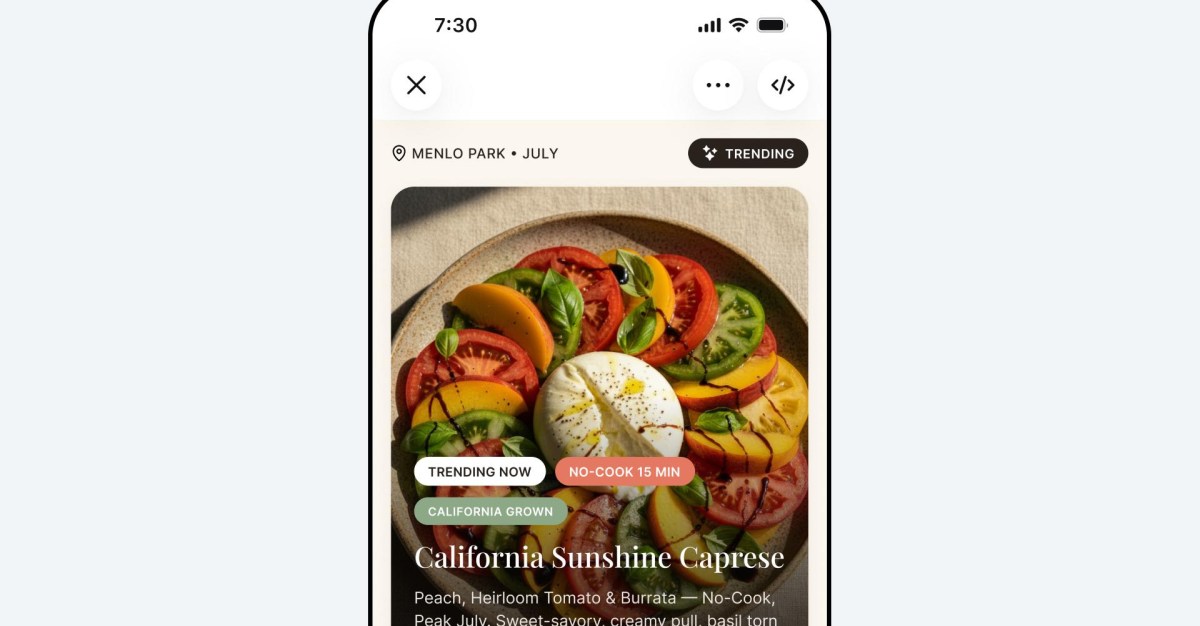
Meta is upgrading its AI chatbot with productivity features like calendar integration, daily briefings, and web research that users can adjust in real time. The update, powered by its new Muse Spark 1.1 model, is rolling out today in select markets and will expand to more countries and WhatsApp in the coming weeks, marking a shift toward competing with ChatGPT, Gemini, and Claude on productivity tasks rather than entertainment alone.
Summaries like this, in your inbox every morning.
Sign up free →What happened
Meta is upgrading its AI chatbot with new productivity features, including the ability to tap into your calendar to plan events, generate daily briefings, perform in-depth research you can steer as it progresses, search Facebook Marketplace, and find restaurants that fit your schedule. The update, powered by Meta's newly released Muse Spark 1.1 model, is rolling out today in select markets in the Meta AI app and on the web, with availability expanding to more countries and platforms including WhatsApp in the coming weeks.
Why it matters
The move reverses Meta's previous strategy of focusing on entertainment and connection rather than productivity features. By adding tools that compete directly with OpenAI's ChatGPT, Google's Gemini, and Anthropic's Claude, Meta is positioning its chatbot as a personal assistant that can handle recurring tasks—like calendar briefings, meal plans, and product restock updates—without requiring you to re-prompt each time. This represents CEO Mark Zuckerberg's stated vision of "personal superintelligence."
What to watch
Meta says the chatbot can now adjust its direction mid-response (similar to ChatGPT) and summarize information from across the web into reports, presentations, or plans. The full rollout timeline extends through the coming weeks as the feature reaches more countries and platforms.
Meta announced today that its AI chatbot is undergoing a major upgrade designed to compete more directly with leading AI assistants. The update equips Meta AI with calendar integration, allowing it to help users plan events, generate daily briefings based on their schedules, and perform in-depth research that users can adjust as the assistant works. The new capabilities also include browsing Facebook Marketplace for used items matching a budget (such as furniture for a kitchen renovation), finding restaurants that align with event planning timelines, and automating recurring tasks without requiring users to re-prompt each time.
Meta is powering these enhancements with its newly released Muse Spark 1.1 model, which extends the chatbot beyond its previous capabilities of answering questions, generating images, and drafting documents. The chatbot can also now summarize information from across the web into reports, presentations, or plans, and allows users to adjust the assistant's direction mid-response—a feature similar to OpenAI's ChatGPT.
The shift marks a notable reversal of Meta's stated direction. In a previous communication to employees, CPO Chris Cox emphasized that the company would "focus on entertainment" and "connection with friends" rather than "focusing obsessively on productivity" like OpenAI, Google, and Anthropic. Today's announcement abandons that approach, aligning Meta with the productivity-first strategies of its competitors. CEO Mark Zuckerberg has publicly touted "personal superintelligence" as the future of AI, and this update represents a concrete step toward that vision.
The rollout is beginning today in select markets through the Meta AI app and the web, with broader availability coming to additional countries and platforms, including WhatsApp, in the coming weeks.
Meta's shift toward productivity-focused AI features represents a significant strategic reversal. Less than a year ago, CPO Chris Cox told employees that the company would focus on entertainment and connection with friends rather than pursuing productivity use cases like rivals OpenAI, Google, and Anthropic. This new update directly contradicts that position, positioning Meta's chatbot as a direct competitor to ChatGPT, Gemini, and Claude by incorporating calendar integration, task automation, and research capabilities.
The timing and scope of the rollout suggest Meta is moving cautiously. By launching in select markets first and expanding through the coming weeks, the company is likely testing performance and user adoption before a wider deployment. The inclusion of WhatsApp as a distribution channel is particularly notable, given the app's 2 billion-plus user base and Meta's ownership—it signals an attempt to embed AI productivity directly into messaging infrastructure where users already spend time.
AI-summarized, only the topics you pick — one digest a day via Email, Slack, or Discord.
Free · takes 30 seconds · unsubscribe anytime
No comments yet. Be the first to share your thoughts!
Log in to join the discussion


Get curated AI news from 200+ sources delivered daily to your inbox. Free to use.
Get Started FreeFree · takes 30 seconds · unsubscribe anytime
