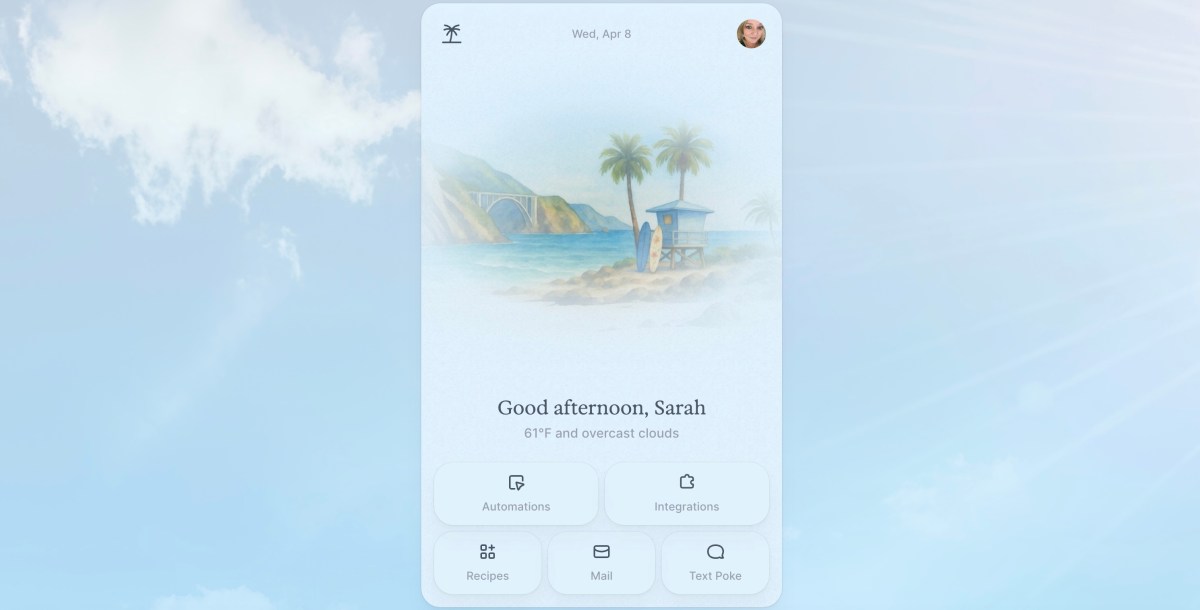
Cognition has acquired Poke, a conversational AI assistant launched in March 2026 that users interact with through messaging apps like iMessage, SMS, and Telegram. The deal, valued in the "low nine figures," reflects a growing belief that how AI assistants interact with users—through personality, humor, and familiarity—is becoming as valuable as the underlying AI models. Poke will now infuse Cognition's coding assistant Devin with its conversational qualities, while gaining access to more powerful infrastructure to run more efficiently.
Summaries like this, in your inbox every morning.
Sign up free →What happened
Cognition, an AI coding startup, has acquired Poke (operated by The Interaction Company of California) in a deal valuing the startup in the "low nine figures." Poke will bring its conversational interaction model to Cognition's coding assistant Devin, while Poke will gain access to Cognition's models and infrastructure.
Why it matters
AI assistants that interact naturally—with personality, humor, and familiarity—may become as competitive an advantage as the underlying technology itself. For software engineers, a coding assistant that feels like a knowledgeable colleague rather than a tool could improve both usability and engagement. Poke had been expensive to operate despite hundreds of thousands of users, so the acquisition gives it a path to profitability and scale.
What to watch
Poke will remain operational through the end of this year on Apple's Messages for Business platform (which it became the first AI agent to be approved for in June). Starting next year, both products will experiment with integration, including Poke using Cognition's SWE-1.7 model for some tasks. Over the past three months, Poke users exchanged more than 100 million messages on the platform.
The Interaction Company of California, which operates Poke, has been acquired by Cognition, an AI coding startup. The deal values Poke in the "low nine figures," according to Cognition co-founder Scott Wu's confirmation. The acquisition brings together two complementary products: Poke, a conversational AI assistant, and Devin, Cognition's coding assistant. Poke will bring its interaction model and personality to Devin, while Poke will gain access to Cognition's models and infrastructure to become faster and more reliable.
Poke, first launched in March 2026, allows users to engage with an AI agent through their preferred messaging platform—iMessage, SMS, Telegram, or WhatsApp in some markets. What distinguishes Poke is how it interacts: instead of functioning like a traditional tool, it chats familiarly with users, responding like a friend and incorporating slang and humor. Users have employed Poke for tasks across travel, health, finance, scheduling, and education, with productivity tasks like email management, reminders, and to-dos being particularly common. Over the past three months, Poke users exchanged more than 100 million messages on the platform. However, despite this adoption by hundreds of thousands of people, Poke had been expensive to operate, making profitability challenging.
In June, Poke achieved a milestone by becoming the first AI agent approved to run on Apple's Messages for Business platform, which standardizes how businesses handle customer communications within Apple's Messages app. Going forward, the companies have committed to maintaining the status quo through the end of this year—Poke will remain on Apple's platform with no immediate changes. However, starting in 2027, the teams will experiment with how both products can improve together. Poke will begin using Cognition's newest software engineering model, SWE-1.7, for some tasks. Fully combining the two products has not been ruled out. Cognition co-founder Scott Wu noted in a blog post that he and fellow co-founder Walden Yan had been angel investors in the company behind Poke, and described the Interaction team as having "built an agent that people love: it's proactive, it knows you, and it's fun to talk to."
Poke co-founder Marvin von Hagen articulated the strategic logic in an interview: "You probably prefer it if you have co-workers that have personality, rather than if you have co-workers that are just robots. When you have co-workers that are also software engineers, they can also make a joke. And you'll find it funny and enjoyable." Looking further ahead, von Hagen suggested that Poke could eventually orchestrate multiple Devin coding sessions, helping Devin handle multiple pull requests in parallel (it currently handles one at a time) while also helping Devin remember tasks across different sessions, creating what he called "a persistent co-worker."
The acquisition of Poke by Cognition signals a shift in how AI companies view competitive advantage. While raw model capability remains important, the quality of interaction—personality, humor, familiarity, and responsiveness—is being recognized as equally valuable to users. Poke co-founder Marvin von Hagen's analogy is telling: people prefer colleagues with personality over robotic ones, and that principle applies to AI assistants. For Devin, a coding agent, this could mean a shift from being perceived as a sterile tool to being experienced as a trusted collaborator.
Poke itself faced a profitability challenge despite meaningful adoption: hundreds of thousands of users exchanging over 100 million messages in just three months. The high operational cost of running Poke made it difficult to turn a profit, which appears to have driven the acquisition. Cognition's infrastructure and engineering resources offer a path forward. The deal also reflects confidence in messaging-based AI assistants—Poke achieved a notable milestone in June by becoming the first AI agent approved to run on Apple's Messages for Business platform, validating demand in that channel.
The long-term vision outlined by von Hagen suggests deeper integration: Poke orchestrating multiple coding sessions across Devin, Devin handling parallel pull requests (currently limited to one at a time), and both tools working together to create a "persistent co-worker" that remembers context across sessions. This paints a picture of AI assistants moving beyond single-task competence toward multi-faceted collaboration.
AI-summarized, only the topics you pick — one digest a day via Email, Slack, or Discord.
Free · takes 30 seconds · unsubscribe anytime
No comments yet. Be the first to share your thoughts!
Log in to join the discussion


Get curated AI news from 200+ sources delivered daily to your inbox. Free to use.
Get Started FreeFree · takes 30 seconds · unsubscribe anytime
