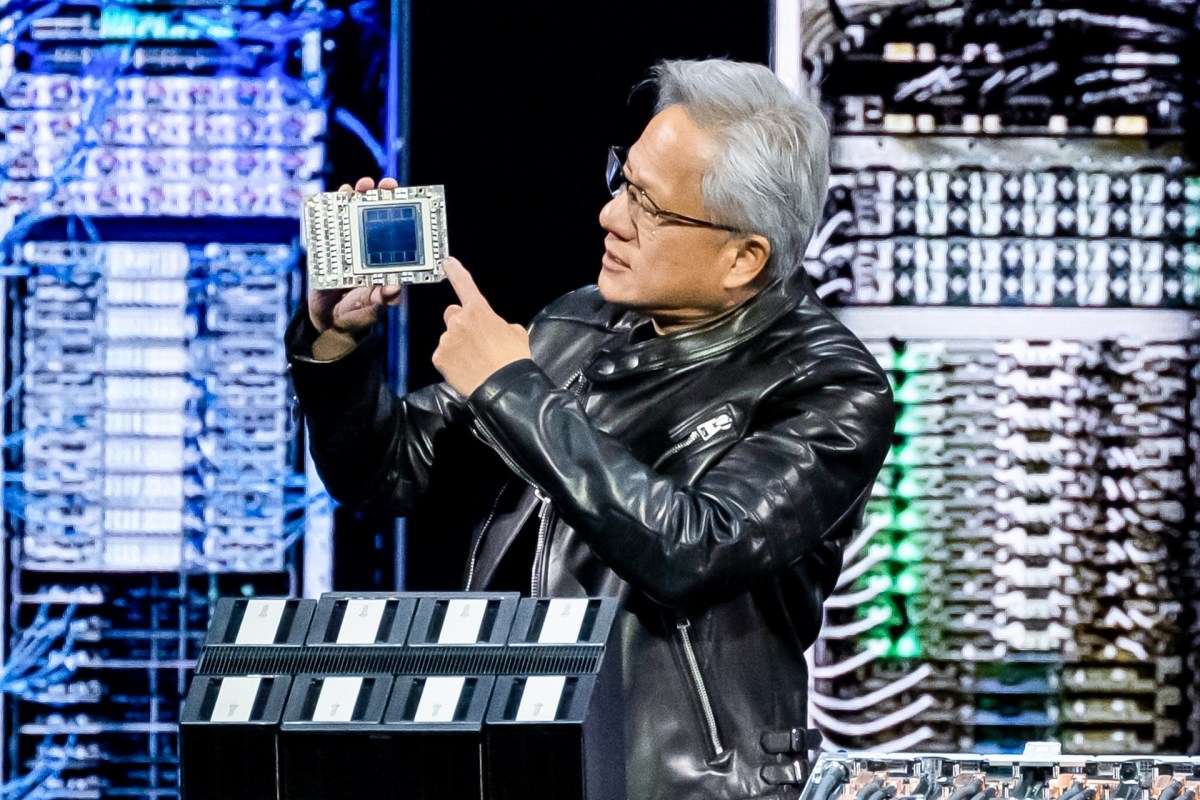
Nvidia secured a $500 billion commitment from major financial firms to fund AI data center construction by guaranteeing the residual value of its GPU chips—agreeing to cover up to 25% of any price decline.
The move aims to create a thriving secondary market for aging hardware, keeping demand for Nvidia chips alive as they mature, though it exposes Nvidia to mounting losses if AI demand weakens or infrastructure becomes obsolete.
What happened
Nvidia announced that Apollo, BlackRock, Blackstone, Brookfield, Goldman Sachs, and KKR committed up to $500 billion to build AI data centers. To secure their participation, Nvidia agreed to guarantee with its own money that its chips used as collateral will retain their value—specifically, Nvidia will cover up to 25% of any shortfall if the chips cannot command their expected price.
Why it matters
The deal addresses a fundamental risk in AI infrastructure financing: as GPU prices fluctuate, collateral backing these loans becomes unstable. By absorbing that risk, Nvidia is creating a secondary market for older hardware, which could sustain demand for its chips as they age rather than becoming obsolete. This sidesteps the Lucent Technologies comparison—where the equipment maker lent customers money to buy its own products—because Nvidia is bringing in independent institutional capital to shoulder most of the burden.
What to watch
The scheme carries "wrong way" risk for Nvidia: its financial obligations grow precisely when demand weakens, squeezing both the value guarantee and broader revenues. The bet hinges on Huang's vision of AI servers as long-term "investable infrastructure" (akin to railroads) rather than quickly depreciating assets. If AI adoption slows, new technologies improve existing infrastructure efficiency, or demand simply cools, the entire structure could face pressure.
Nvidia this week announced a landmark partnership in which Apollo, BlackRock, Blackstone, Brookfield, Goldman Sachs, and KKR committed up to $500 billion toward building AI data centers. The centerpiece of the deal is a value guarantee: Nvidia agreed to back its own chips used as collateral for these ventures, promising to cover up to 25% of any gap between the chips' expected price and their liquidation value should a borrower default.
The move has drawn intense scrutiny from financial markets and commentary alike. CEO Jensen Huang felt compelled to explain the strategy on X and business television, defending it against concerns about circular financing and comparisons to Lucent Technologies, which famously lent customers money to purchase its own telecom equipment before crashing during the dotcom collapse. Huang acknowledged the worry directly on X: "Is this circular financing? This initiative is designed to address that concern. We are bringing independent, long-term institutional capital into the AI infrastructure market." The distinction matters: Nvidia is not lending the money itself; instead, it is inviting blue-chip financial firms to deploy capital while Nvidia absorbs a portion of the collateral risk.
The underlying economics reveal why Nvidia took this step. Traditional funding sources for AI infrastructure have begun to tighten. Hyperscalers have strained themselves—Oracle accumulated significant debt, Google issued new equity tranches, and Meta burned through cash. Microsoft CEO Satya Nadella recently cited "1873," a historical account of railroad-era financial engineering that precipitated a national economic crash, signaling alarm among industry leaders about the sustainability of current funding models. Bloomberg has calculated that Nvidia is working on another $750 billion worth of similar circular deals this summer.
But underneath the immediate financing puzzle lies a deeper strategic insight: Nvidia is deliberately attempting to nurture a secondary market for aging GPUs. As Huang framed it, AI servers are not quick-depreciating assets like PCs but long-term "investable infrastructure" comparable to railroads and airlines. "When needs change, the factory can be used by another customer, another cloud or another operator. This broad ecosystem gives NVIDIA compute a deep market of potential users and offtakers, helping protect residual value," he said. The guarantee of up to 25% price protection on collateral is designed to stabilize that secondary market and keep demand alive for hardware as it ages.
The risk to Nvidia is substantial. Financiers call this "wrong way" risk: Nvidia's obligations expand precisely when demand weakens. Should adoption slow, new technologies make current infrastructure obsolete, or enterprises and consumers temper their AI spending, both the collateral value and Nvidia's own revenues could deteriorate simultaneously. If today's AI boom, where capacity still lags demand, cools before AI becomes embedded as foundational infrastructure, the entire structure could unravel. Yet if Huang's vision holds—if AI infrastructure anchors long-term growth the way utilities and transportation did—then Nvidia's guarantee becomes a cheap insurance premium on a durable revenue stream.
The $500 billion commitment represents a watershed moment in AI infrastructure financing, driven by the paradox that traditional funding sources are wearing thin. Hyperscalers like Oracle have accumulated heavy debt, Google has issued new equity, and Meta has burned substantial cash. Microsoft CEO Satya Nadella recently invoked "1873," a book about railroad-era financial engineering that crashed the economy, signaling how precarious the current funding model feels.
Nvidia's guarantee strategy is deliberately constructed to avoid the Lucent trap. Rather than Nvidia itself bankrolling its customers' purchases, the company is inviting Apollo, BlackRock, Blackstone, Brookfield, Goldman Sachs, and KKR—seasoned institutional investors with deep pockets—to provide the bulk of capital. Nvidia's role is narrower: it absorbs a portion of the residual-value risk (up to 25%) to make the collateral stable enough for lenders to finance. Bloomberg has calculated Nvidia is working on another $750 billion worth of similar circular deals. This asymmetry is the scheme's rigor: Nvidia shoulders risk only on price depreciation, not on the entire lending structure.
The real gamble beneath the financial engineering is Huang's thesis that AI infrastructure is not a depreciating asset like a PC but a long-term asset like railroads or airlines. If that vision holds—if demand remains robust, if new competitors do not render current chips obsolete, and if enterprises and consumers sustain their AI investment—then aging hardware will command secondary-market demand, and Nvidia's guarantee becomes cheap insurance. If that vision fails—if AI adoption tempers, if new architectures emerge, or if the boom deflates—Nvidia faces mounting losses precisely when its core revenues are squeezed. The outcome hinges not on financial engineering but on whether AI's current trajectory persists.
AI-summarized, only the topics you pick — one digest a day via Email, Slack, or Discord.
Free · takes 30 seconds · unsubscribe anytime
Ask AI anything about this article. Q&As are published on this page for other readers too.
Sam Altman is demanding OpenAI's IPO valuation reach $1 trillion, but SoftBank must repay a $40 billion bridge…

Bank of America raised its 2030 server CPU market estimate to more than $210 billion from about $170 billion…
Google released Gemini 3.7 Flash, its successor to Gemini 3.6 Flash (released three weeks earlier), available…

DeepSeek moved its V4-Pro flagship model to production (build V4-Pro-0813), released its proprietary agent har…

Microsoft has begun integrating its consumer and enterprise Copilot applications into a unified platform, star…
OpenAI and Cerebras announced Ultrafast Mode, a new service tier delivering up to 750 output tokens per second…

The AI news that matters, in one minute each morning.
Sign up free