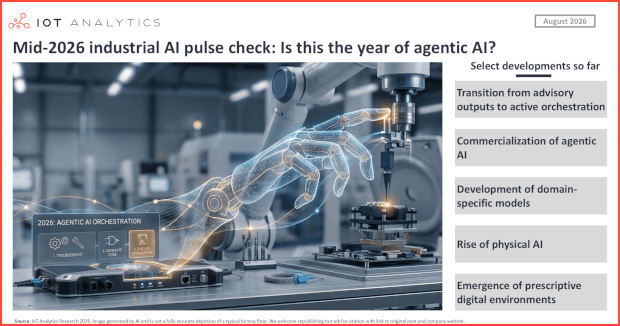
In mid-2026, enterprises are moving beyond early AI phases and entering a new era of agentic and autonomous operations, according to IoT Analytics research.
At Hannover Messe 2026, vendors showcased 29 mature industrial agentic AI solutions—most already commercialized—that execute multi-step tasks with minimal human intervention, particularly in maintenance, troubleshooting, and safety incident reporting.
Major software vendors are shifting pricing models to account for agentic capabilities, signaling that AI agents are transitioning from pilots to revenue-generating products.
What happened
IoT Analytics research shows enterprises are advancing into the agentic and autonomous operations phase of the IoT Value–Maturity Curve in 2026. At Hannover Messe 2026, the team identified 29 industrial agentic AI solutions from vendors like Siemens, Schneider Electric, ABB, and Rockwell Automation—78% model-agnostic and 72% already commercially available (not just pilots). Cisco's CEO called 2026 "a turning point for AI" and "the year of agentic applications" in February 2026.
Why it matters
Agentic AI is shifting from advisory outputs to autonomous execution on the plant floor—tasks like maintenance troubleshooting, incident reporting, and predictive maintenance now run with minimal human intervention. Vendors are ending free pilot phases and monetizing agentic capabilities; Microsoft is moving customers from per-seat to "seats plus consumption" pricing, and Oracle is introducing outcome-based commercial models. This signals that industrial AI is moving from concept to revenue-generating product, with domain-specific models addressing the determinism and physics-based reasoning that generic frontier models lack.
What to watch
Maintenance and troubleshooting lead as the primary agentic AI use case at Hannover Messe 2026. Physical AI—where agentic reasoning controls robots and edge devices in the real world—is emerging as a parallel trend; Beckhoff Automation demonstrated TwinCAT CoAgent, which translates natural language commands into machine motion and error diagnostics. Siemens committed to investing over €1B in industrial AI over the next few years (announced November 2025).
Midway through 2026, IoT Analytics assesses that many enterprises are entering the agentic and autonomous operations phase of the IoT Value–Maturity Curve. CEO discussions on AI topped corporate earnings calls, and Cisco's CEO Chuck Robbins declared in February 2026 that "2026 is going to be a turning point for AI. We believe that this will be the year of agentic applications." Riding this momentum, IoT Analytics deployed 12 analysts to Hannover Messe 2026 to document industrial technology trends.
The team's central finding starkly contrasts 2026 with 2025: whereas agentic AI at Hannover Messe 2025 appeared mostly as simple automation demonstrations, 2026 revealed 29 industrial agentic AI solutions at significantly higher maturity. Of these, 78% were already model-agnostic and 72% were commercially available rather than pilots. Maintenance and troubleshooting emerged as the primary use case. For example, US-based Tulip, in partnership with Norway-based Cognite and AWS, showcased multi-agent troubleshooting: a Cognite Atlas AI agent (backed by Cognite Data Fusion's industrial knowledge graph) passes rich contextual data to a Tulip frontline operations agent, with the Cognite agent identifying issues using industrial context and the Tulip agent translating findings into actionable workflows for frontline workers. The IoT Analytics team ranked this as agentic AI level 3 due to its multi-agent coordination capability. At Maintenance Dortmund 2026, IFS Ultimo demonstrated an agentic module that independently identifies safety-related content within a technician's routine report and automatically generates a separate, compliant safety incident record without human intervention—exemplifying the shift from advisory alerts to autonomous execution.
This maturation has triggered a commercial pivot. Vendors are ending free pilot phases and implementing monetization structures. Siemens, for instance, moved to a fixed subscription model of €2,100/user/year for its Eigen Engineering Agent, citing customer demand for predictable costs. Agentic AI is also upending software pricing models at larger vendors: Microsoft reported in April 2026 that customers are shifting "from traditional seat model to seats plus consumption," with nearly 60% of its service customers already purchasing usage-based credits. Oracle announced in June 2026 that it is "simplifying how customers consume and pay for agentic capabilities" through "bundles of tokens" and "outcome-based commercial models that align pricing directly to the value derived."
Industrial software leaders are also investing heavily in proprietary foundation models to address gaps in generic frontier models. Adopters piloting frontier models in industrial settings encounter outputs lacking the determinism, physics-based reasoning, and domain grounding that industrial use cases require. SymphonyAI's Iris Foundry platform, expanded in April 2026 to include 8 industrial applications co-built with Microsoft, provides a model-agnostic architecture enabling customers to select verticalized AI models suited to their workflows—particularly for energy operators using industry-specific failure nodes, process dynamics, and regulatory obligations. Siemens, which released its Industrial Foundation Model in partnership with Microsoft in 2025, publicly committed to investing over €1B into industrial AI over the next few years in November 2025. Physical AI—where agentic reasoning extends into real-world machine control—is also gaining traction. At Hannover Messe 2026, Germany-based Beckhoff Automation demonstrated TwinCAT CoAgent, which uses LLMs connected via the Model Context Protocol to directly control real machine motion sequences; engineers type a command, and CoAgent translates it into machine commands, orchestrates path planning, generates function blocks, and performs error diagnostics. Such solutions address skill gaps by allowing operators to specify goals (e.g., "clear this field") rather than program paths, enabling less-experienced workers to operate with veteran-level proficiency.
Agentic AI has moved from emerging theme to operational reality in industrial environments. In 2025, Hannover Messe demonstrations of agentic AI remained largely rooted in simple automation; by 2026, the maturity leap is stark—78% of the 29 solutions observed were model-agnostic, enabling multi-vendor flexibility and multi-agent coordination. This shift reflects a fundamental move from advisory AI (alerting humans to problems) to autonomous execution (resolving problems without intervention). The Smart Maintenance Trends Report 2026 documents this transition, with AI modules now automatically generating safety incident records and daily maintenance briefings rather than merely flagging issues. Vendors are responding to this maturation by ending free pilot phases and implementing commercial monetization—Siemens fixed its Eigen Engineering Agent at €2,100/user/year, while Microsoft and Oracle are restructuring pricing to align with consumption or outcome rather than fixed seats.
The acceleration reflects a move up the operational stack: as enterprises progress through the IoT Value–Maturity Curve (connectivity, platforms, scaling), agentic AI represents the next growth stage. Industrial software leaders are also building proprietary foundation models (Siemens' Industrial Foundation Model, SymphonyAI's Iris Foundry) to address the determinism and domain grounding that generic frontier models lack in industrial workflows. Parallel to this is the rise of physical AI—agents that reason not only about decisions but also directly control robots and edge devices in real-world environments—reducing skill gaps by allowing operators to specify goals rather than program sequences.
AI-summarized, only the topics you pick — one digest a day via Email, Slack, or Discord.
Free · takes 30 seconds · unsubscribe anytime
Ask AI anything about this article. Q&As are published on this page for other readers too.
SpaceX AI has launched Grok Bot, an AI agent designed to handle workplace tasks and operate digital tools with…

TSMC says competition in advanced chip packaging for AI is shifting beyond single-device performance metrics t…

Passive component distributor Nichidenbo reported that supply of MLCCs (multilayer ceramic capacitors) and oth…

Foxconn reported second-quarter net profit of NT$59.97 billion ($1.86 billion), up 35 percent year-on-year, be…

Owlet Inc reported Q2 2026 total revenue of $33.9 million, up 29.9% year-over-year, with gross margin expandin…

Taiwan's Foxconn reported second-quarter net profit of T$59.97 billion ($1.86 billion) for April–June, up 35%…

The AI news that matters, in one minute each morning.
Sign up free