What happened
OpenAI cut GPT-5.6 Luna prices by 80% (now $0.20 per million input tokens and $1.20 per million output tokens) and Terra by 20% (to $2/$12), while launching Sol Fast mode at 2.5× speed for 2× the price. The cuts follow systemic efficiency gains: self-optimization reduced serving costs by 20%, speculative decoding improved token efficiency by over 15%, and optimizations to KV caching, context bloat avoidance, and prompt caching lowered infrastructure demands.
Why it matters
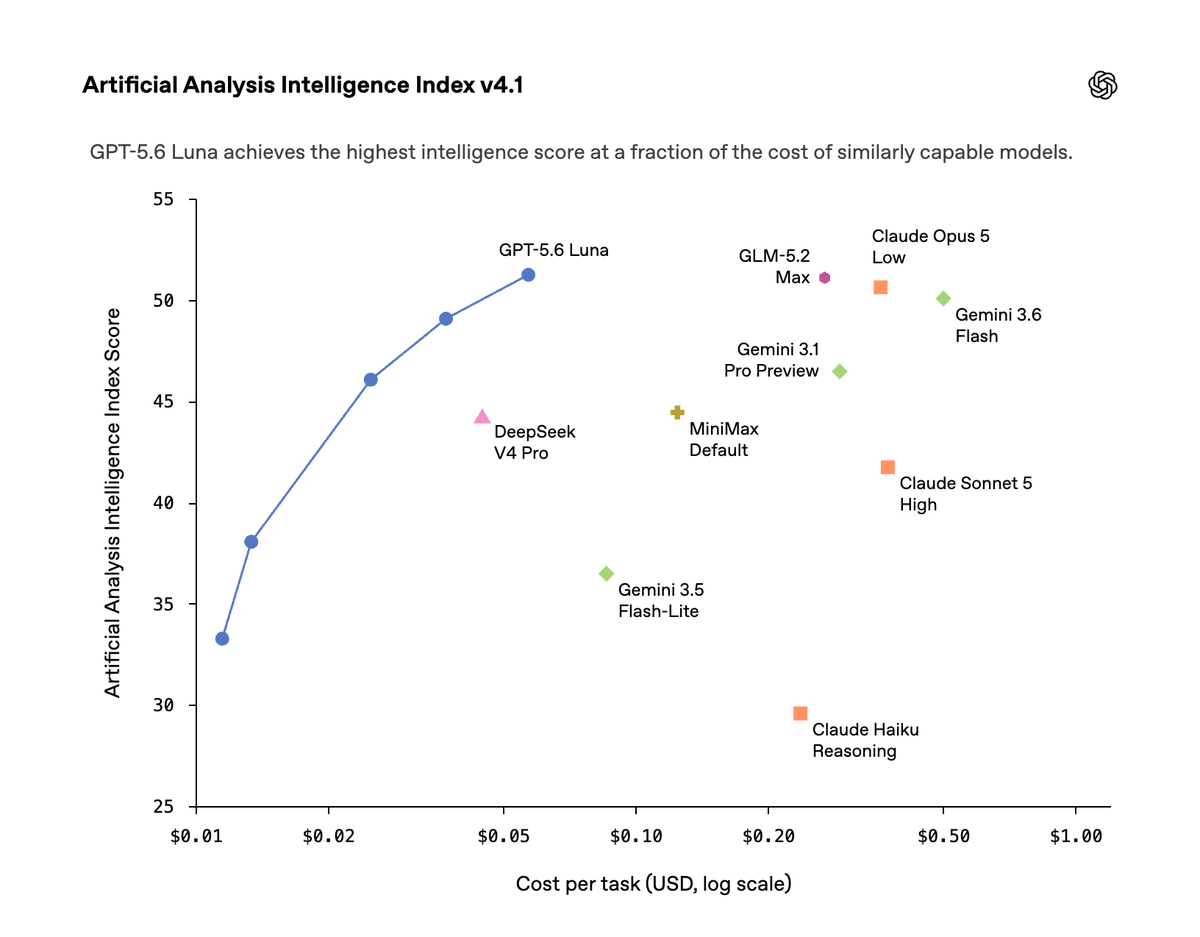
GPT-5.4 full intelligence (scored 51 on Artificial Analysis Cost per Task benchmark) cost $2.50/$15 four months ago; that same intelligence level is now available in Luna at $0.20/$1.20—roughly one-thirteenth the token price. For workflows like auto-review in ChatGPT and Codex CLI moving from GPT-5.4 to Luna, OpenAI projects roughly 10× lower cost. This undercuts open models like DeepSeek and specialized cheap models like Gemini Flash-Lite on cost-per-task.
What to watch
OpenAI's pricing gains reflect sustained deflationary pressure on commodity AI inference. The body notes an annualized rate of roughly 2000× cost reduction per year (though benchmarks like Artificial Analysis may be partially trained-to), and the article frames this as an acceleration beyond the 1000× drop over 18 months observed a year prior. Sol Fast mode is available in the API; Luna and Terra cuts are effective immediately.
Summaries like this, in your inbox every morning.
The article traces a striking pattern of sustained cost reduction in AI inference. A year ago, holding model quality constant (measured by LMSys Elo), GPT-4-level intelligence fell 1000× in cost over 18 months; the new data suggest this deflation has not only continued but accelerated. The specific claim—that GPT-5.4 intelligence now costs roughly one-thirteenth what it did four months earlier—translates to an annualized rate the article frames as "roughly 2000× a year," though it hedges this with the caveat that public benchmarks like Artificial Analysis may be partially trained-to, whereas Elos resist direct optimization.
The price cuts are tied directly to systems-level improvements across three layers: the model itself (self-optimization where GPT-5.6 analyzed production traffic and autonomously rewrote serving kernels), the inference stack (speculative decoding and KV caching tuning), and the agentic harness (context bloat avoidance and prompt caching). This multi-layer optimization appears to reflect a shift from low-hanging fruit (moving from completions to reasoning, from dense to mixture-of-experts) to harder architectural and infrastructure wins. The practical impact is immediate: teams using Codex and ChatGPT are moving auto-review from GPT-5.4 to Luna with an expected 10× cost reduction.
The article also notes that on cost-per-task benchmarks, OpenAI has "beat even open models like DeepSeek, GLM, and MiniMax, and dedicated cheap-but-good models like Gemini Flash-Lite," positioning proprietary inference as the cheapest option for non-finetuned intelligence—a reversal from prior periods when open models offered better unit economics.
Pick your industry and the AI tools you use, and get news related to your work every day.
Free · 30 seconds with Google · unsubscribe anytimeWhat is AIToday? →
Ask AI anything about this article. The AI reads this article, earlier AIToday articles, and Wikipedia, and cites its sources. Q&As are published on this page for other readers too.
The Motley Fool argues Amazon is the AI company of the two, since AWS was just 21% of first-half 2026 revenue…

Hewlett Packard Enterprise stock is down 5% at $55.87

Cammarata reinterprets InceptionV1's cat-car neuron as a V-shape detector, not two unrelated concepts

Google Deepmind's Gemini 4 Argon scored 97.5 percent on ARC-AGI-3 at a cost of $4,800, second only to GPT-6 As…
Microsoft's Surface Laptop Ultra, using Nvidia's RTX Spark platform, starts at $2,599 (up to $5,899)

Meta's new commercial terms, effective October 30th, appear to let it crawl and train AI on content from websi…