What happened
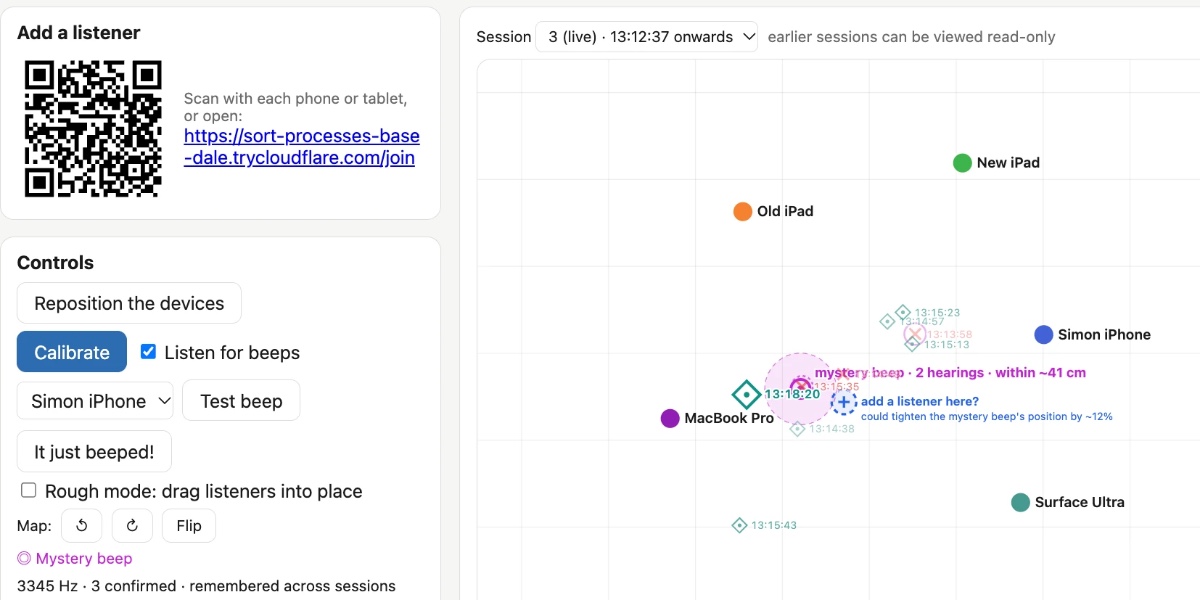
Simon Willison had Claude Code build Beep Locator, which uses several devices as listeners. It located the beep to within about 40cm, and he found an old carbon monoxide detector needing new batteries.
Why it matters
The project shows a coding agent can be given 'ears' by running code that analyzes microphone audio, letting it work on a physical-world problem with minimal human input.
Summaries like this, every morning.
Willison's project began with a frustrating problem: an intermittent beep in a cluttered box room. Rather than unpack every box, he turned to Claude Code, an AI coding agent, to build a solution. The agent researched the problem and surfaced a 2007 academic paper, BeepBeep, which described a way to use commodity devices—speakers and microphones—to range and localize sounds. That research directly informed the design of Beep Locator, which coordinates multiple listening devices via a Python web server and WebSockets.
The system's development also showcased a practical technique: giving the AI agent the ability to perceive audio. Claude lacks native audio input, but by running JavaScript and Python code that captured and analyzed microphone data, Willison effectively gave it 'ears.' This let the agent iterate on the software while Willison mostly chatted with it about what was happening. The approach echoes other efforts to let coding agents sense the physical world, such as using a webcam to debug hardware.
The outcome was a working tool that pinpointed the beep to within about 40cm, leading to the discovery of an old carbon monoxide detector. The project illustrates how AI coding agents can be extended beyond screen-based tasks to interact with and interpret real-world signals, potentially opening up new ways to solve physical-world problems with software.
Pick your industry and the AI tools you use, and get news related to your work every day.
Free · 30 seconds with Google · unsubscribe anytimeWhat is AIToday? →
Ask AI anything about this article. The AI reads this article, earlier AIToday articles, and Wikipedia, and cites its sources. Q&As are published on this page for other readers too.
Bay AI Inc. launched with $50 million — a $37 million Series A led by Battery Ventures and a $13 million seed…

Kora Systems, led by Cyanogen co-founder Kirt McMaster, unveiled a Linux-based desktop OS that runs AI models…

IPROS announced five free 20-minute sessions at AI-Industry World 2026, covering Microsoft 365 Copilot, busine…

At NVIDIA's Agentic AI Day Japan 2026 on Nov 10 in Tokyo, JAIST's Shota Imai predicted competitive areas will…
Devon Thomas quit Apple and founded Abliteration AI, which removes safeguards from open-weight models like Z.a…

On November 10, OpenAI Academy and partners including Caregiver Action Network and Alzheimer's Association wil…