What happened
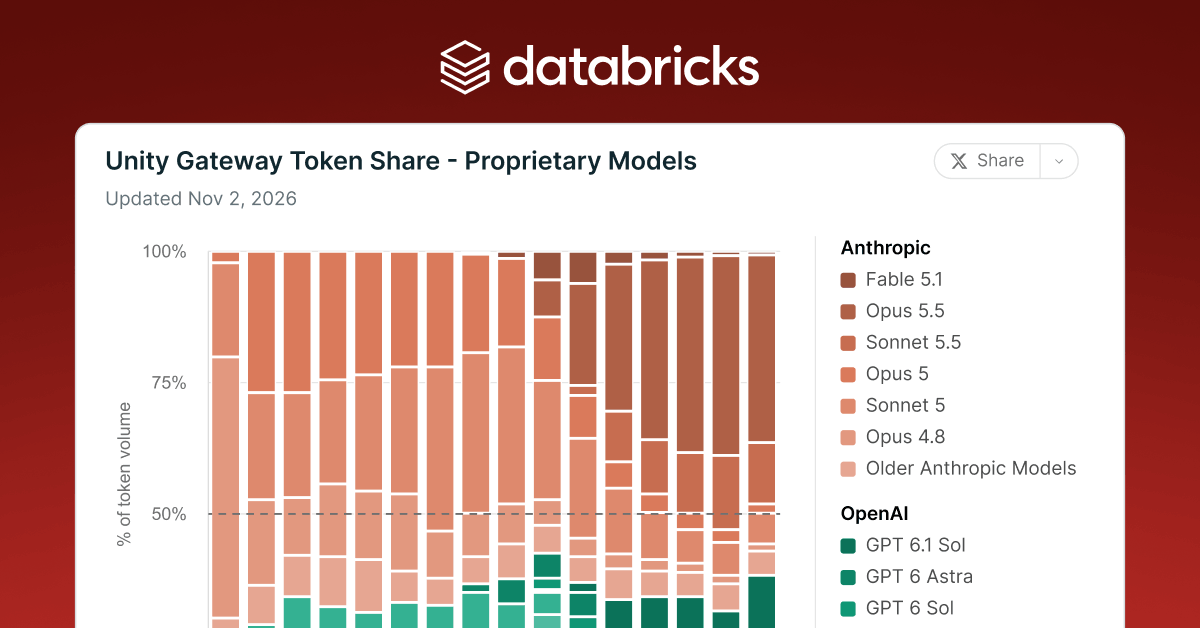
Databricks launched the Databricks AI Index, a public resource drawing on anonymized usage data from 10,000+ companies on Unity Gateway plus weekly coding-agent benchmarks; in the first dataset, enterprises relying on one model provider fell from about 64% in July to 28% by November 2.
Why it matters
That sharp drop suggests enterprises are spreading AI workloads across multiple model providers rather than standardizing on one, making centralized access and spend visibility a more pressing need for the teams buying and governing these tools.
What to watch
The Index is updated weekly as new proprietary and open-weight models are evaluated, with the current dataset covering September 21 through November 7, 2026.
WHO IT HITSEnterprise IT and platform teams that procure and govern AI models now have a public, weekly benchmark for comparing adoption, quality and cost per task across providers, which may reshape how they justify model choices and budgets.
Summaries like this, every morning.
The Databricks AI Index arrives as enterprises face an unusually crowded model market: since May 2026, a new flagship proprietary or open-weight model has launched roughly every week, or every 3.7 days when regional labs are included. Databricks says customers have repeatedly asked how new models compare and what adoption looks like across enterprises, and the Index makes its internal evaluation suite permanently public with weekly updates.
The first dataset points to a rapid fragmentation of enterprise AI usage. At mid-year, most organizations relied on a handful of Anthropic models for the majority of their work, but adoption has since spread across model versions and providers. Databricks also describes its own Day 1 model rollout process, which lets it evaluate new releases within days, and says this helped it manage cost while improving internal AI quality.
The Index also highlights a gap between benchmark performance and cost. In Databricks' coding benchmark, GPT-6 Luna and Claude Opus 5.5 both achieved an 89.1% task success rate, but Luna averaged $0.05 per task versus $1.62 for Opus 5.5, a roughly 32x difference. Databricks says enterprises can use Unity Gateway dashboards and traces to analyze model consumption and costs on their own workloads, and Smart Routing to match tasks to cost-effective models.
Pick your industry and the AI tools you use, and get news related to your work every day.
Free · 30 seconds with Google · unsubscribe anytimeWhat is AIToday? →
Ask AI anything about this article. The AI reads this article, earlier AIToday articles, and Wikipedia, and cites its sources. Q&As are published on this page for other readers too.
BlackRock's Jean Boivin said a slowdown in AI buildout would have a material real-economy impact, while Morgan…

QTS, backed by Blackstone, cut its planned private debt sale by about 60%, raising roughly $300 million instea…

CVS Health, Cigna and Abridge are collaborating with OpenAI to test computer-use agents, as reported from HLTH…
CrowdStrike was named the Visionary Leader in the Frost Radar™: AI Security Operations Centers, 2026, position…

ServiceNow selected Copilot Studio and launched a Microsoft AI Agent Creation Portal, where its makers can bui…

Amphenol shares have climbed 15.8% year to date versus a 7.1% gain for the Zacks Computer and Technology secto…