What happened
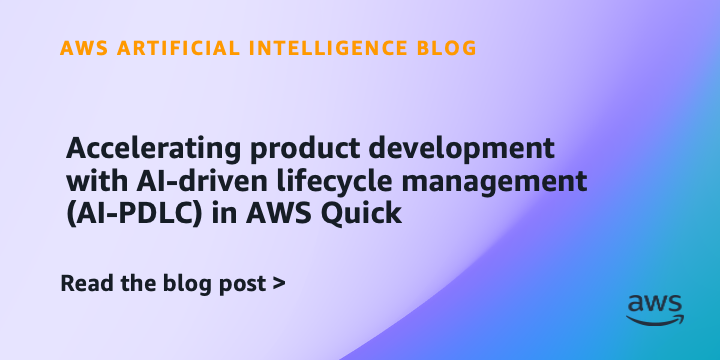
AWS Quick introduced AI-PDLC, a six-agent suite — led by an Orchestrator — that runs Discover, Decide, Design and Prototype phases, pulling context from Slack, Jira, Salesforce and SharePoint and producing a shared prototype_spec.md.
Why it matters
The suite scores pain points for severity and frequency, ranks use cases on transparent 0–10 criteria, and gates each phase on human signoff — so teams build against evidence rather than hunches, with every decision traced to its source.
WHO IT HITSProduct managers and UX teams at enterprises using AWS Quick are the primary users, as they can now run a structured discovery-to-prototype pipeline without leaving their existing tools. Engineering teams receive a build-ready spec with acceptance criteria instead of one-line tickets.
Summaries like this, every morning.
The AI-PDLC framework arrives as coding agents make implementation fast, shifting the bottleneck upstream to discovering the right customer problem, deciding what to build, and producing a clear specification. AWS Quick positions itself as a connective layer for fragmented enterprise knowledge, grounding agents in data from Slack, Jira, Salesforce, SharePoint, ServiceNow, and Outlook. The suite's value rests on governance: a human approval gate at every stage and dual-level decision logging (each specialist records its own rationale while the Orchestrator keeps a shared log) aim to ensure no gate approval goes untracked. The framework also delegates development to coding agents via the Agent Client Protocol (ACP), an open JSON-RPC 2.0 standard with no vendor lock-in, so teams can use tools like Kiro or Claude Code against the generated spec. Whether this compresses the upstream cycle enough to deliver the claimed compounding advantage — building the right product faster with fewer costly pivots — may depend on how well teams adapt to the structured Q&A and approval discipline.
Pick your industry and the AI tools you use, and get news related to your work every day.
Free · 30 seconds with Google · unsubscribe anytimeWhat is AIToday? →
Ask AI anything about this article. The AI reads this article, earlier AIToday articles, and Wikipedia, and cites its sources. Q&As are published on this page for other readers too.
Salesforce AI Research released SFR-AutoR&D, agents that form hypotheses, run controlled experiments and keep…
Interactive Brokers launched IBKR Autonomous Trading, which lets eligible clients connect AI platforms to a ri…

KWCH published guidance advising users to keep certain personal information out of AI chatbots to protect thei…
A Seeking Alpha analyst published a piece calling NextEra Energy (NEE) a forgotten AI winner following a Democ…

Upgraded Points published a walkthrough for redeeming the up-to-$300 ChatGPT Business credit available on Amex…

Corning signed multiple long-term, multibillion-dollar optical agreements with carriers including Verizon and…