AIToday

Cornell researchers beam AI model updates to robots via light

IEEE Spectrum Robotics5h agoSend on LINE
Cornell researchers beam AI model updates to robots via light

Key takeaway

Researchers at Cornell Tech have developed an optical receiver that can update AI model parameters by beaming light patterns directly onto processor memory, bypassing power-hungry electronic circuits. The technique could significantly reduce energy consumption in robots, autonomous vehicles, and data centers by replacing traditional metal wires with optical links. While the core concept was demonstrated in a lab setting, the team must overcome engineering hurdles—including miniaturizing the light-sensitive memory cells and building a fast transmitter—before the technology is ready for real-world deployment.

Summaries like this, in your inbox every morning.

Sign up free →

3 Key Points

  • What happened

    Cornell Tech researchers presented a new optical receiver design that can update AI model parameters directly using photocurrents from beamed light matrices, eliminating the need for power-hungry analog circuits. The work was presented last month at the IEEE/JSAP Symposium on VLSI Technology & Circuits.

  • Why it matters

    Moving data between memory and processors via optical links instead of metal wires could significantly reduce energy consumption in data centers, self-driving cars, and edge AI applications like robots. The current electrical connections create cost and efficiency bottlenecks when systems scale up, and this approach enables fully digital optical communication with less energy loss.

  • What to watch

    The researchers are working toward building a transmitter capable of altering the light matrix millions of times per second and transferring gigabits per second—the current lab prototype emits only a static 14×14-bit matrix. A key challenge is shrinking the photosensitive bit cells, which are currently larger than conventional SRAM cells, reducing overall memory capacity.

In Depth

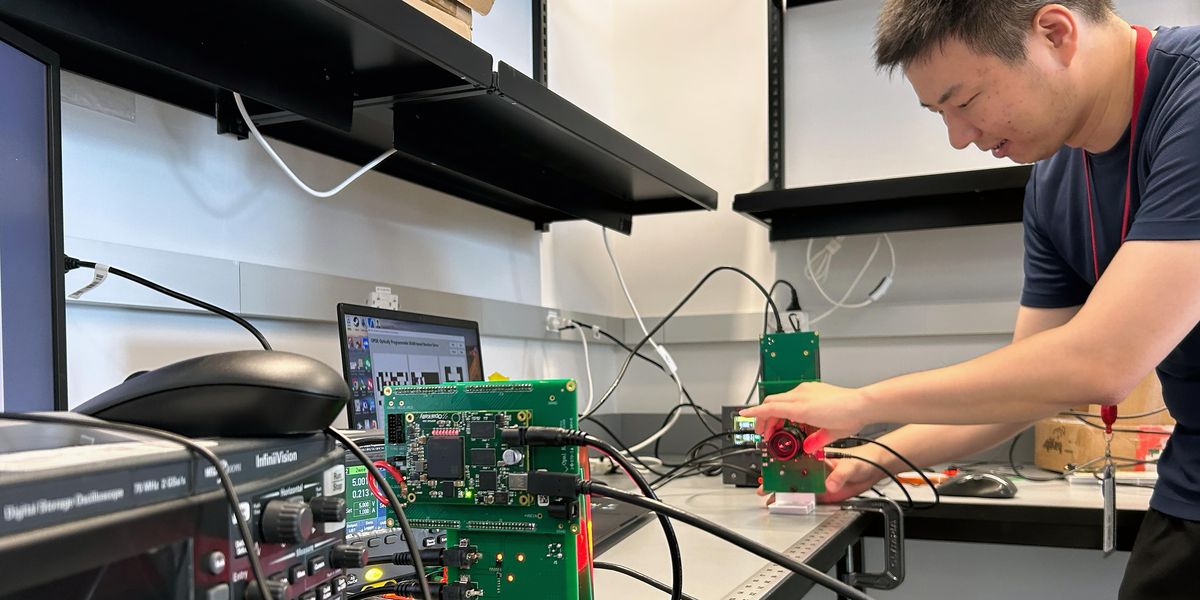
Atop a lab bench at Cornell Tech, postdoctoral researcher Yifan He positioned an optical receiver nearly a meter away from an LED emitting red light. When the receiver captured the beamed light, the attached computer monitor displayed an array of squares resembling a QR code—but unlike a standard QR code that points to a web address, this optical matrix conveyed the parameters of an AI model. This setup, presented last month at the IEEE/JSAP Symposium on VLSI Technology & Circuits, represents a fundamentally different approach to one of AI infrastructure's most pressing problems.

The core issue, explained by Jae-sun Seo, an associate professor of electrical and computer engineering at Cornell Tech, is that modern AI chips lack sufficient built-in static random-access memory (SRAM) to hold all model parameters. Instead, large models are stored in dynamic random-access memory (DRAM), and data must be shuttled between the DRAM and processor using electrical connections. "That's one of the major bottlenecks," Seo notes. These metal-wire connections consume substantial power and become increasingly problematic as systems scale. Optical links can move data at high bandwidth with less energy loss than metal wires, but existing optical receivers rely on power-hungry analog circuits to convert light into electronic bits—a conversion that undercuts optical communication's efficiency advantage.

The Cornell team's solution bypasses the analog step entirely. Their receiver design modifies SRAM cells to contain photodiodes; when light from the transmitter strikes each photodiode, it creates a current that directly flips the binary values stored in that cell. This enables fully digital optical communication with no analog conversion. The system requires calibration to account for misalignment between transmitter and receiver, achieved by referencing a data frame containing expected pixel positions. "Ideally the best way is to have direct, point-to-point space between the transmitter and the receiver," Seo explains, "but even if it's slightly tilted, we have this calibration circuit."

To reach practical deployment, the researchers face two major hurdles. First, the transmitter must be capable of altering the light matrix millions of times per second, transferring gigabits per second; the current lab prototype is static, emitting only a 14×14-bit matrix through a metal mask. The team is working with optics research groups to build a dynamic transmitter. Second, the photosensitive bit cells are larger than conventional SRAM cells, reducing the total memory that can fit on a chip—a trade-off that could negate efficiency gains. Seo says the group is pursuing ongoing efforts to shrink the bit cells through transistor and circuit optimization and CMOS scaling. Seo and He are targeting robotics and edge applications, where the technology could update AI models in warehouse robots or power microrobots that are inherently memory-constrained by their size. Dennis Sylvester, an IEEE Fellow at the University of Michigan who was not involved in the work, called the problem "really important" with "massive commercial implications," but cautioned that the current form is "likely far from commercialization" due to the cell-size trade-off.

Context & Analysis

The bottleneck that Cornell's optical receiver addresses is well-established in AI infrastructure: as AI models grow larger, they no longer fit entirely in the fast, built-in memory (SRAM) that processors contain. Current systems must shuttle model parameters between slower, higher-capacity DRAM and the processor using metal wires, a process that consumes significant energy and creates a major efficiency constraint as systems scale. Optical communication has long promised higher bandwidth and lower energy loss, but conventional optical receivers have negated that advantage by relying on energy-intensive analog circuits to decode the signal. The Cornell team's key insight is to skip the analog step entirely—by etching photodiodes directly into SRAM cells, incoming light can flip binary memory values directly, enabling what the researchers call "fully digital optical communication."

The practical implications are substantial: robots in warehouses or factories could receive AI model updates via light beams without the energy overhead of current electrical interfaces, and edge devices like microrobots could operate more efficiently with remote memory access. However, the path from lab demonstration to product is not straightforward. The photosensitive cells are larger than standard SRAM cells, reducing memory density—a tradeoff that researchers acknowledge could undercut the efficiency gains unless the cell size problem is solved through transistor optimization and CMOS scaling. The current prototype transmitter is static; a working system would need to modulate the light pattern millions of times per second, a capability the team is developing in partnership with optics research groups. These engineering challenges explain why outside experts, including University of Michigan's Dennis Sylvester, characterize the technology as "far from commercialization" despite its "massive commercial implications."

FAQ

How does the optical receiver update AI models differently than conventional methods?
Instead of using power-hungry analog circuits to convert light to electronic bits, the new receiver directly alters SRAM memory using photocurrents produced by beamed light matrices that resemble QR codes. This enables fully digital optical communication that consumes less energy than metal-wire connections.
What is the main engineering challenge preventing commercialization?
The individual photosensitive bit cells in the receiver are larger than SRAM bit cells in conventional chips, meaning the chip can fit less memory—a trade-off that could cancel out the added efficiency of the light-based approach. The researchers are working to shrink the bit cells by optimizing transistor and circuit sizes.
Where could this technology be used first?
The researchers are targeting robotics and edge AI applications, including AI robot-powered warehouses and factories where optical data transmission could save time and energy when updating models in each robot, and potentially microrobots that are constrained by size.

Get the latest Robotics news every morning

AI-summarized, only the topics you pick — one digest a day via Email, Slack, or Discord.

Free · takes 30 seconds · unsubscribe anytime

Discussion

No comments yet. Be the first to share your thoughts!

Log in to join the discussion

Related Articles

Stay ahead with AI news

Get curated AI news from 200+ sources delivered daily to your inbox. Free to use.

Get Started Free

Free · takes 30 seconds · unsubscribe anytime