AIToday

Japan launches state-backed physical AI project with Noetra, four core companies

Top Companies AI — Japan (2/2)3h ago
Japan launches state-backed physical AI project with Noetra, four core companies

Key takeaway

Japan's Ministry of Economy, Trade and Industry and Noetra, backed by Sony, SoftBank, NEC, and Honda, launched a state-supported initiative on July 16 to build a domestic multimodal AI foundation model for physical AI—robots and machinery that solve real-world industrial problems. The FRONTia Project aims to create a feedback loop in which deployed AI collects manufacturing data, improves the model, and returns benefits to production, keeping sensitive industrial information within Japan while reducing reliance on foreign AI systems. The project represents a coordinated push by government, research institutions, and 44 participating companies to position Japan as an alternative to foreign AI models.

Summaries like this, in your inbox every morning.

Sign up free →

3 Key Points

  • What happened

    Japan's Ministry of Economy, Trade and Industry announced on July 16 a policy framework for physical AI (AI that works through robots and machines on real-world tasks). Noetra, a company backed by Sony, SoftBank, NEC, and Honda, formally began developing a domestic multimodal foundation model—AI that processes voice, images, video, and sensor data together—under the FRONTia Project (Foundation for Real-world Omni-Native Trustworthy Intelligence & Alignment). Noetra has received investment from a total of 44 companies.

  • Why it matters

    The initiative aims to reduce Japan's dependence on foreign AI models by building a domestic alternative rooted in Japan's manufacturing data and expertise. The strategy creates a feedback loop: deploy physical AI in factories and facilities, collect real-world operational data (equipment status, workflows, images, audio, sensor readings), use that data to improve the AI, and feed the results back into production. This keeps sensitive industrial data within Japan while strengthening the country's position in robotics and manufacturing—sectors where Japan already has advantages amid global labor shortages.

  • What to watch

    Noetra plans to deploy about 27,500 NVIDIA Rubin GPUs by April 2027 for AI computation, operational by June 2028. The roadmap includes reasoning foundation models by fiscal 2026, an omnimodal model (combining language, images, video, and audio) by fiscal 2028, and "real-world native AI" with spatial reasoning by fiscal 2030. Noetra intends to release safe, tested models publicly each fiscal year starting soon, beginning with reasoning models for AI agents and language processing.

In Depth

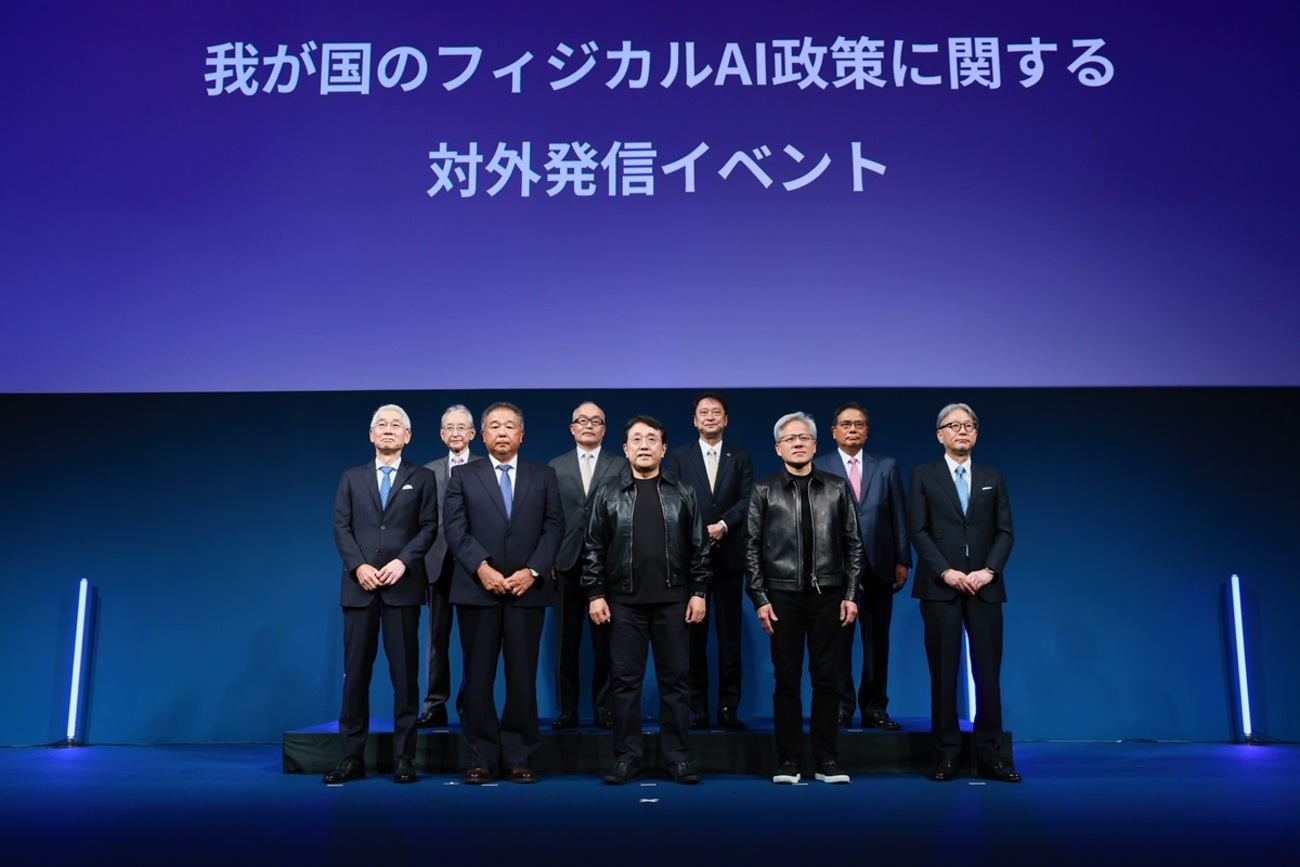
On July 16, Japan's Ministry of Economy, Trade and Industry held an event introducing its comprehensive policy framework for physical AI and announcing the full launch of Noetra, a company tasked with developing a domestic multimodal foundation model. Prime Minister Takae Takaichi delivered a video message emphasizing the importance of leveraging data accumulated in Japan's manufacturing sites to build a secure, trustworthy domestic AI foundation. Minister of Economy, Trade and Industry Akira Akazawa framed "field data"—information from production sites—as the key to physical AI deployment, underscoring the need to apply Japan's manufacturing and operational expertise to implement AI-powered robots and physical systems.

NVIDIA CEO Jensen Huang called Japan's industrial expertise a "national intellectual asset and national treasure," predicting that Japanese industrial specialization could become "Japan AI" and lead the next industrial revolution. Yutaka Matsuo, professor at the University of Tokyo, defined physical AI as "using AI technology in robots and machines to model the surrounding environment and enable more dexterous movements." Matsuo noted that while current large language models and AI agents are ready to use today, physical AI remains a research domain requiring sustained national investment—precisely the justification for a coordinated government-industry program.

The Ministry's strategy involves deploying physical AI in real-world settings, collecting operational data (equipment status, workflows, movement data, images, video, audio, and sensor readings), and using that data to further evolve the AI, creating a closed feedback loop. This approach aims to build AI rooted in Japan's production environment rather than relying solely on foreign models, thereby expanding options for Japanese industry and keeping sensitive competitive data within domestic control. The initiative is branded as the FRONTia Project, defined as "Foundation for Real-world Omni-Native Trustworthy Intelligence & Alignment."

Noetra, supported by Sony, SoftBank, NEC, and Honda as core investors and 44 companies in total, will conduct research and development in partnership with AIST (National Institute of Advanced Industrial Science and Technology) under a NEDO (New Energy and Industrial Technology Development Organization) program. Noetra's CEO Hirotoyo Tanba stated that leading Japanese AI engineers have joined the company and will work alongside AIST to advance the project. He characterized Noetra's goal as building "core AI that acts as a teacher and master" for downstream applications, taking insights from Japan's manufacturing floor and feeding results back into production. Daisuke Okanohara, director of Noetra's development strategy division, described the target AI as one that "sees and comprehensively understands the real world and works on-site."

The development roadmap is explicit: by fiscal 2026, Noetra will begin building reasoning foundation models for AI agents and language processing; by fiscal 2028, an omnimodal foundation model combining language, image, video, and audio; and by fiscal 2030, "real-world native AI" with spatial reasoning for production deployment. To support this, Noetra will deploy approximately 27,500 NVIDIA Rubin GPUs, beginning setup in April 2027 and reaching full operation in June 2028. Tanba pledged to release tested, safe models publicly each fiscal year, stating the aim is to create alternatives to foreign models and give Japan independent options. AIST will pursue collaborative research themes with top researchers from the UK, France, Germany, Canada, the US, and Japan, feeding cutting-edge findings into Noetra's model development. The Ministry is also establishing partnerships with research institutions in Canada, France, Germany, the UK, and the US, with plans to expand into new countries and institutions.

Context & Analysis

Japan's domestic AI capability has become a strategic concern as reliance on foreign large language models and AI systems grows. The FRONTia Project addresses this gap by focusing on physical AI—a field still in research and development, according to the body, rather than immediately deployable like current large language models. By tying AI development to manufacturing data and real-world factory operations, the government and Noetra position the initiative to leverage Japan's existing strengths in robotics, precision manufacturing, and industrial expertise rather than competing head-to-head in general-purpose text AI where foreign companies already lead.

The collaboration structure reflects a strategic bet on ecosystem coordination: Noetra develops the core AI models; the National Institute of Advanced Industrial Science and Technology (AIST) conducts frontier research in language, vision, robotics, and agents; NEDO and the Ministry provide oversight and resource allocation; and 44 companies contribute data, use cases, and funding. International partnerships with research institutions in the UK, France, Germany, Canada, and the US are designed to inject cutting-edge research into the effort while maintaining Japan's independent capability. The explicit goal to release models publicly each fiscal year signals an intent to create a domestic alternative to foreign options, giving Japanese industry choice and reducing lock-in to any single foreign provider.

FAQ

When will Noetra's AI models be ready?
Noetra plans to build reasoning foundation models by fiscal 2026 for AI agents and language processing. By fiscal 2028, it aims to develop an omnimodal foundation model that integrates language, images, video, and audio. By fiscal 2030, it intends to achieve "real-world native AI" with spatial reasoning capabilities for real-world deployment.
What computing power is Noetra building?
Noetra, with NVIDIA's support, will deploy approximately 27,500 NVIDIA Rubin GPUs starting April 2027, with full operation planned for June 2028.
Which companies are backing Noetra?
The four core investors are Sony, SoftBank, NEC, and Honda. Noetra has also received investment from a total of 44 companies.

Get the latest Top Companies' AI Moves news every morning

AI-summarized, only the topics you pick — one digest a day via Email, Slack, or Discord.

Free · takes 30 seconds · unsubscribe anytime

Discussion

No comments yet. Be the first to share your thoughts!

Log in to join the discussion

Related Articles

Stay ahead with AI news

Get curated AI news from 200+ sources delivered daily to your inbox. Free to use.

Get Started Free

Free · takes 30 seconds · unsubscribe anytime

1 minute a day. The AI essentials.

200+ sources · Email / LINE / Slack

Get it free →