
What happened
Salesforce's head of data architecture, Tristan Baker, outlined how knowledge graphs are becoming a foundational layer for enterprise AI systems. He described a layered stack where lakehouses and operational databases sit below a metadata layer, with graph technology managing relationships and context across them—enabling AI agents to reason from trusted data rather than simply retrieve it.
Why it matters
Enterprise leaders are seeking conversational interfaces that return trustworthy answers in seconds, but that requires far more than a single database. Baker emphasized that the hard problem is accurately describing enterprise information so AI can make sense of it across fragmented data landscapes. Governance and semantic access policies are emerging as critical challenges; legal teams need to define data protection at the semantic level, not just within individual databases.
What to watch
Baker noted that most organizations have not yet fully solved this architecture problem. He cautioned that even the best technology yields "garbage in, garbage out" if the content exposed to it is not carefully curated—a challenge many enterprises are still grappling with.
Summaries like this, in your inbox every morning.
Enterprise organizations are shifting from cloud-native IT stacks to AI-native ones, and that transition is reshaping how they think about data architecture. The move reflects a fundamental change in what enterprises expect from data systems: no longer just speed and scale, but the ability to deliver trustworthy, explainable answers in a conversational interface. Knowledge graphs have emerged as the connective tissue binding fragmented data sources together—lakehouses, operational databases, customer profile stores—into a coherent system of intelligence.
Baker's framing reveals why this shift is non-trivial. The problem is not that enterprises lack data; it is that their data lives scattered across dozens of copies in incompatible systems, with no shared semantic understanding of what it means. A metadata layer can bridge that gap by translating business language into database columns, and graph technology can track relationships and context across those translations. But without careful governance—semantic policies that legal and security teams can understand and enforce—even the best AI reasoning engine will produce unreliable answers. Most organizations, Baker suggests, are still struggling to design these governance layers at the semantic level rather than hiding them inside individual databases.
Pick your industry and the AI tools you use, and get news related to your work every day.
Free · 30 seconds with Google · unsubscribe anytimeWhat is AIToday? →
Ask AI anything about this article. The AI reads this article, earlier AIToday articles, and Wikipedia, and cites its sources. Q&As are published on this page for other readers too.
Dell says its AI Data Platform uses a four-engine architecture and a Unified Semantic Layer to connect siloed…
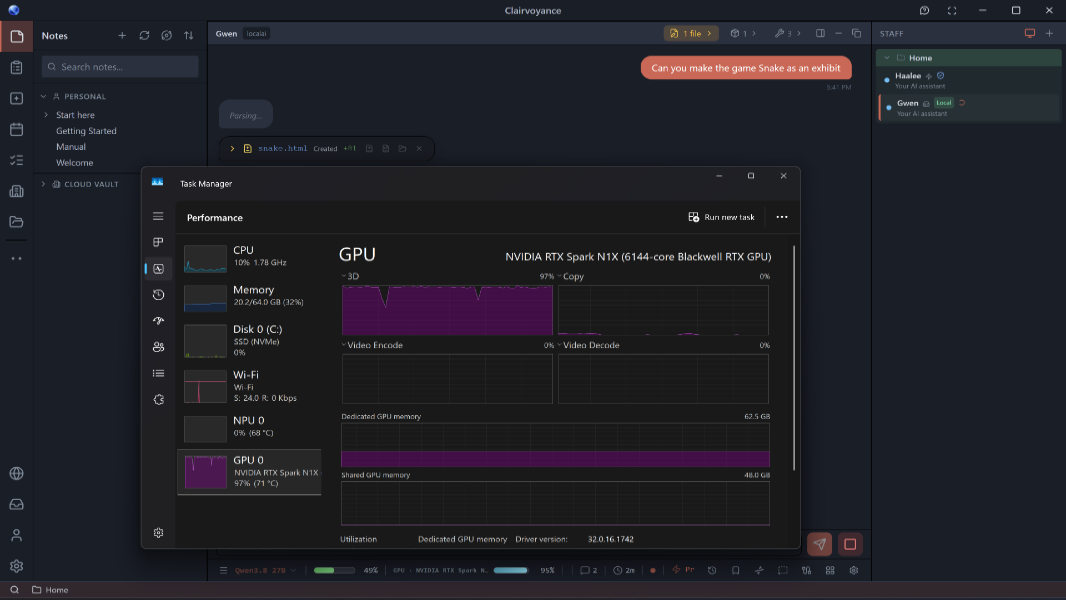
Microsoft and Nvidia are promoting RTX Spark, a new class of Windows PCs for local AI, with a top configuratio…
Microsoft AI CEO Mustafa Suleyman told employees that MAI-Base-2, announced Thursday, is a stronger pre-traine…

Germany's government will unveil an AI agreement with Nvidia next week, according to government sources cited…

Amazon introduced Bee Frontier, a wearable personal AI, for $74.99 in Onyx, Lavender and Sage, and Bee Eclipse…

Wall Street ended down sharply, with worries about the AI trade and high oil prices weighing on the market