AIToday
AI Stocks & MarketsAI Business & IndustryYahoo Finance AIPublished: Jul 31, 2026, 19:00 JST5 min read

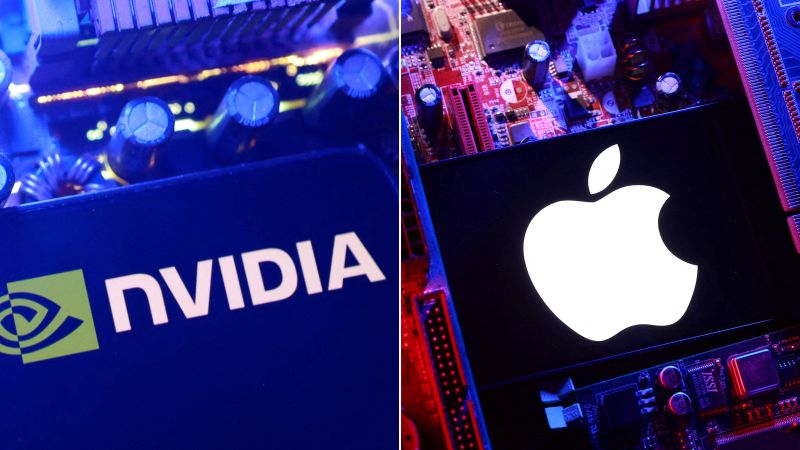
Apple overtakes Nvidia as world's most valuable company amid divergent AI strategies

Apple overtakes Nvidia as world's most valuable company amid divergent AI strategies

Key takeaway

  • Apple has surpassed Nvidia to become the world's most valuable company, reflecting a fundamental split in how Big Tech is approaching artificial intelligence.

  • While Nvidia profits from selling the chips and infrastructure powering AI data centers—reporting record earnings with 85% year-over-year growth in its most recent quarter—Apple is taking the opposite path, avoiding massive data-center spending and instead monetizing AI through consumer devices like iPhones.

  • Analysts say Apple's strategy, which leverages partnerships with existing AI model companies, appeals to investors because it delivers predictable returns without requiring hundreds of billions in infrastructure investment.

3 Key Points

  1. What happened

    Apple became the world's most valuable company this month, surpassing Nvidia, which had briefly held the $5 trillion market-cap milestone in October. Apple's iPhone revenue grew 22% year-over-year in its most recent quarter, with overall revenue rising 16% and beating Wall Street expectations.

  2. Why it matters

    The two companies represent opposite bets on AI's near-term value. Nvidia profits from the infrastructure buildout (holding 81% of the market share revenue for data center chips), while Apple avoids massive data-center spending and instead monetizes AI consumption through devices like iPhones—partnering with AI model companies rather than building its own. According to analysts, Apple's strategy appeals to investors because it does not require hundreds of billions in spending to stay relevant.

  3. What to watch

    Apple expects even higher memory costs in the September quarter after raising prices on Mac computers, iPads, and other products due to what CEO Tim Cook called a "100-year-flood on memory pricing." Nvidia's long-term performance depends on whether tech giants continue spending heavily on AI data centers—a dependency that has drawn scrutiny over potential circular funding arrangements.

In Depth

Read the full story

The world's two most valuable companies are taking opposite approaches to profiting from artificial intelligence, with Apple and Nvidia trading positions at the top of the market-capitalization rankings.

Nvidia became the first company to hit $5 trillion in market capitalization in October 2024, just months after reaching $4 trillion in July. But this month, Apple surpassed the chipmaker to become the world's most valuable company. The divergence reflects fundamentally different business models. Nvidia manufactures the chips and developer tools that power AI infrastructure, making it essential to the technology's future but also vulnerable to uncertainty about continued spending. The company reported record revenue in its most recent earnings report in May, up 20% from the previous quarter and 85% from the same period a year ago. It holds 81% of the market share revenue for data center chips, according to the International Data Corporation.

Apple, meanwhile, makes the phones and computers that billions of people use to access AI chatbots and agents. Unlike many of its Big Tech peers, Apple is not pouring billions into building new data centers. Instead, its revenue is largely driven by iPhone sales—a consistent and predictable business model that appeals to investors. iPhone revenue grew 22% in the company's most recent quarter compared to the same period last year; overall revenue rose 16% year-over-year and beat Wall Street's expectations. Apple has partnered with companies like Google to use their AI models rather than developing its own from scratch.

However, Apple is facing indirect pressure from the AI buildout. A memory shortage spurred by AI data center construction has forced the company to raise prices on Mac computers, iPads, and other products. CEO Tim Cook said during his recent earnings call, "We reluctantly raised prices. We did it because we're in what I would characterize as a 100-year-flood on memory pricing, with exponential increases in memory prices." Apple is expecting even higher memory costs for the September quarter. Shares dropped by more than 6% after the market closed on Thursday following the earnings report. The company recently launched a customer leasing program for iPhones, iPads, Apple Watches, and Macs as an alternative to purchasing, potentially making devices feel more affordable to consumers.

Analysts see the two companies as embodying different phases of AI adoption. According to Joe Tigay, portfolio manager for the Rational Equity Armor Fund, "When we're in the part where we're creating (AI)… that's where you're going to be watching Nvidia." In the future, he said, "we're going to be looking for companies that are going to monetize the consumption of AI. And Apple absolutely wants to be that company." Bloomberg Intelligence analyst Anurag Rana added: "The reason why Apple has done so well is people finally recognize that they don't need to spend hundreds of billions to be relevant in this market, because they will use whichever best (AI) model that's out there, and that model company would be privileged to be on the iPhone." As Tigay summarized the division: "Nvidia is selling horsepower. Apple is selling the steering wheel."

Context & Analysis

The article frames Apple and Nvidia as competing visions of AI value creation, each with distinct vulnerabilities. Nvidia's explosive growth—85% year-over-year in its most recent quarter and 20% quarter-over-quarter—stems from being essential to the infrastructure phase of AI deployment. However, that position creates a dependency: investors now expect "nothing short of explosive growth every quarter," and long-term performance hinges on whether tech giants sustain their massive data-center spending. The article also flags a structural concern: Nvidia has invested billions in AI companies like OpenAI and Anthropic, which in turn commit to buying Nvidia's chips, raising questions about whether these companies are propping each other up.

Apple's ascendancy reflects a different calculus. By avoiding hundreds of billions in data-center spending and instead leveraging partnerships with external AI model providers, Apple can deliver predictable, profitable growth tied to its core iPhone business—which grew 22% year-over-year. The article notes that consumers ultimately need smartphones or laptops to use AI services, placing Apple downstream of Nvidia's infrastructure play. That said, Apple faces near-term headwinds: memory-cost inflation has forced price increases, shares dropped 6% after earnings, and the company is expected to face even higher memory costs in the coming quarter. The article suggests that Apple's strategy may prove more durable if the AI buildout eventually stabilizes, but Nvidia's dominance remains unshaken as long as spending continues.

FAQ

When did Apple become the world's most valuable company?
This month, according to the article. Nvidia had previously hit the $5 trillion market capitalization milestone in October 2024, and Apple has now surpassed it.
How much of the data center chip market does Nvidia control?
Nvidia holds 81% of the market share revenue for data center chips, according to the International Data Corporation.
Why is Apple raising prices on its products?
Apple has raised prices on Mac computers, iPads, and other products due to a memory shortage spurred by the AI data center buildout. CEO Tim Cook described it as a "100-year-flood on memory pricing, with exponential increases in memory prices."
Yahoo Finance AIRead Original Article

Get the latest AI Stocks & Markets news every morning

AI-summarized, only the topics you pick — one digest a day via Email, Slack, or Discord.

Free · takes 30 seconds · unsubscribe anytime

Related Articles

Next articleSenators urge State Dept. to unlock family planning funds for Ebola-hit Congo

The AI news that matters, in one minute each morning.

Sign up free