What happened
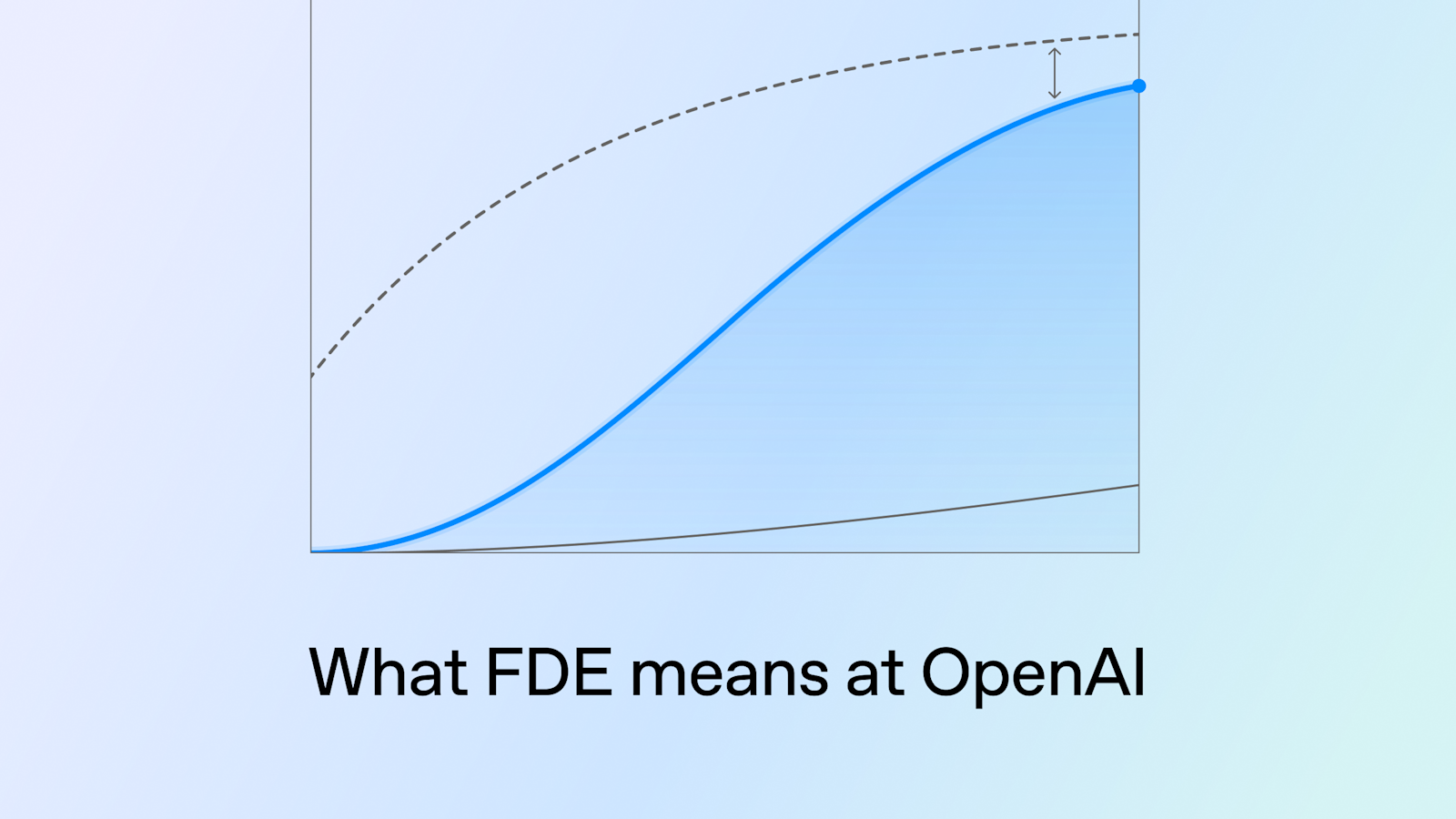
OpenAI said its FDE team, around 15 people working with a large semiconductor customer on 10+ use cases in mid-2025, saw about 48% time saved from AI-based directed test generation, and later removed roughly 90% of custom code per project by rebuilding on Codex.
Why it matters
That roughly 90% reduction is the team's stated way of making itself obsolete, since reusable Codex plugins and skills replace per-project custom integration and give the next customer a better starting point.
WHO IT HITSEnterprise customers deploying OpenAI models — such as semiconductor verification teams, John Deere's precision-agriculture support, life-sciences researchers and accounting firms — get repeatable, production-grade systems, while OpenAI's product and research teams get concrete problems to fold back into future models.
Summaries like this, in your inbox every morning.
OpenAI frames the FDE team's purpose around what it calls the deployment gap: model capabilities have moved faster than the systems and processes needed to put them to use. Sometimes the missing piece is a product; sometimes a model performs well on a benchmark but cannot handle real-life variables and constraints. The team's stated goal is for each engagement to leave the next customer with a better starting point — if a class of problem no longer needs FDEs the next time, the team counts that as success.
The John Deere example illustrates the pattern. See & Spray, its precision weed-control technology, uses cameras and machine learning to spray weeds rather than treating entire fields, reducing chemical use by up to 70%. But capturing those benefits depends on farmers knowing how to configure the technology and plan their season, so John Deere deployed OpenAI's APIs to make support personalized and scalable. In life sciences, OpenAI says its FDEs' scientific backgrounds help them earn trust with researchers on tasks such as target validation and gene-expression analysis.
The account also describes how the team manages to shrink its own custom work. After Codex grew in capability, one FDE tested rebuilding an application around it and moved use cases onto a common harness, turning custom applications into plugins and skills. OpenAI says this let it retire separate terminal UIs and CLIs, and that the same principle fed into OpenAI Presence, its product for enterprise voice and chat agents. In a telecom engagement, the model scored around 60% on key evals during scoping; over six months, with Research working on capability gaps, performance rose to 90%+.
Pick your industry and the AI tools you use, and get news related to your work every day.
Free · 30 seconds with Google · unsubscribe anytimeWhat is AIToday? →
Ask AI anything about this article. The AI reads this article, earlier AIToday articles, and Wikipedia, and cites its sources. Q&As are published on this page for other readers too.
Anthropic introduced Claude Duet, a proactive AI agent in research preview for Pro and Max subscribers, availa…

Anthropic released Claude Duet, an agent for professionals and small businesses, built on Claude Opus 5.5 and…
Egis Group and SiPearl formally signed a strategic CPU partnership at the Egis Group TechDay Taiwan-France cer…

Startups Electric Twin, Artificial Societies, GWI and Toluna are using data from real focus groups and surveys…

DeepSeek raised around $15 billion in one of China's biggest-ever financing rounds, after twice increasing its…
US stock futures and Asian markets fell on fears the AI boom is turning to bust, as an Australian data center…