AIToday

Dexory taps SimScale AI to speed warehouse robot design

Robotics & Automation News1h agoSend on LINE
Dexory taps SimScale AI to speed warehouse robot design

Key takeaway

Dexory has deployed SimScale's Engineering AI to speed up the design and testing of autonomous warehouse robots. The platform automates simulation tasks, tests multiple design variations simultaneously, and builds a searchable knowledge base from previous projects—helping engineering teams shorten development cycles as the global warehouse robotics market expands rapidly from $14.7 billion(約2.4兆円) in 2024 to a projected $117 billion(約19兆円) by 2034.

Summaries like this, in your inbox every morning.

Sign up free →

3 Key Points

  • What happened

    Dexory, a robotics and warehouse intelligence company, has deployed SimScale's Engineering AI to accelerate design and testing of autonomous warehouse robots. The platform will help engineers identify structural failures faster, automatically test multiple design variations, and build a searchable knowledge base from past projects.

  • Why it matters

    As warehouse robotics adoption accelerates, engineering teams need to shorten development cycles without sacrificing reliability. The global warehouse robotics market is projected to reach $117 billion(約19兆円) by 2034, from $14.7 billion(約2.4兆円) in 2024, pushing manufacturers to find faster ways to develop and refine products while maintaining quality.

  • What to watch

    The program is designed as a pilot to discover where AI agents deliver the greatest value in engineering workflows and establish best practices for future adoption. Dexory is focusing on understanding how AI will reshape engineering over the coming years, rather than just pursuing immediate productivity gains.

In Depth

Dexory, a robotics and warehouse data intelligence company, has deployed SimScale's Engineering AI to help accelerate the design and testing of autonomous warehouse robots. The move builds on Dexory's existing use of SimScale's AI-native cloud simulation platform and adds new capabilities aimed at speeding up critical engineering workflows.

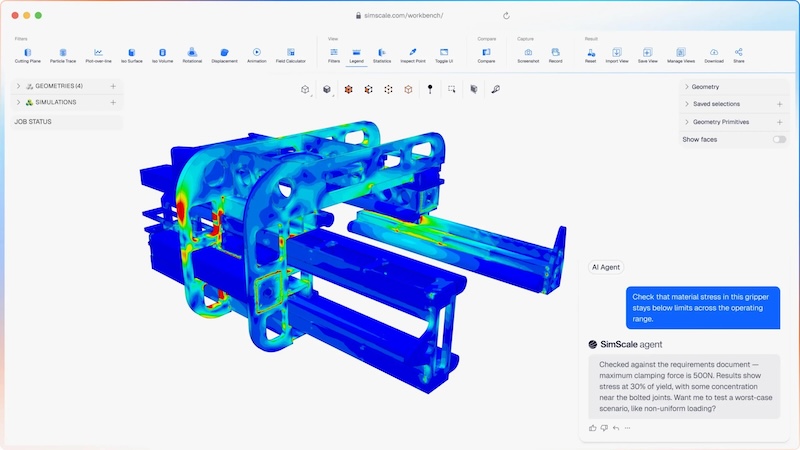
Under the new program, Dexory's engineers will use Engineering AI to identify the root cause of structural component failures more quickly, automatically explore multiple design variations through simulation, and create a searchable engineering knowledge base from previous projects. The platform automates several time-consuming tasks: it reduces the time spent investigating structural failures by enabling more simulation iterations during critical design phases, automates simulation reporting to make results easier to analyze and share, and allows engineers to automatically run parameter sweeps—testing multiple design variables simultaneously and generating comparative results without manual configuration. AI agents will also capture simulation knowledge from past projects to create a searchable engineering memory, helping teams reuse proven approaches and preserve expertise as the business grows.

The timing reflects broader industry pressure. As warehouse robotics adoption accelerates, engineering teams face increasing pressure to shorten product development cycles while maintaining performance and reliability. The global warehouse robotics market is projected to reach $117 billion(約19兆円) by 2034, up from $14.7 billion(約2.4兆円) in 2024, creating urgent demand for faster product development methods. Calum MacDougall, a senior mechanical design engineer at Dexory, framed the initiative as exploratory: "This pilot isn't just about solving today's engineering challenges. It's about understanding how AI will reshape engineering over the coming years and helping us discover where it can genuinely transform the way engineers work." Rather than focusing solely on productivity gains, the program is designed to help Dexory understand where AI agents deliver the greatest value across engineering and establish best practices for their future adoption. David Heiny, CEO at SimScale, noted that forward-thinking companies are already investing to understand how AI fits into their engineering workflows, and that Engineering AI has proven its ability to automate simulation tasks, explore significantly more design options, and help engineers make better decisions faster.

Context & Analysis

Dexory's decision to deploy Engineering AI reflects a wider shift in how manufacturers are approaching product development. While AI has already become central to the robots operating inside warehouses, the use of AI in the engineering processes that design and test those robots is still emerging. According to SimScale's CEO David Heiny, many engineering teams are still defining how AI will fit into their workflows, but forward-thinking companies are already investing to understand that fit quickly.

The scale of opportunity is substantial: with the warehouse robotics market projected to grow from $14.7 billion(約2.4兆円) in 2024 to $117 billion(約19兆円) by 2034, manufacturers face mounting pressure to accelerate product development without compromising on performance or reliability. Dexory's approach—using AI to reduce investigation time for structural failures, automate simulation reporting, and preserve engineering knowledge—directly addresses that tension. Rather than pursue productivity gains alone, the company is treating the pilot as an opportunity to learn where AI agents can genuinely reshape how engineers work, a mindset that may influence engineering practices across the broader robotics industry.

FAQ

What specific capabilities does SimScale's Engineering AI provide to Dexory?
The platform helps engineers identify root causes of structural component failures more quickly, automatically runs parameter sweeps to test multiple design variables simultaneously, automates simulation reporting for easier analysis and sharing, and uses AI agents to capture and organize simulation knowledge from previous projects into a searchable engineering memory.
What is the size of the warehouse robotics market Dexory is serving?
The global warehouse robotics market was valued at $14.7 billion(約2.4兆円) in 2024 and is projected to reach $117 billion(約19兆円) by 2034.
Is this a permanent deployment or a test?
The program is designed as a pilot to help Dexory understand where AI agents deliver the greatest value across engineering and establish best practices for future adoption, rather than just solving immediate engineering challenges.

Get the latest Robotics news every morning

AI-summarized, only the topics you pick — one digest a day via Email, Slack, or Discord.

Free · takes 30 seconds · unsubscribe anytime

Discussion

No comments yet. Be the first to share your thoughts!

Log in to join the discussion

Related Articles

Stay ahead with AI news

Get curated AI news from 200+ sources delivered daily to your inbox. Free to use.

Get Started Free

Free · takes 30 seconds · unsubscribe anytime