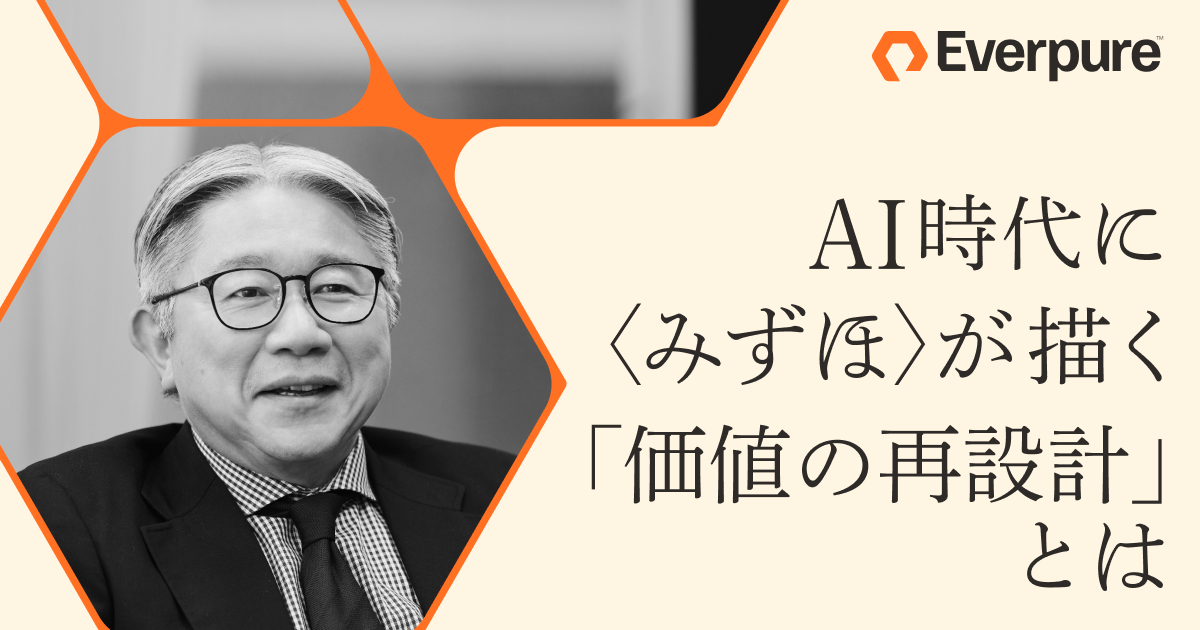
What happened
Mizuho Financial Group is restructuring its digital transformation by separating value creation—which remains a human responsibility—from value delivery, which it is redesigning around AI. The bank is adopting Evergreen//One, a pay-as-you-go data management platform from Everpure, to support this shift and enable continuous operational updates rather than one-time system overhauls.
Why it matters
As AI becomes accessible to all financial institutions, efficiency alone no longer differentiates competitors. Mizuho's approach—splitting which capabilities to preserve and which to redesign for AI—allows it to maintain core competitive advantages while accelerating how it serves customers. The move signals that financial DX is no longer a project with an endpoint, but an ongoing process of updating operations while protecting strategic foundations.
What to watch
The bank is intentionally holding core banking systems (security, stability) internally while outsourcing data infrastructure and operational improvements to specialist partners. Success depends on how well internal teams and external partners coordinate to balance stability demands with the speed and flexibility AI-driven transformation requires.
Summaries like this, in your inbox every morning.
Mizuho's restructuring reflects a fundamental shift in how mature financial institutions must compete in an AI-enabled landscape. Historically, banking DX meant modernizing systems once—migrating to the cloud, adopting digital channels—and stabilizing them. But the article argues that AI evolves too quickly for that model: solutions valid today may become obsolete in years. Mizuho's answer is to split its strategy explicitly: hold core competitive strengths (risk management, capital-allocation judgment, regulatory compliance) in human hands and organizational systems, while treating customer-facing operations and internal workflows as continuous redesign projects powered by AI.
This division matters because it solves a real operational tension. Core banking systems demand high stability and reliability, but AI-driven transformation demands speed and flexibility—and these are nearly incompatible in a single system. By keeping them separate, Mizuho can maintain rigorous stability standards for its most sensitive functions while giving AI teams the freedom to experiment and iterate on how customers are served. The adoption of Evergreen//One—a service-based data platform rather than owned infrastructure—reinforces this philosophy: instead of predicting data needs years ahead and buying capacity, Mizuho pays for what it uses and adjusts instantly. This approach aligns infrastructure cost and capability with the unpredictability of AI development, removing a major friction point in the transformation cycle.
The implicit risk is organizational: Mizuho must coordinate between teams managing stability (core systems) and teams driving change (AI operations), a coordination challenge the article acknowledges explicitly. Success depends not just on technology choices but on how well the bank can train and align people across these two missions.
Pick your industry and the AI tools you use, and get news related to your work every day.
Free · 30 seconds with Google · unsubscribe anytimeWhat is AIToday? →
Ask AI anything about this article. The AI reads this article, earlier AIToday articles, and Wikipedia, and cites its sources. Q&As are published on this page for other readers too.
Wells Fargo hired an AI executive based in San Francisco, a move The Business Journals describes as part of em…

Amazon launched two Bee "personal AI" devices on Thursday: the $74.99 Bee Frontier wristband and the $99.99 Be…

Apple released MLX today, which runs the 816B-parameter Muse Spark Open on four Mac Studios at over 36 tokens…

Bloom Energy stock fell 4% to $229.83, still up 165% year to date, while Caterpillar slipped 3% to $727.55 and…
LogicMonitor announced its 2026 Elevate Award winners at its Elevate Community Conference in Chicago, honoring…

Sandisk, AMD shares fall as Anthropic adds to AI concerns, per Barron's