What happened
Google's EmbeddingGemma team released a 744M-parameter model that maps text, images, audio, video and combinations into one 768-dimension embedding space, scoring 68.46 on MTEB(English, v2) and 78.68 on MTEB(Code).
Why it matters
The paper says this unified design establishes a new Pareto frontier, outperforming both specialist models and models two to twelve times larger — a claim that, if it holds, could simplify how teams build multimodal search and retrieval systems.
What to watch
The full multimodal stack runs at 567 MB on a Google Pixel 11 Pro, compared with 191 MB for the text-only quantized variant.
WHO IT HITSEnterprise ML teams building retrieval and search systems may benefit from a single embedding model that handles text, images, and audio without a separate ASR pipeline. Developers deploying on mobile devices will be watching the memory footprint closely.
Summaries like this, every morning.
The release lands in a busy week of open-weights announcements, positioning EmbeddingGemma as Google's bid to unify modalities that previously required separate specialist models. The parameter budget is split deliberately: a 271M text backbone, a 167M vision encoder, and a 305M audio encoder feed one shared 768-dimension output, which the authors say supports selective modality encoder loading. That means text-only applications can skip the heavier vision and audio towers entirely at load time, keeping the on-device footprint small.
The ablation on native audio offers the most striking evidence of the design's value. The 69.54 MRR@10 score for native audio retrieval, compared with 50.95 for Google's own prior EG1 ASR-plus-text pipeline, suggests that handling audio directly rather than converting it to text first may improve retrieval quality — most notably cross-language, where the gap widens to 67.68 versus 41.87. The authors also note that quality survives quantization, with MTEB(English) ticking up slightly to 68.49 at int4 Q4_C. Whether these gains hold across the broader benchmark suite will become clearer as the open-weights community tests the model.
Pick your industry and the AI tools you use, and get news related to your work every day.
Free · 30 seconds with Google · unsubscribe anytimeWhat is AIToday? →
Ask AI anything about this article. The AI reads this article, earlier AIToday articles, and Wikipedia, and cites its sources. Q&As are published on this page for other readers too.
Brains Technology's Neuron ES was named No.1 in the interactive AI service category of BOXIL REVIEW AWARD Autu…

Tencent's WorkBuddy AI assistant, combining its messaging and office tools with AI agents that produce reports…
Anthropic gathered 61 causal-inference experts to judge a farm-support case

On his October 27 YouTube livestream, Sakanaction's Ichiro Yamaguchi asked ChatGPT to write a haiku about a st…
Itera's LLMO Cheki now offers "AI question suggestions": users pick a site URL and a goal, and AI proposes pro…
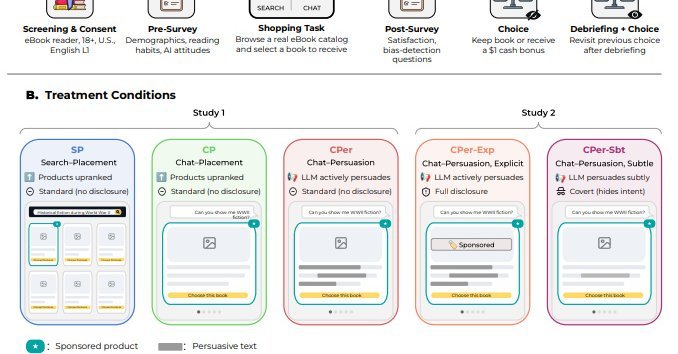
In a Princeton study of 2,012 US participants choosing from about 5,500 ebooks, sponsored products were picked…