What happened
Four major AI × pharma tool deals were announced at the January JPM Pharma conference in San Francisco. Chai Discovery, backed by OpenAI and valued at $4B, was central to this shift. Since June, Chai has announced partnerships with Lilly, Novartis, and argenx, plus an expansion of their Eli Lilly program.
Why it matters
Structural AI models have evolved into binding models (tools that predict how well molecules bind to targets), enabling drug designers to create better candidates without extensive lab iteration. This turns drug discovery from trial-and-error into engineering: better molecules reach clinical trials faster and with higher success rates. Pharma teams now trust the tools enough to adopt them widely, rather than forcing AI companies to build their own drug pipelines to prove value.
What to watch
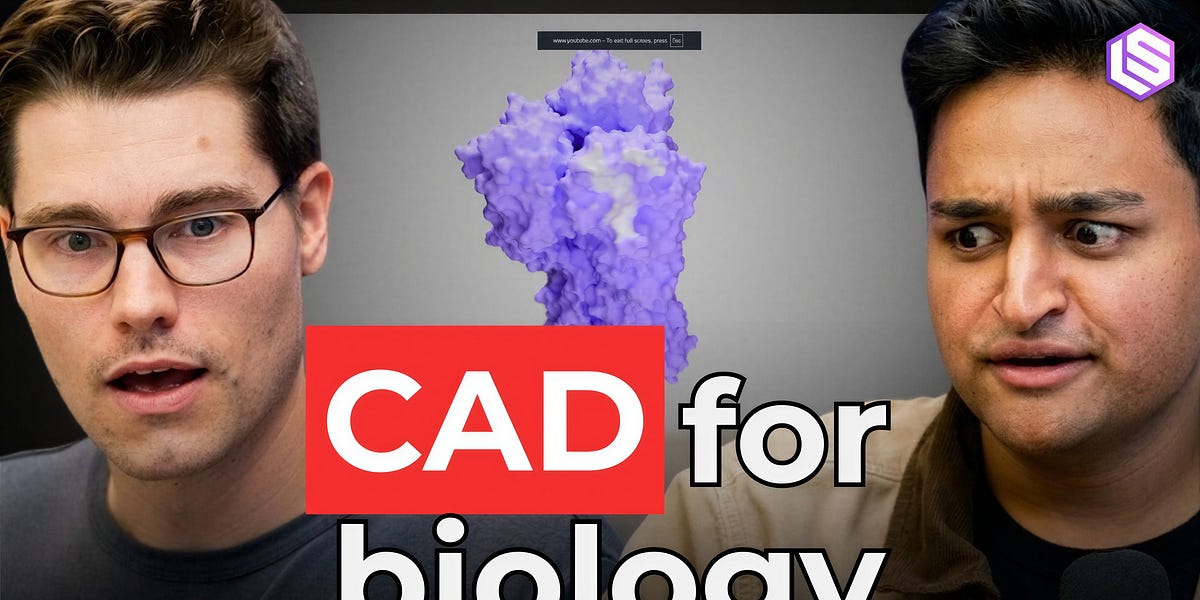
Chai's strategy focuses on close partnerships with pharma counterparts and product design (a molecule editor similar to CAD software) rather than building research in isolation. The company is betting that for engineering problems, the best product wins—and that close alignment with customer needs is as critical as the underlying technology.
Summaries like this, in your inbox every morning.
Until January 2025, the pharma AI landscape operated under a constraint: startups building AI tools for drug discovery struggled to convince large pharma companies to adopt them without proof of efficacy. Proof required identifying validated drug targets with clinical backing, which created a catch-22. The rational escape route was to build proprietary drug pipelines—proving the tool worked by commercializing drugs directly—rather than licensing the tool itself. This optionality, the body notes, "proved to be the only good path up until January."
What changed is not the business model or strategy, but the underlying technology. Structural AI models—which predict how molecules fold in three dimensions—matured into binding models that predict binding affinity: how strongly a molecule binds to a target protein. This shift from structure to binding unlocks design capability. A drug designer can now use the AI to iterate rapidly, generating molecules that are likely to succeed in the lab before physical synthesis, dramatically compressing the iteration cycle. The body illustrates the stakes: designing bi-specific antibodies (molecules that bind two targets simultaneously) takes years via lab trial-and-error; AI tools can now tackle this directly. This is not a marginal efficiency gain—it is a qualitative change in what is possible.
Chai's competitive insight is that in engineering-driven domains, the best product tends to win, and that close partnership with pharma teams—learning what problems practitioners actually face rather than theorizing in isolation—drives better UX and feature prioritization. The result is a molecule editor modeled on CAD software, not a chatbot. This customer-centric approach, combined with the leap in model capability, has unlocked the first wave of true tool adoption: Lilly, Novartis, and argenx are now using Chai's platform in production workflows. The JPM announcements in January signal that pharma has collectively crossed a threshold of trust, and the "tools deal" is now a viable business model alongside (and potentially instead of) proprietary drug development.
Pick your industry and the AI tools you use, and get news related to your work every day.
Free · 30 seconds with Google · unsubscribe anytimeWhat is AIToday? →
Ask AI anything about this article. The AI reads this article, earlier AIToday articles, and Wikipedia, and cites its sources. Q&As are published on this page for other readers too.
Chunghwa Telecom president Rong-shy Lin said the shift from conversational AI to autonomous AI agents is resha…

CoreWeave fell 5% in premarket trading Friday and was on track to finish the week down 15%, after rebounding f…
Apple and Meta said they would jointly release a new open-weight AI model designed to run on high-end Macs, ai…

Investors put $38.5 billion into Asian startups in Q3, per Crunchbase data

A longtime Anthropic investor told Fortune he expects shares priced around $1.8 trillion, below the company's…
In Q2, billionaires or their funds sold six 'Magnificent Seven' AI stocks