AIToday

Harnesses Now Outperform Models in AI Coding Benchmarks

Tomasz Tunguz (Theory Ventures)6h agoSend on LINE
Harnesses Now Outperform Models in AI Coding Benchmarks

Key takeaway

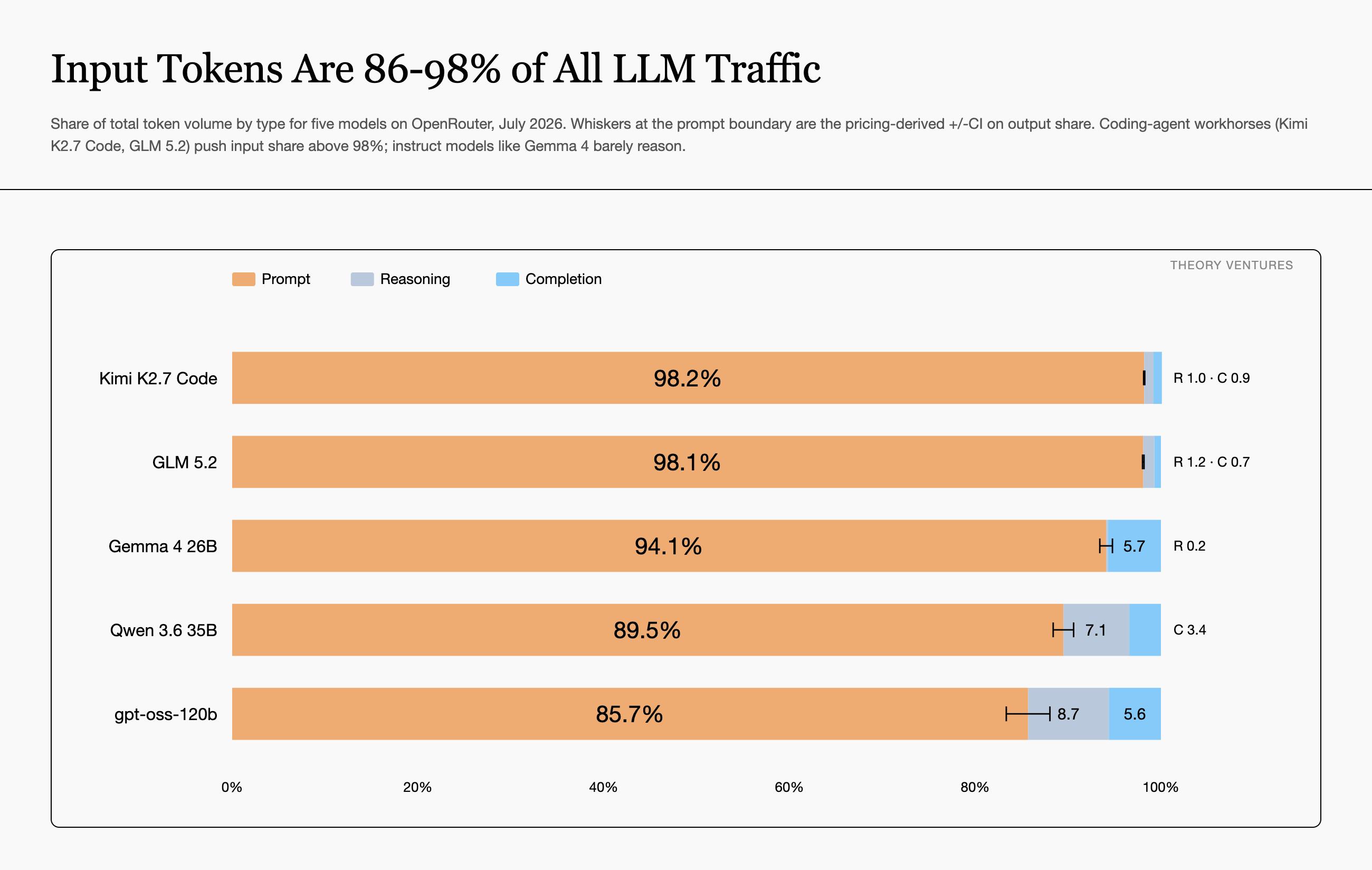
A new analysis by Endor Labs shows that how an AI model is queried—its harness, or software interface—now matters more than the model itself for coding performance. GPT-5.5 scored 25.7 percentage points higher in Cursor's harness than OpenAI's own Codex harness, and Claude Opus 4.7 also performed better in Cursor. Since input tokens dominate AI costs (86-98% of traffic), and harnesses control which context gets cached and sent, they now determine the bill more than the model does. Smart caching strategies can cut costs by 41-80% while speeding up response time, making the harness a critical lever for businesses optimizing AI at scale.

Summaries like this, in your inbox every morning.

Sign up free →

3 Key Points

  • What happened

    Endor Labs tested GPT-5.5 and Claude Opus 4.7 through different harnesses (software interfaces that shape how models process requests) and found dramatic performance swings. GPT-5.5 scored 61.5% functional correctness in OpenAI's native Codex harness but 87.2% in Cursor's harness—a 25.7-point difference from the harness alone. Claude Opus 4.7 scored 87.2% in Claude Code but 91.1% in Cursor, showing both frontier models performed better in a competitor's harness.

  • Why it matters

    Input tokens represent 86-98% of LLM traffic on OpenRouter, making input cost the dominant expense—practitioners report a 95/5 input-to-output ratio at scale. Because harnesses control which context gets sent and can cache intelligently, they now control the cost structure more than the model itself. A study of 500 long-horizon agent sessions found that smart caching strategies delivered 41-80% cost reduction and 13-31% faster time-to-first-token, with savings scaling linearly from 500-token to 50,000-token prompts. For businesses running AI at scale, the choice of harness can rival the choice of model.

  • What to watch

    Cursor's harness uses dynamic tool fetching, priority-based prefix assembly, and two-tier caching—techniques that match Claude Code's approach—and achieves those gains without first-party co-design. This suggests third-party harnesses may become the primary lever for cost and performance optimization, shifting power in the AI stack away from model makers toward harness builders.

In Depth

Endor Labs conducted a comparative study of coding performance across two frontier models and two harnesses, revealing a surprising inversion of conventional wisdom: the harness now shapes model output more than the model itself. OpenAI's GPT-5.5 achieved 61.5% functional correctness when run through its native Codex harness, but when the same model was tested through Cursor's harness in the same week, it scored 87.2%—a 25.7-point swing attributable solely to the runtime interface. Similarly, Anthropic's Claude Opus 4.7 scored 87.2% functional correctness in Claude Code (Anthropic's native harness) and 91.1% in Cursor. Both frontier models performed better in a competitor's harness than in the one their maker ships. This performance gap centers on cost control through intelligent caching and context selection. Input tokens constitute 86-98% of LLM traffic on OpenRouter; while output costs 5× per token compared to input, input volume is so large that it dominates total expenditure—practitioners report a 95% input / 5% output cost split at scale. Because the model does not control which context gets sent or cached, but the harness does, input cost management is now the harness's domain. A study across 500 long-horizon agent sessions found that harnesses employing smart caching strategies—such as caching only the stable prefix and placing dynamic content after the cache breakpoint—achieved 41-80% cost reduction and 13-31% faster time-to-first-token. These savings scale linearly from 500-token to 50,000-token prompts. Cursor's harness employs three key techniques: dynamic tool fetching (retrieving only necessary code or documentation), priority-based prefix assembly (ordering context by importance), and two-tier caching (maintaining both stable and dynamic content layers). These are precisely the same techniques used in Claude Code, which reports a 96% cache hit rate in real sessions and leverages user-shared system-prompt caching and byte-identical sub-agent forking for 90% savings. The fact that Cursor matches or exceeds these results without being Anthropic's first-party harness suggests that the discipline enabling high cache hit rates lives in the harness architecture, not in privileged access to the model. First-party co-design of harness, cache API, and model does buy real cache discipline, but that discipline can be replicated by a sufficiently sophisticated third-party harness. This finding repositions harnesses from mere wrappers around models into primary performance levers—what the article calls a jockey pushing AI further than the breeder imagined.

Context & Analysis

The findings challenge a long-held assumption in the AI stack: that model selection dominates performance and cost. Endor Labs' testing reveals that the harness—the software layer orchestrating how a model receives and processes queries—now exerts greater leverage. Input tokens constitute 86-98% of LLM traffic on OpenRouter, and because output costs 5× input per token but input volume overwhelms the ratio, controlling input costs is where economic value concentrates. The model itself cannot control which context is cached or sent; that power belongs to the harness. Cursor's ability to extract higher functional correctness scores from both GPT-5.5 and Claude Opus 4.7 than their native harnesses demonstrates that this leverage is not locked to first-party integration. Techniques like dynamic tool fetching, prefix assembly based on priority, and two-tier caching—all harness-level choices—can replicate or exceed the cache hit rates (96% in Claude Code's real sessions) that model makers achieved through deep co-design. For practitioners at scale, this means the harness decision may now rival or surpass the model decision in determining both cost and performance.

FAQ

What is a harness in this context?
A harness is the software interface that shapes how a model processes requests—it decides which context to send, how to cache it, and how to retrieve information like code or documents. It sits between the user and the model and controls cost, quality, and accuracy.
How much can caching in a harness save?
A study across 500 long-horizon agent sessions found 41-80% cost reduction and 13-31% faster time-to-first-token, with savings scaling linearly from 500-token to 50,000-token prompts.
Can a third-party harness match a model maker's harness?
Yes. Cursor's harness uses the same techniques as Claude Code—dynamic tool fetching, priority-based prefix assembly, and two-tier caching—and achieves comparable or better results, demonstrating that discipline in caching lives in the harness, not exclusively in first-party co-design.

Get the latest Large Language Models news every morning

AI-summarized, only the topics you pick — one digest a day via Email, Slack, or Discord.

Free · takes 30 seconds · unsubscribe anytime

Discussion

No comments yet. Be the first to share your thoughts!

Log in to join the discussion

Related Articles

Stay ahead with AI news

Get curated AI news from 200+ sources delivered daily to your inbox. Free to use.

Get Started Free

Free · takes 30 seconds · unsubscribe anytime