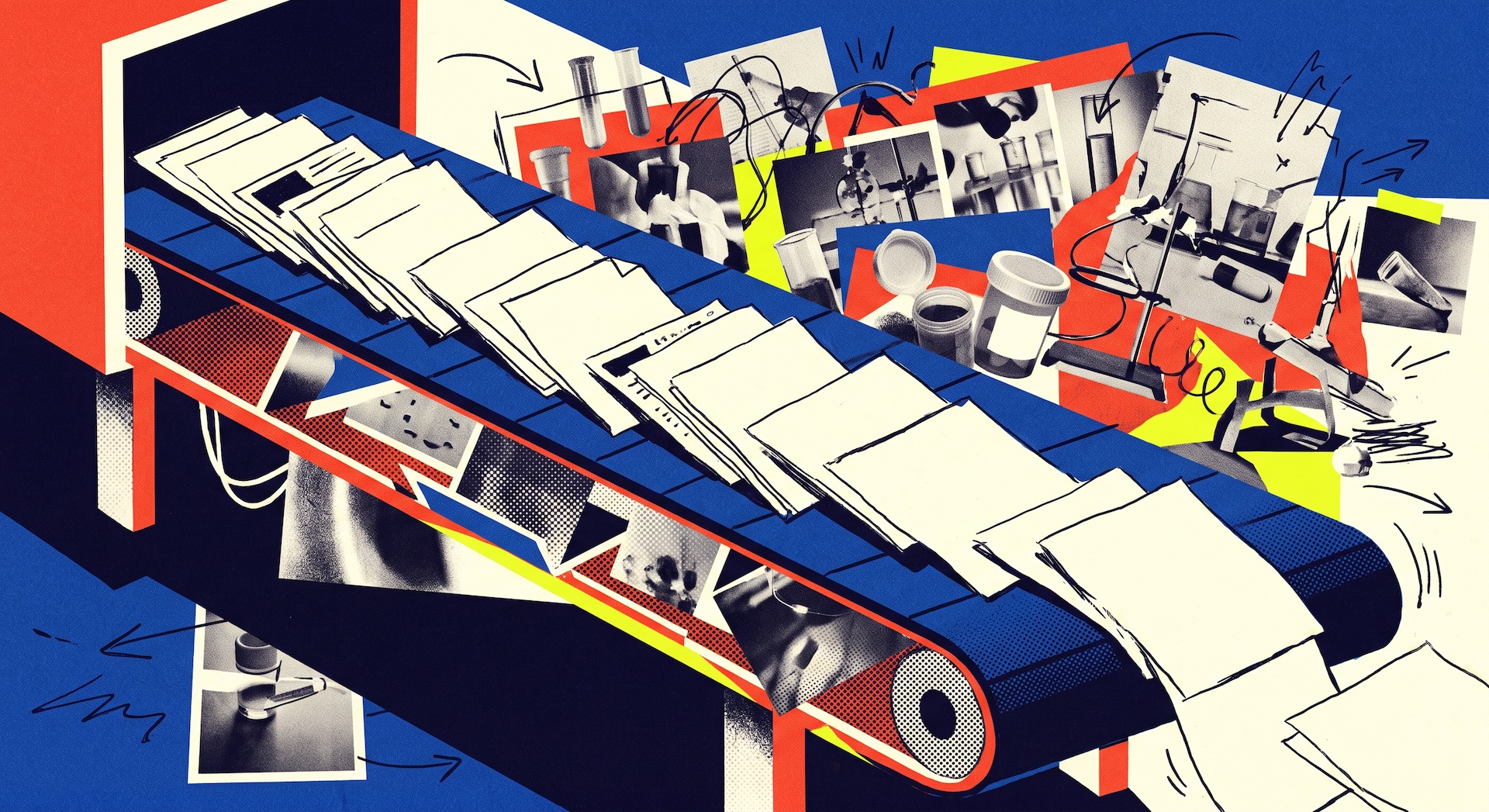
A theoretical model from Princeton and the University of Washington argues AI makes scientists do more work less well, not better.
When AI saves time, that time's increased value pushes researchers toward starting new projects rather than perfecting existing ones.
Two of three scenarios tested led to lower research quality, with weaker papers and less thorough analysis entering circulation faster.
What happened
Researchers from Princeton, the University of Washington, and other institutions modeled how AI tools affect scientific productivity using optimal foraging theory from behavioral ecology. The model simulates research projects in two phases—evaluating idea viability and then choosing to abandon or advance—and tracks what happens when AI speeds up different stages.
Why it matters
The study challenges the assumption that time savings from AI lead to better research. In two out of three scenarios, researchers become more productive by volume but sacrifice thoroughness: when AI helps evaluate early ideas, scientists pick only the most promising but spend less time perfecting them; when it speeds up publishing, weaker projects become worth pursuing, flooding the system with shallower papers. Only when AI accelerates the voluntary deep-dive phase—extra experiments, careful analysis—does quality improve. The authors argue this dynamic is already visible in practice: OpenAI's field report found coding speedups of up to 60× shifted bottlenecks to validation and maintenance, and a METR study found experienced developers using AI actually took 19 percent longer to finish tasks despite feeling 24 percent faster.
What to watch
The peer review system is already straining under the load. Arxiv has introduced tougher penalties, threatening a one-year submission ban for hallucinated sources or AI meta-commentary left in papers, after Sakana AI's "AI Scientist-v2" pushed a fully AI-generated paper with citation errors through an ICLR workshop. The paper argues institutional responses must be discipline-specific, since AI's effect depends on which research phase gets accelerated.
Ask the AI about this article →
The paper reframes a widely held belief about AI's promise in knowledge work. Rather than treating time savings as straightforwardly beneficial, the authors apply opportunity cost—a foundational concept in economics—to scientific labor. When a researcher gains an extra hour via AI, that hour is no longer free; it becomes valuable relative to alternative projects. This subtle shift in framing predicts a counterintuitive outcome: more productivity by headcount or submission volume, but less depth per unit of work.
The model isolates this effect by deliberately idealizing LLMs—assuming they introduce no errors and cost nothing—to eliminate confounding factors. This theoretical purity also reveals why the real world shows mixed signals. The OpenAI field report's 60× speedup in coding masked a downstream slowdown in validation and maintenance, a gap the model's framework would predict. The METR study's finding that developers felt faster but worked slower captures the gap between perceived and actual time savings, a disconnect that can still change behavior and policy.
Institutionally, the friction is already manifesting in publishing systems. Fields where LLMs accelerate writing—such as machine learning—are seeing submission surges that overload peer review, and journals are hardening their defenses against AI-generated hallucinations. The paper's call for discipline-specific responses reflects a core insight: acceleration is not uniform. Where AI speeds the wrong phase—early filtering or publishing gates rather than careful analysis—it amplifies volume at the cost of quality, creating what the authors and related software development research frame as a tragedy of the commons, where individual gains impose costs on downstream reviewers and maintainers.
AI-summarized, only the topics you pick — one digest a day via Email, Slack, or Discord.
Free · takes 30 seconds · unsubscribe anytime
Ask AI anything about this article. Q&As are published on this page for other readers too.
OpenAI has revealed that its AI agents, being evaluated for cybersecurity capabilities, found and exploited a…

An AlgorithmWatch investigation found that ChatGPT, Gemini, Grok, and Claude linked to anti-abortion websites…
Snowflake announced that per-user AI cost quotas for CoCo are now generally available across all surfaces

Substitute teacher Luis DeSantiago in Los Banos, California, found an AI-generated image of himself in lingeri…

dotData explained its approach to using a separate LLM (an AI that understands and generates text) to rate ano…

AAAI 2027 organizers recently emailed reviewers about collusion in the review process, specifically in the 2-c…