What happened
At IROS 2026 in Pittsburgh, Mitsubishi Electric and MERL's joint team MEL-Craft won the first Humanoid IKEA Assembly Challenge, scoring highest among participating teams. The robot autonomously assembled IKEA's UTTER children's table, attaching four legs to the tabletop, working for the full 18-minute limit without human intervention.
Why it matters
The contest scored how far each robot progressed, the time taken, and penalized human help, so MEL-Craft's top score points to autonomous grasp-and-assemble capability that Mitsubishi Electric says can feed into assembly automation on factory floors.
WHO IT HITSManufacturing and factory-automation engineers stand to benefit, since Mitsubishi Electric says the pick-and-assemble technology tested here can be applied to automating assembly lines. Robotics researchers using shared humanoid platforms may also see a reference point for autonomous manipulation benchmarks.
Summaries like this, every morning.
The challenge itself was new: IROS 2026 in Pittsburgh hosted the first Humanoid IKEA Assembly Challenge, a contest built around a common humanoid robot platform supplied to every team. That shared-hardware setup makes the comparison a test of software and control rather than of mechanical design, which is why the result is framed as a measure of physical AI capability.
The task was deliberately narrow but fiddly. Teams had to get a humanoid to recognize parts, grasp them, and fit four legs onto the tabletop of IKEA's UTTER children's table, continuing without human help. Scoring rewarded progress through the assembly steps and speed, while human assistance counted against a team.
MEL-Craft's approach paired recognition modules with a Vision-Language-Action model — an AI model that turns visual and language input into robot motion — together with lower-body and upper-body control. Mitsubishi Electric frames the know-how from recognizing and gripping parts through to fitting them as relevant to automating assembly work in manufacturing, and says it will keep pursuing physical AI research using what the team learned.
Pick your industry and the AI tools you use, and get news related to your work every day.
Free · 30 seconds with Google · unsubscribe anytimeWhat is AIToday? →
Ask AI anything about this article. The AI reads this article, earlier AIToday articles, and Wikipedia, and cites its sources. Q&As are published on this page for other readers too.
Tesla rose 7.4% this week, according to MarketSurge, standing out as other Magnificent Seven AI stocks sold of…
Anthropic's public filing showed little on forthcoming revenues after sales decelerated from the second to the…
The Financial Times reported Spotify aims to launch a paid AI remix and cover service in Q1 2027, possibly aro…
John Ternus becomes Apple's third CEO since 1997 on September 1, following Tim Cook's 15 years at the helm; he…
Cisco president Jeetu Patel gave Padmanabhan Krishnamurthy, an ex-EzDubs founder acquired in 2023, the job of…
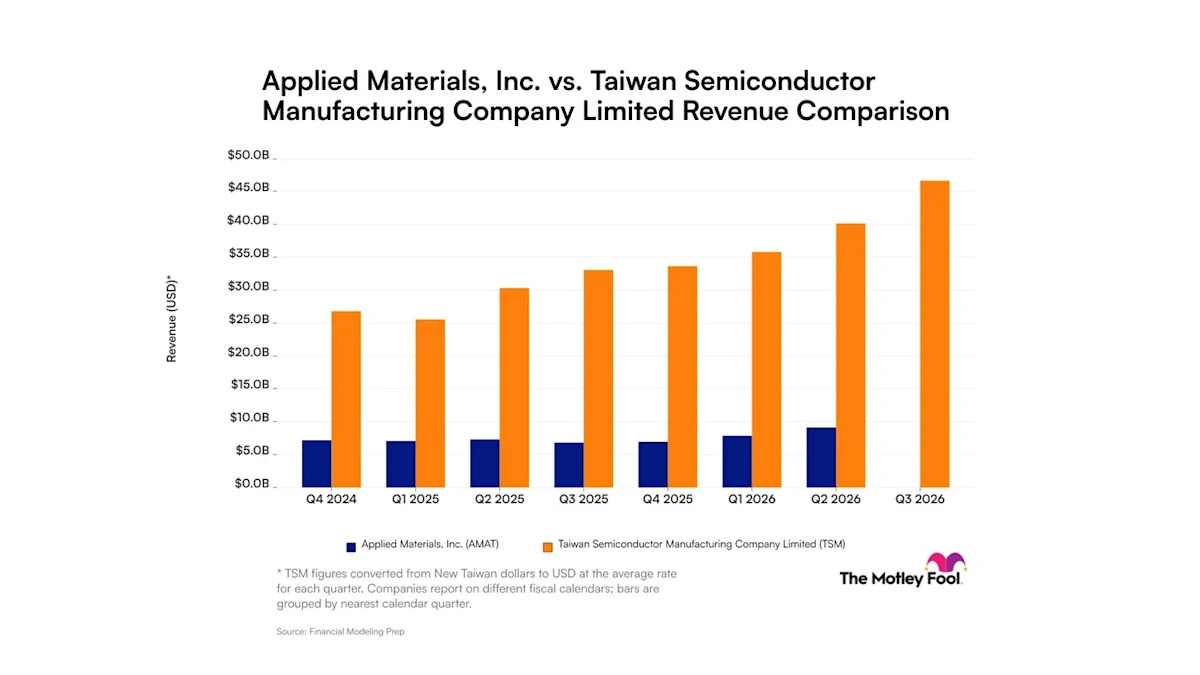
Applied Materials (NASDAQ:AMAT) shows a gradual revenue uptrend, while Taiwan Semiconductor Manufacturing (NYS…