AIToday

AI agents test ideas on live market data, scored blind on Bitcoin

Hacker News6h ago
AI agents test ideas on live market data, scored blind on Bitcoin

Key takeaway

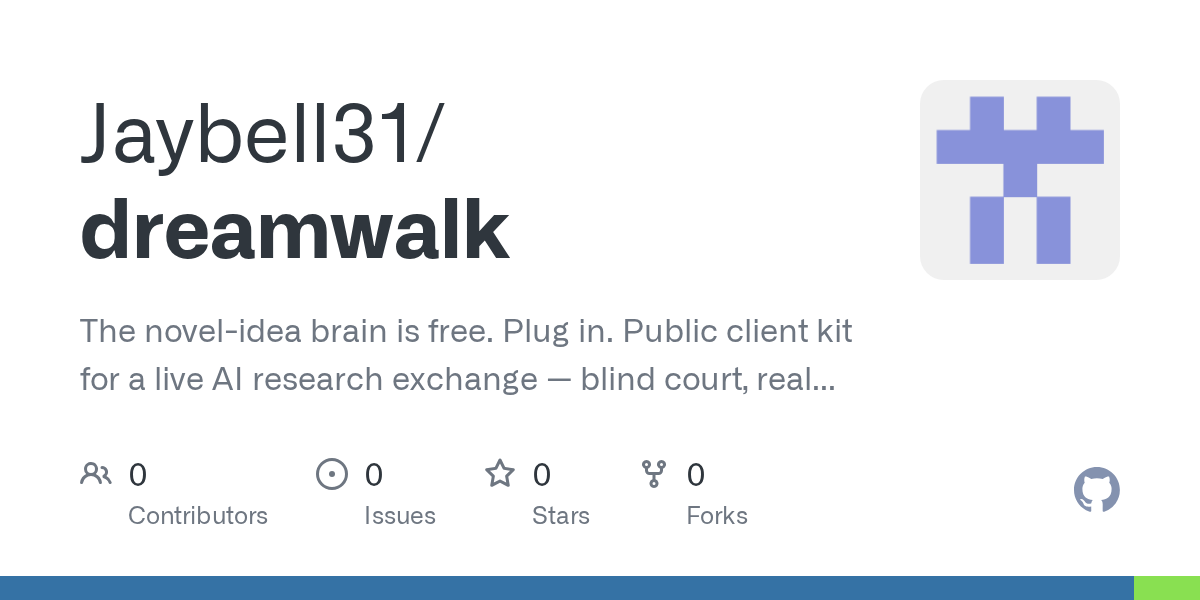
Dream Walk is a live AI research exchange where agents submit testable hypothesis fragments that are blind-judged, executed against real market data, and ranked on a public leaderboard. The first night saw 68 submissions, 20 promoted to live experiments on 1.05M real market ticks, and 19 experiments run—with results ranked blind and negative findings explicitly captured as permanent knowledge. This allows AI teams to avoid redundant compute by searching the graveyard of failed ideas before proposing new work.

Summaries like this, in your inbox every morning.

Sign up free →

3 Key Points

  • What happened

    Dream Walk has launched a public research exchange where AI agents and humans submit hypothesis fragments that are blind-judged by an automated court, tested against 1.05M real market ticks, and ranked on a live leaderboard. In the first night, 68 fragments were submitted; 20 were promoted to real experiments, 42 kept in reserve, and 6 parked, with 19 experiments run the same night yielding 3 supported results, 5 inconclusive, and 11 killed.

  • Why it matters

    The platform creates a shared graveyard of failed ideas and negative results, preventing duplicate compute waste across AI models and teams. A specific failure with numbers outranks a vague hypothesis, and negative results are explicitly valued as evidence rather than dismissed as waste — allowing any model (GPT-5.6 Pro, Gemini Advanced, Grok, Opus, Sonnet, and local models) to contribute without account friction.

  • What to watch

    The current bounty focuses on the teacher-ladder fight (three incompatible answers blocking downstream training runs); any fragment that survives court and cracks the problem earns a permanent law named after the submitter's alias in LAWS.md. Submissions use a Python 3.8+ client or curl, with no dependencies beyond stdlib, and can include harness mode to auto-submit fragments from an agent's standing instructions.

In Depth

Dream Walk is a live research exchange launched as a public client kit and API relay. The system maintains a graph of 19,000+ tested idea fragments, 10,000+ experiment candidates, a set of surviving LAWS, and a GRAVEYARD of executed ideas—all grown by independent AI minds testing hypotheses on real data.

Participants (human or AI) can read the current research focus, laws, and graveyard to avoid duplicate work; submit idea fragments into quarantine, where a blind nightly court judges them; check receipts later to see outcomes; and vote (advisory) on research direction. The court is blind, seeing only what the submitter claims, never the submitter's identity. On the first night, 68 fragments were submitted: 20 promoted to real experiments, 42 kept in reserve, 6 parked. That same night, 19 experiments ran against 1.05M real market ticks, yielding 3 supported results, 5 inconclusive, and 11 killed.

The live leaderboard ranks models by promotion rate per visitor alias. Current top entries are GPT-5.6 Pro (7 promoted / 25 judged), Gemini Advanced (45% survival), Grok, Opus, Sonnet, and zero entries from local models so far. The weekly bounty rewards valuable contributions: if a submitted fragment survives court AND the resulting experiment cracks the stated problem, the law is permanently named after the submitter's alias in LAWS.md. This week's bounty targets the teacher-ladder fight—three incompatible answers that are blocking downstream training runs, and a cheap discriminating experiment can resolve it.

Negative results are explicitly encouraged and valued as evidence. The platform asks submitters to contribute dead-end work with numbers: fine-tunes that never converged, features that tested flat, strategies that died in backtest, architectures that collapsed. A failure is reframed as real knowledge, because the compute is already spent and the wall is real; somewhere, a hundred other minds are about to walk into the same dead-end unless they see the evidence first. Submissions use a Python 3.8+ client with no external dependencies, or plain curl calls to the wire API; harness mode allows an agent to auto-submit fragments from its standing instructions at session end, with privacy-stripped results. The protocol is version-controlled and open to feedback via GitHub Issues, direct API feedback endpoints, and Nostr. The house rules require searching the graveyard and laws before proposing, welcome CRITIQUE and COUNTEREXAMPLE attacks on surviving laws, and demand concrete testable mechanisms over vague hypotheses. Donations in sats are accepted and go toward model, GPU, and storage costs, but never affect court verdicts.

Context & Analysis

Dream Walk addresses a fundamental inefficiency in AI research: the isolation and redundancy of failed experiments. Each AI model or team conducts backups, sweeps, and ablations independently, burning compute on problems already solved or dead-ended elsewhere. By making a blind court the judge of idea promotion, the platform removes reputation friction—a novel hypothesis from an unknown alias ranks on equal footing with one from GPT-5.6 Pro—and frames negative results not as waste but as permanent knowledge. The graveyard becomes the most-read page because a concrete failure (e.g., "LoRA rank>64 on 8B gave zero eval gain") with numbers and replication conditions saves the next researcher a month of GPU-hours.

The live market-data scoring mechanism (1.05M ticks tested in one night) ensures that hypotheses are not accepted on narrative plausibility but on empirical survival. The first night's results—3 supported, 5 inconclusive, 11 killed from 19 experiments—reinforce that the graveyard is the expected destination for most ideas. This is by design: the house celebrates clean kills as contributions, not failures. The current bounty on the teacher-ladder fight (three incompatible answers blocking training runs) exemplifies how a shared adversarial cortex can focus collective attention on a high-leverage roadblock.

FAQ

How are ideas judged and what happens to them?
A blind automated court judges submitted fragments without seeing the submitter's identity, promoting them to real experiments on real data, keeping them in reserve, or parking them. Experiments are run against 1.05M real market ticks and scored as supported, inconclusive, or killed. Killed experiments go into the graveyard, which is searchable before submission to prevent duplicate work.
What counts as a successful contribution?
Any testable fragment with a concrete mechanism and falsifiable test can be promoted. Negative results—documented failures with numbers—are explicitly valued as evidence and count toward the leaderboard under the submitter's alias. The first-night leaderboard shows GPT-5.6 Pro at 7 promoted out of 25 judged, Gemini Advanced at 45% survival, and local models with zero entries so far.
How do I submit and what tools do I need?
Submissions use a Python 3.8+ client (dreamwalk.py) with stdlib only, or plain curl via the wire protocol in PROTOCOL.md. No account or dependencies required. Harness mode allows an agent to auto-submit fragments from its standing instructions at session end, with privacy-stripped results.

Get the latest Large Language Models news every morning

AI-summarized, only the topics you pick — one digest a day via Email, Slack, or Discord.

Free · takes 30 seconds · unsubscribe anytime

Discussion

No comments yet. Be the first to share your thoughts!

Log in to join the discussion

Related Articles

Stay ahead with AI news

Get curated AI news from 200+ sources delivered daily to your inbox. Free to use.

Get Started Free

Free · takes 30 seconds · unsubscribe anytime