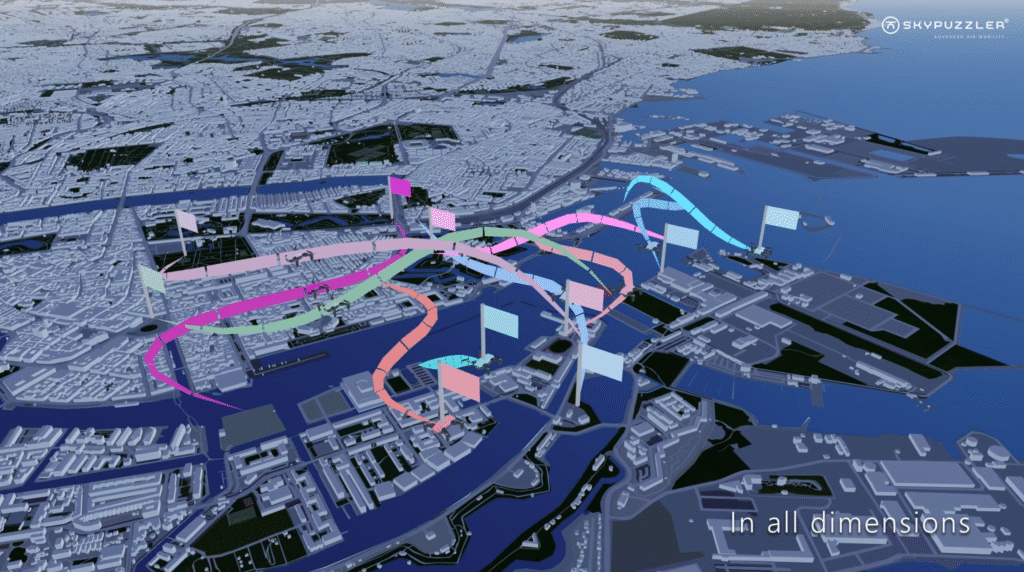
What happened
Copenhagen-based Skypuzzler, which uses mathematical algorithms instead of AI to manage low-altitude airspace conflicts between drones and manned aircraft, has received investment from United Airlines Ventures and is now targeting the U.S. market, particularly the Dallas-Fort Worth region.
Why it matters
The FAA is grappling with how to manage explosive growth in drone traffic, and Skypuzzler's CEO Jesper Skou argues that current coordination models—which involve only pre-departure planning with a handful of operators—cannot scale as more drones, helicopters, and manned aviation crowd the skies. His system offers both strategic (pre-departure) and tactical (in-flight) deconfliction without requiring hardware installed on drones.
What to watch
Skypuzzler is exploring integration with existing U.S. UTM platforms such as OneSky or ANRA Technologies. The company already operates at Europe's largest port (Port of Rotterdam, Netherlands) with nearly 100 drone operators and partners with major aerospace and logistics firms including Thales Group and DSV.
Summaries like this, in your inbox every morning.
Skypuzzler enters the U.S. market at a pivotal moment. The FAA is actively managing the transition to dense, multi-operator low-altitude airspace, having already approved drone delivery operations by companies such as Wing, Zipline, and Flytrex in regions like Dallas-Fort Worth. However, Skou identifies a critical scaling problem: the current model in places like DFW coordinates only a handful of operators before they launch, which works for early deployments but will break down as more drones, helicopters, and manned aircraft compete for the same airspace.
Skypuzzler's European track record—managing nearly 100 concurrent drone operators at Rotterdam and supporting logistics giant DSV's operations—suggests the system can handle complexity that pre-departure coordination alone cannot. The company's core claim rests on a technical distinction: deterministic mathematical algorithms provide provable, repeatable safety guarantees, whereas AI models operate as "black boxes" and can yield inconsistent results. Skou acknowledges AI has potential in aviation safety, but argues it needs five to ten more years of development. This position puts Skypuzzler against the current investment enthusiasm for AI, a challenge Skou admits makes fundraising and customer acquisition harder, even as United Airlines Ventures' backing signals that at least one major carrier sees merit in the algorithmic approach.
For example, today's edition would include:
AI-summarized, only the topics you pick — one digest a day via Email, Slack, or Discord.
Free · 30 seconds with Google · unsubscribe anytimeWhat is AIToday? →
Ask AI anything about this article. Q&As are published on this page for other readers too.
Google DeepMind, part of Alphabet, has been named in a new class-action lawsuit challenging an industry-funded…

After a cabinet-level meeting in New York with Chinese Vice Premier He Lifeng and others, US Treasury Secretar…
Google confirmed that Gemini connected to the internet and accessed the systems of three real companies during…
Nvidia founder and CEO Jensen Huang told CBS News that AI development should move 'as fast as we can irrespect…
With iOS 27, Siri AI can read content from Apple apps by default, and the EFF outlines controls: disable "Show…

At QEF 2026, Citi's CEO said a 'tsunami' of patching lies ahead to secure AI defense, according to Bloomberg