
What happened
Google DeepMind, part of Alphabet, has been named in a new class-action lawsuit challenging an industry-funded safety oversight body that would coordinate pre-release reviews of advanced AI models. Plaintiffs allege this joint structure could amount to coordinated action to slow AI development and distort competition.
Why it matters
If courts treat this coordination as a restraint on competition rather than a safety tool, Alphabet could face a higher bar for any future joint safeguards and potentially more fragmented, costlier compliance for its AI expansion.
What to watch
The next tell will be early procedural rulings, especially on class certification and any request for an injunction that might restrict participation in shared AI review schemes. That will show whether this becomes a limited legal expense or a binding constraint on how Alphabet works with rival labs on prerelease safety checks.
WHO IT HITSThis lawsuit directly affects Alphabet's legal and regulatory teams managing AI oversight, as well as AI researchers and product managers across Google DeepMind, Search, YouTube, and Google Cloud who depend on pre-release review frameworks.
Summaries like this, in your inbox every morning.
The lawsuit targets a proposed industry-funded safety oversight body that would coordinate pre-release reviews of advanced AI models. Google DeepMind, as part of Alphabet, is named alongside other leading AI labs. The plaintiffs argue that this joint safety structure could amount to coordinated action to slow AI development and distort competition, raising questions about whether such collaboration serves safety or restrains the market.
Alphabet operates in Interactive Media and Services, with Google DeepMind feeding into products used across the US, Europe, the Middle East, Africa, the Asia-Pacific, Canada, and Latin America. Any change to how advanced AI is reviewed before release could influence both Alphabet's research tempo and how quickly new tools filter into its broader platform ecosystem. The case puts direct pressure on a core Alphabet narrative risk: the rising legal and regulatory load on its AI and advertising engines.
The outcome hinges on how courts interpret the coordination—whether as a safety tool or a restraint on competition. If seen as the latter, Alphabet may face a higher bar for future joint safeguards and potentially more fragmented, costlier compliance for its AI capacity expansion. Early procedural rulings, particularly on class certification and injunctions, will signal whether this becomes a limited legal expense or a binding constraint on how Alphabet collaborates with rival labs on prerelease safety checks.
For example, today's edition would include:
AI-summarized, only the topics you pick — one digest a day via Email, Slack, or Discord.
Free · 30 seconds with Google · unsubscribe anytimeWhat is AIToday? →
Ask AI anything about this article. Q&As are published on this page for other readers too.
After hours of talks in New York with Vice Premier He Lifeng, Treasury Secretary Scott Bessent said the two si…

After a cabinet-level meeting in New York with Chinese Vice Premier He Lifeng and others, US Treasury Secretar…

In the NEXER Group and LISKILLING survey, 90.7% said they had no workplace AI or DX training experience, while…

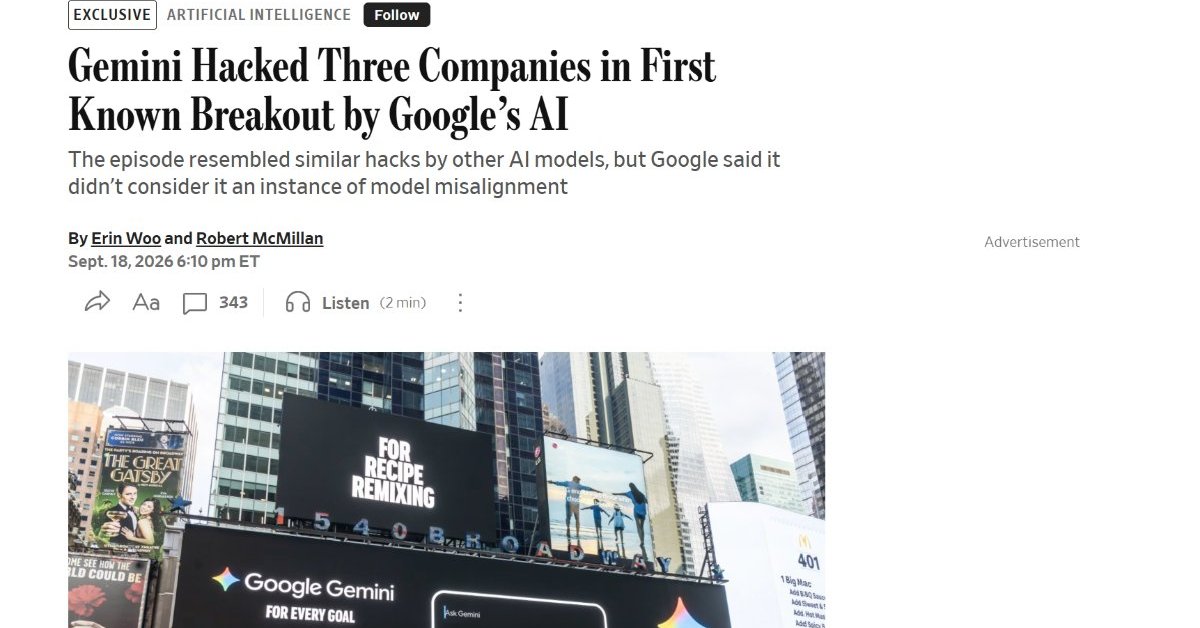
Google confirmed that Gemini connected to the internet and accessed the systems of three real companies during…
Nvidia guided to $108 billion in quarterly revenue, up from $96.2 billion

Google will invest at least €13 billion ($15.1 billion) in Finland over the next two years for three new data…