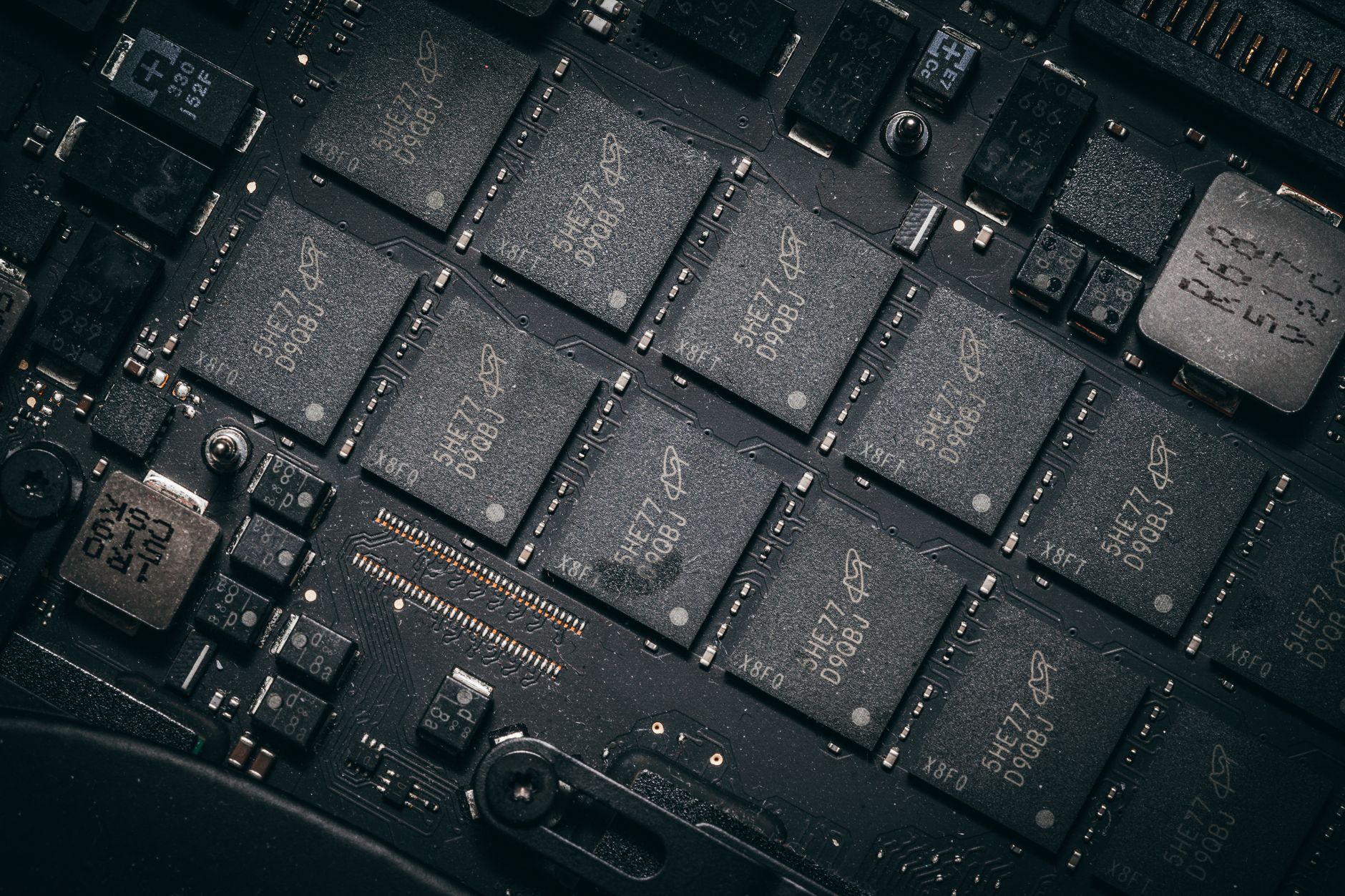
Micron Technology reported third-quarter fiscal 2026 revenues of $41.46 billion, up 346% year over year, driven by surging demand for AI memory chips.
The company has already generated more than $1 billion in HBM4 revenues and is ramping this product twice as fast as its predecessor, positioning itself to compete more effectively against SK Hynix in the high-bandwidth memory market where AI accelerators depend on supply.
What happened
Micron's third-quarter fiscal 2026 revenues jumped 346% year over year to $41.46 billion, driven by strong data-center demand exceeding $25 billion. The company has generated more than $1 billion in HBM4 revenues, with its 12-high HBM4 ramp progressing twice as fast as its HBM3E 12-high ramp.
Why it matters
Micron's aggressive focus on AI memory—HBM, DRAM, and data-center storage—is helping it narrow SK Hynix's HBM market lead (SK Hynix holds 58% of the HBM market versus Micron's 21%). HBM is critical infrastructure for AI accelerators, making this strategy central to capturing AI infrastructure spending.
What to watch
Micron holds a 21% share in the global HBM market and 13% in the global NAND memory market. The Zacks Consensus Estimate projects fiscal 2026 and 2027 revenues to increase 247% and 91% year-over-year, respectively.
Micron Technology reported extraordinarily strong third-quarter fiscal 2026 results, with revenues surging 346% year over year to $41.46 billion and non-GAAP earnings reaching $25.11 per share compared to $1.91 a year earlier. The growth was turbocharged by data-center demand, which exceeded $25 billion during the quarter alone. This surge reflects Micron's deliberate pivot toward artificial intelligence infrastructure, particularly high-bandwidth memory (HBM), DRAM, and data-center storage—all critical inputs for AI accelerator deployment.
HBM is the cornerstone of Micron's strategy. The company has already generated more than $1 billion in HBM4 revenues, and its 12-high HBM4 ramp is progressing twice as fast as its HBM3E 12-high ramp. HBM4 is already shipping in high volumes to a lead customer, with additional customers receiving qualification samples—a sign of rapid market adoption. Micron's HBM market share stands at 21% globally, compared to SK Hynix's 58%, according to a Counterpoint report. SK Hynix, as a key supplier of AI memory chips to NVIDIA, has leveraged its early HBM leadership to dominate the segment. In SK Hynix's second-quarter 2026 results, revenues surged 257% year over year and net income jumped 1,242%, reflecting the intensity of AI data-center buildout.
In NAND memory and enterprise SSDs, Micron competes more directly with SanDisk, which holds a 13% share in the global NAND market (Micron also holds 13%). In the fourth quarter of fiscal 2026, SanDisk reported revenues of $8.97 billion, up 372% year over year, with non-GAAP net income jumping to $6.16 billion from $42 million a year earlier. SanDisk's data-center revenues surged 437% year over year to $5.15 billion in fiscal 2026. The company has bolstered its competitive position by securing long-term supply agreements: during its fourth-quarter earnings call, SanDisk revealed eight long-term contracts with six customers worth $93.9 billion, with an average contract length of four years. SanDisk expects half of its bit production to be covered by these deals in fiscal 2027 and two-thirds in fiscal 2028.
Micron's stock performance underscores investor confidence in the AI memory thesis. Shares have surged approximately 220.3% year to date, dramatically outpacing the Zacks Computer and Technology sector's return of 16.8%. From a valuation standpoint, Micron trades at a forward price-to-earnings ratio of 5.93, significantly lower than the sector average of 21.33. Analyst estimates project Micron's fiscal 2026 and 2027 earnings to increase 791% and 114% year-over-year, respectively, with bottom-line estimates revised upward in the past 30 days. The Zacks Consensus Estimate for fiscal 2026 and 2027 revenues indicates year-over-year increases of 247% and 91%, respectively. Micron currently carries a Zacks Rank #1 (Strong Buy) rating. The body notes that if Micron maintains its HBM4 ramp pace while expanding advanced packaging capacity, AI could help it narrow SK Hynix's HBM lead and outperform SanDisk's storage-focused growth.
Micron is pursuing a deliberate strategy to capture AI infrastructure spending by concentrating on memory products—HBM, DRAM, and data-center storage—precisely as AI accelerator deployment accelerates globally. The third-quarter results ($41.46 billion revenue, up 346% year over year) validate this focus; data-center revenues alone exceeded $25 billion in the quarter. HBM is the linchpin: the company has already crossed $1 billion in HBM4 revenues and is scaling the 12-high variant twice as fast as the prior generation, suggesting both customer pull and manufacturing readiness.
Micron faces two distinct competitive fronts. In HBM—the high-margin, AI-critical segment—SK Hynix holds 58% of the market to Micron's 21%, though Micron's faster HBM4 ramp suggests it may begin narrowing that gap. In NAND memory and enterprise SSDs, SanDisk is the more direct competitor; both companies hold 13% of the global NAND market. SanDisk, however, has secured demand visibility through long-term contracts worth $93.9 billion with six customers (average duration four years), with half of its bit production covered by these deals in fiscal 2027 and two-thirds by 2028.
The body's forward estimates underscore the scale of anticipated growth. Zacks Consensus Estimate calls for Micron's fiscal 2026 and 2027 revenues to rise 247% and 91% year-over-year, respectively—a substantial deceleration from Q3's 346% but still indicating sustained momentum. Micron's valuation (forward price-to-earnings ratio of 5.93 versus the sector average of 21.33) and its Zacks Rank #1 (Strong Buy) reflect analyst confidence in the AI memory thesis, though execution—particularly the capacity expansion for advanced packaging that the body flags as critical—will determine whether Micron can sustain this advantage.
AI-summarized, only the topics you pick — one digest a day via Email, Slack, or Discord.
Free · takes 30 seconds · unsubscribe anytime
Ask AI anything about this article. Q&As are published on this page for other readers too.
Marvell Technology's stock rose around 5 percent, driven by social media discussion of its optical networking…

Three semiconductor equipment suppliers—Onto Innovation (US$1.1b revenue, US$15.7b market value), KLA (US$13.6…
IBM and OpenAI announced a strategic partnership on August 13, 2026, embedding OpenAI frontier models like GPT…

GE Vernova (NYSE:GEV), a power infrastructure company spun off from General Electric, is being highlighted as…

Wells Fargo identified commercial real estate (CRE) as a beneficiary of what it calls "unrelenting demand for…

ExxonMobil deployed artificial intelligence, machine learning, high-performance computing, and seismic techniq…

The AI news that matters, in one minute each morning.
Sign up free