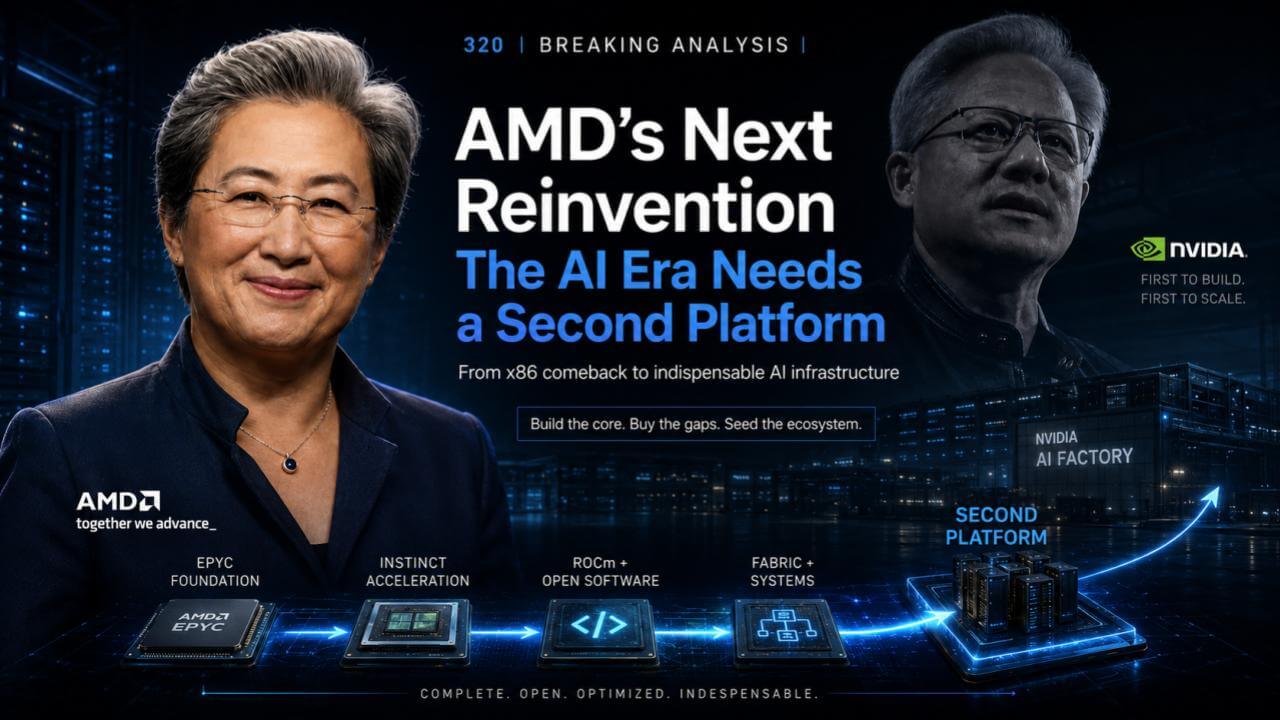
AMD is shifting its strategy from trying to beat Intel in the x86 market to becoming a trusted second option in AI infrastructure, where Nvidia is expected to remain dominant. The company will win by building integrated platforms—combining CPUs, accelerators, software, and ecosystem support—rather than competing on individual processor specs alone. This represents a fundamental change from AMD's past playbook and requires acquisitions, software partnerships, and disciplined execution to compress years of platform development into a shorter timeframe.
Summaries like this, in your inbox every morning.
Sign up free →What happened
AMD is abandoning its Intel-focused playbook and repositioning itself as the "indispensable second platform" for AI infrastructure, built around EPYC CPUs, Instinct accelerators, ROCm software, rack-scale systems such as Helios, and an open ecosystem. The company's past turnaround relied on winning share in a mature x86 CPU market through superior architecture, execution, and manufacturing partnerships; its next reinvention requires a fundamentally different approach centered on integrated systems rather than individual processors.
Why it matters
AMD recognizes that Nvidia is likely to remain the dominant AI infrastructure supplier for the foreseeable future, so the strategic goal has shifted from displacement to becoming a credible, necessary alternative in a market where AI demand vastly outstrips supply. Unlike the x86 era—where competitive variables like process technology, CPU architecture, and price-performance were the levers—AI infrastructure competition is now about delivering complete platforms that integrate silicon, software, networking, and developer ecosystems. For enterprises and software vendors, this means an alternative pathway to build AI systems without sole dependence on Nvidia.
What to watch
AMD's execution on this new strategy hinges on three elements: organic investment in core differentiation (EPYC, Instinct, ROCm, chiplet innovation); disciplined acquisitions to close gaps in time-to-market; and cultivating an open ecosystem. The company will highlight its latest EPYC processor, Venice, at its Advancing AI event this coming week. The transition also depends on whether software vendors will port their applications from x86 to AI-native stacks such as CUDA and ROCm as infrastructure modernizes—a shift AMD is positioned to benefit from given its strong x86 data center foothold and AI acceleration advantage over Intel.
AMD's next chapter represents a fundamental departure from the playbook that delivered one of the semiconductor industry's most impressive turnarounds. The company's first reinvention, which rebuilt it from near-irrelevance to a credible player with roughly 55% revenue share in the x86 data center market, rested on three strategic pillars: the decision to spin out its manufacturing operations (GlobalFoundries in 2009) and embrace the fabless model, the architectural reset that came with Zen—spearheaded by Jim Keller's return and Mike Clark's CPU micro-architecture work—and CEO Lisa Su's unwavering execution after assuming the role in 2014 at age 44. That combination of architecture innovation, process excellence through TSMC partnership, and predictable product delivery (Ryzen in PCs, EPYC in data centers) lured customers away from Intel at precisely the moment when Intel's manufacturing leadership faltered and its x86 CPU roadmap stalled.
Yet the article argues that this formula—superior architecture, manufacturing advantage, disciplined execution—cannot be replicated against Nvidia in AI infrastructure, and nor should AMD try. Nvidia has built perhaps the strongest AI infrastructure platform in the industry, anchored not just in silicon but in software (CUDA), networking (Mellanox, NV-Link, Spectrum-X), rack-scale systems integration, and an ecosystem two decades in the making. The competitive variables have shifted. In x86, AMD won by outdesigning and out-executing on CPU performance, power efficiency, and cost per unit. In AI, the battleground is the total integrated system—silicon, software, networking, and developer ecosystem bundled into a coherent platform. That structural advantage is far harder to dislodge through incremental innovation.
AMD's new strategy, therefore, reframes success: the goal is not to be number one but to become an indispensable alternative in a market where supply is far outstripping demand for the foreseeable future. The company is positioning itself around EPYC CPUs, Instinct accelerators, ROCm software, rack-scale systems such as Helios, and a commitment to openness and heterogeneous computing. Operationally, this translates to a three-layer model: building core competencies organically (where the company's differentiation is strongest), acquiring to close time-to-market gaps (where building internally would be inefficient), and seeding an open ecosystem to attract partners and software vendors.
The article hints at one further strategic opportunity: a bridge from x86 to AI. AMD holds a strong position in x86 data center infrastructure and is ahead of Intel in AI acceleration capabilities. As enterprises transition infrastructure from general-purpose x86 systems to AI-native platforms, independent software vendors will face economic and functional pressure to port their stacks to modern frameworks such as CUDA and ROCm. AMD, having built trust and installed base in x86, is uniquely positioned to guide that transition and capture value, even as x86 unit volumes continue their slow decline from their 2011 peak of 365 million units. The company will highlight its latest EPYC processor, Venice, at its Advancing AI event this coming week—a signal of its commitment to the roadmap. But the underlying bet is far larger: that execution, openness, and ecosystem depth, applied at scale over the next few years, can establish AMD as the second essential platform in the AI era.
AMD's strategic pivot reflects a maturation in how semiconductor companies compete in large infrastructure markets. The article traces AMD's first reinvention—a comeback against Intel in x86—to three convergent decisions: spinning out its foundry (GlobalFoundries) to embrace the fabless model, rebuilding technical credibility through Zen architecture, and CEO Lisa Su's consistent execution from 2014 onward. That playbook succeeded because AMD attacked a well-understood, mature market where the competitive levers—process, architecture, core count, power, price-performance—were clear and measurable.
But the AI era operates under entirely different rules. Where x86 competition centered on the CPU as the core of computing, AI has made the GPU (and now broader accelerators) the foundation, and the competitive unit has become the entire "AI factory"—a term the article uses to describe integrated silicon, software, networking, and ecosystem. Nvidia's near two-decade head start in CUDA, software integration, and developer adoption creates an advantage that AMD cannot overcome through pure silicon or process advantages alone. That realization is reflected in AMD's new three-layer playbook: build core capabilities organically (EPYC, Instinct, ROCm), acquire to close time-to-market gaps, and seed an open ecosystem to attract independent software vendors and partners.
The article also flags a contextual headwind: x86 volumes peaked around 2011 and have declined since, eroding the unit volume economics that once favored TSMC over Intel's integrated foundry model (Wright's Law advantage). AMD cannot replicate its past share gains at the same rate because the addressable x86 market is shrinking for both AMD and Intel. However, AMD's opportunity lies in being a bridge from x86 to AI infrastructure, leveraging its strong x86 data center position to ease customer transitions to AI-native software stacks. That transition will only occur if independent software vendors re-architect their stacks around modern platforms—CUDA, ROCm—and AMD's goal is to ensure it captures a meaningful share of that migration.
AI-summarized, only the topics you pick — one digest a day via Email, Slack, or Discord.
Free · takes 30 seconds · unsubscribe anytime
No comments yet. Be the first to share your thoughts!
Log in to join the discussion


Get curated AI news from 200+ sources delivered daily to your inbox. Free to use.
Get Started FreeFree · takes 30 seconds · unsubscribe anytime
1 minute a day. The AI essentials.
200+ sources · Email / LINE / Slack
