What happened
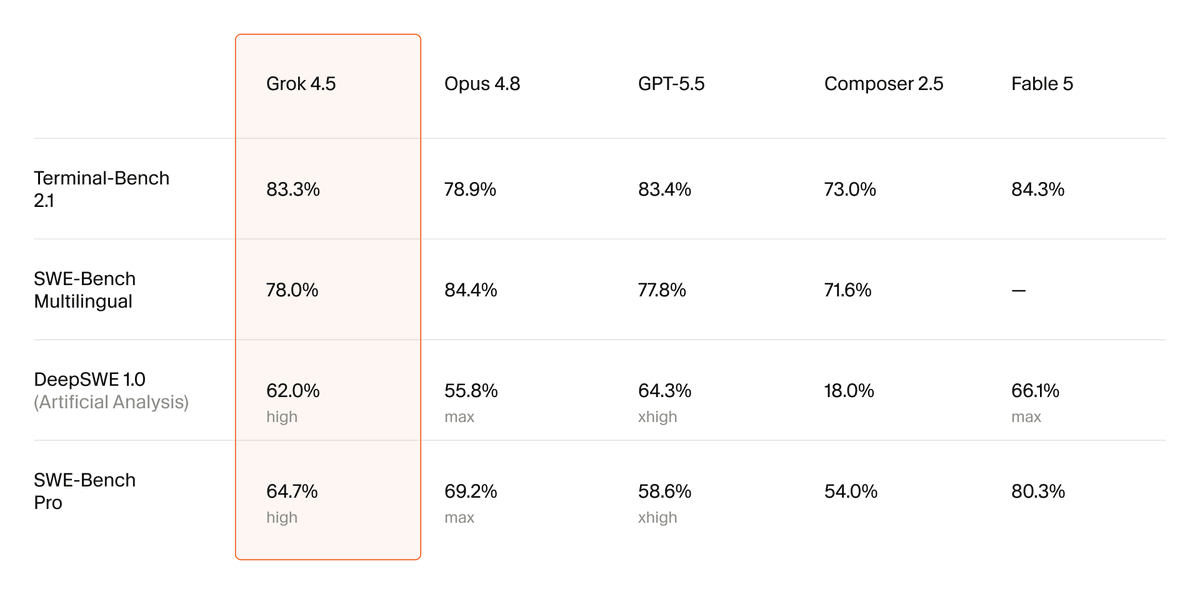
xAI and Cursor jointly launched Grok 4.5, positioned as the first model trained specifically for coding and agents. Grok 4.5 is 3x larger than Grok 4.3 at 1.5T parameters, priced at $2 per 1M input tokens and $6 per 1M output tokens, with a 500k context window (expandable to 1M soon). It ranked #4 on Artificial Analysis Intelligence Index with a score of 54 and #4 on GDPval-AA v2 Elo at 1543.
Why it matters
Grok 4.5 targets the coding-agent workflow market dominated by Anthropic and OpenAI, offering near-Opus quality with materially better economics and speed. Its pricing undercuts GPT-5.6 ($5/$30) and Opus 4.8 ($5/$25) significantly, and efficiency metrics show average output tokens per task are over 60% lower than Opus 4.8, making it potentially attractive to developers and engineering teams seeking cost-effective frontier capabilities.
What to watch
Grok 4.5 is available immediately in Grok Build, the API, Cursor, Hermes Agent, OpenRouter, and Grok subscriptions. Cursor is offering double usage for the first week. Cache hits are discounted by 75% to $0.5 per 1M tokens, and long inputs over 200k tokens cost double.
Summaries like this, in your inbox every morning.
xAI's Grok 4.5 launch reflects a strategic shift toward the coding-and-agents market segment that has become central to LLM (AI that understands and generates text) competition. The body frames Grok 4.5 not as a general-purpose flagship chasing absolute benchmark supremacy, but as a specialist model optimized for efficiency and speed in engineering workflows. This positioning aligns with Elon Musk's framing of the model as "roughly comparable to Opus 4.7, but much faster," emphasizing utility to Tesla and SpaceX engineers over benchmark chasing.
The efficiency gains are substantive: independent evaluation by Artificial Analysis found that Grok 4.5 achieves near-frontier capability while using 60% fewer output tokens per task than Opus 4.8, translating to lower cost per task ($0.31–$2.59 depending on task type). The pricing undercuts both OpenAI's GPT-5.6 and Anthropic's Opus 4.8, which positions Grok 4.5 as a value proposition for cost-sensitive developer and enterprise use cases, particularly those running agents (autonomous AI systems) that incur high token consumption. The body notes that Grok 4.5 is 3x larger than Grok 4.3, a substantial architectural jump that supports its capability gains.
Pick your industry and the AI tools you use, and get news related to your work every day.
Free · 30 seconds with Google · unsubscribe anytimeWhat is AIToday? →
Ask AI anything about this article. The AI reads this article, earlier AIToday articles, and Wikipedia, and cites its sources. Q&As are published on this page for other readers too.
Hewlett Packard Enterprise stock is down 5% at $55.87

The Motley Fool argues Amazon is the AI company of the two, since AWS was just 21% of first-half 2026 revenue…

Google Deepmind's Gemini 4 Argon scored 97.5 percent on ARC-AGI-3 at a cost of $4,800, second only to GPT-6 As…
Cammarata reinterprets InceptionV1's cat-car neuron as a V-shape detector, not two unrelated concepts

OpenAI is launching the Rosalind Academic Plan, offering eligible research labs at US universities up to 30 fr…
Microsoft's Surface Laptop Ultra, using Nvidia's RTX Spark platform, starts at $2,599 (up to $5,899)