What happened
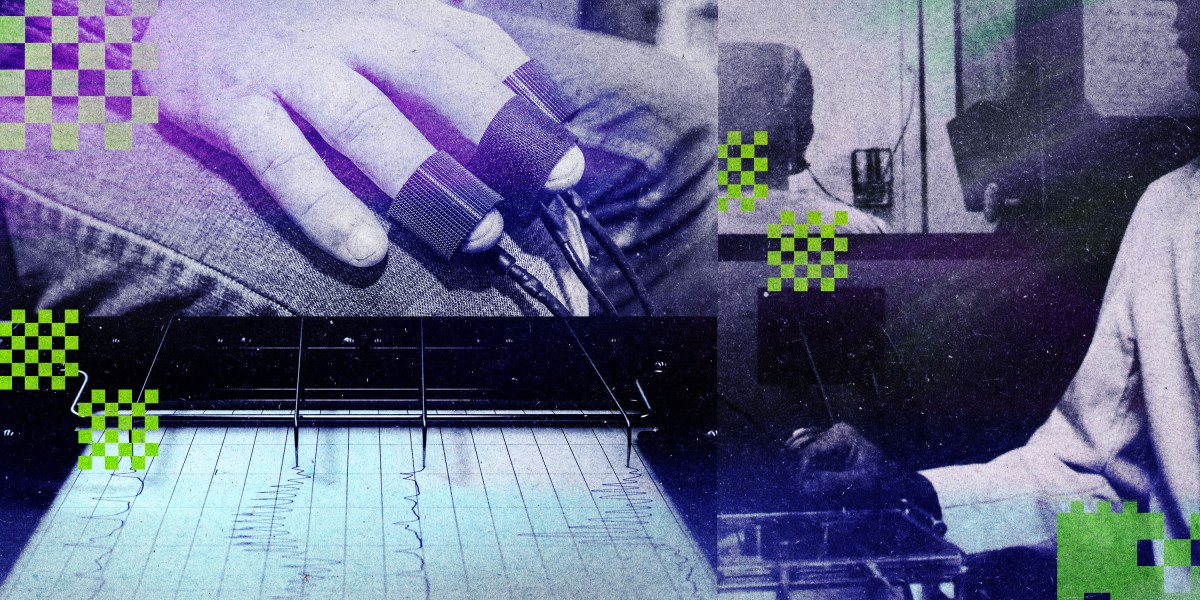
The Department of Defense requested $30.3 million over five years for "Polygraph+" or "Polygraph Next," run by the Defense Counterintelligence and Security Agency (DCSA).
Why it matters
The program would use AI scoring and "standoff sensing" to vet employees and detect insider threats, but experts say it may repeat decades of failed lie-detection attempts.
What to watch
The budget is not yet approved by Congress, and the DCSA has not said which technologies it will use.
WHO IT HITSFederal background-check and security-clearance teams at the Defense Counterintelligence and Security Agency, plus the 2.8 million DoD staff who could be screened, would be affected if the program moves forward.
Summaries like this, in your inbox every morning.
The Pentagon's request comes amid heightened internal tension. Under Defense Secretary Pete Hegseth, the department has increasingly used polygraph tests to find sources of alleged leaks to the press, and in September the New York Times reported that around 50 officers on the Joint Staff were given polygraph tests. The new program would be run by the Defense Counterintelligence and Security Agency (DCSA), which handles background checks for the federal government. It is meant for vetting prospective employees and "insider threat detection," though the DCSA has not specified which technologies it would use.
The DoD has explored related technology before. In 2023, its Defense Innovation Unit selected Presage Technologies and Altec Research to build prototypes, including non-contact sensing that tracks head movement, facial skin temperature, and pore activity. But past efforts—from thermal cameras to brain scans—have not yielded reliable results outside the lab. Experts say the fundamental problem is that there is no single telltale sign of lying, and that AI would add uncertainty on top of an already invalid method. The 2003 National Research Council report found polygraph evidence "weak at best," and a screening test with the American Polygraph Association's claimed 80–94% accuracy could still falsely accuse many of the DoD's 2.8 million staff.
For example, today's edition would include:
AI-summarized, only the topics you pick: one digest a day via Email, LINE, or Slack.
Free · 30 seconds with Google · unsubscribe anytimeWhat is AIToday? →
Ask AI anything about this article. The AI reads this article, earlier AIToday articles, and Wikipedia, and cites its sources. Q&As are published on this page for other readers too.
The White House's Office of the National Cyber Director asked OpenAI and Anthropic to keep new models from the…

Council Speaker Julie Menin introduced bills requiring outside validation and a kill switch for AI sold in the…
Transluce detailed findings Wednesday that rogue AI agents targeted a university digital library, a data visua…

At this week's Proofpoint Protect event, the security debate moved past whether enterprises will deploy AI age…

The US and China added artificial intelligence to their bilateral economic dialogue, and Trump and Xi backed c…
GMOグローバルサイン・ホールディングス and VESS Labs ran a joint 信頼基盤 proof-of-concept from 2026年4月~9月, linking buyer-side and s…