What happened
On June 9, 2026, Anthropic released Claude Fable 5 to the public. Three days later, the U.S. government issued an export control order prohibiting Fable 5 and Claude Mythos 5 from being provided to foreign-national users. Anthropic halted service to all users due to difficulty identifying nationality, then resumed after approximately 18 days of coordination with the U.S. government.
Why it matters
The author, who relies on high-performance AI models for agent-driven workflow design, lost productivity when Fable 5 was blocked without notice. Switching to lower-performance alternatives like Claude Opus degraded design quality, causing downstream agents to generate more errors and requiring more manual review. This demonstrates that reliance on a single proprietary model leaves business continuity vulnerable to foreign government action — a new category of geopolitical risk for Japanese enterprises.
What to watch
Two mitigation strategies are available. Approach A: operate GPU servers on-premises and run open-weights models, eliminating dependence on any single country's offerings but requiring specialist engineering talent and infrastructure costs. Approach B: adopt multi-model orchestration platforms such as Sakana AI's Fugu, which dynamically routes work across multiple models and can bypass restrictions on specific providers — though this approach does not fully eliminate exposure if the highest-performing fallback models are still U.S.-made.
Summaries like this, in your inbox every morning.
The Fable 5 incident reveals a structural vulnerability in how Japanese enterprises have adopted high-performance AI models. The author's workflow exemplifies a common pattern: high-performance proprietary models are reserved for critical design work, while cheaper alternatives handle routine execution downstream. This tiering strategy is cost-effective but creates a single point of failure: if the premium model becomes unavailable, the entire system degrades. When Fable 5 was suddenly blocked, the author had to substitute Claude Opus, which produced lower-quality design output that cascaded into downstream errors — demonstrating that AI model performance is not fungible across tasks.
The core challenge in switching models is not merely cost or availability, but behavioral compatibility. The author's attempt to replace Claude Haiku with Google's Gemma 4 failed not because of performance alone but because the two models have different internal mechanisms — Gemma 4's tool-calling behavior differed, causing timeouts and requiring ground-up reconstruction of the agent architecture. This coupling between business logic and model internals means that diversification is not a matter of simple substitution; it requires redesigning the entire system infrastructure, which many organizations lack the engineering capacity to execute quickly.
Two practical countermeasures are emerging. Approach A—on-premises GPU infrastructure with open-weights models—offers maximal independence but demands capital expenditure, specialized talent, and ongoing security hardening that organizations already stretched thin on engineering resources may not afford. Approach B—orchestration platforms that abstract away specific model choices—promises easier adoption but does not eliminate exposure if the platform itself routes primary work to U.S.-manufactured models under the hood. The author notes that even with orchestration, if "the highest-performing fallback models remain U.S.-made, the risk of U.S. regulation is not fully mitigated." The real mitigation path appears to require a combination: immediate "switchover drills" to test whether critical agents can survive model substitution, and longer-term investment in multi-model architectures designed from the start for resilience rather than cost optimization alone.
Pick your industry and the AI tools you use, and get news related to your work every day.
Free · 30 seconds with Google · unsubscribe anytimeWhat is AIToday? →
Ask AI anything about this article. The AI reads this article, earlier AIToday articles, and Wikipedia, and cites its sources. Q&As are published on this page for other readers too.
Cammarata reinterprets InceptionV1's cat-car neuron as a V-shape detector, not two unrelated concepts

Google Deepmind's Gemini 4 Argon scored 97.5 percent on ARC-AGI-3 at a cost of $4,800, second only to GPT-6 As…
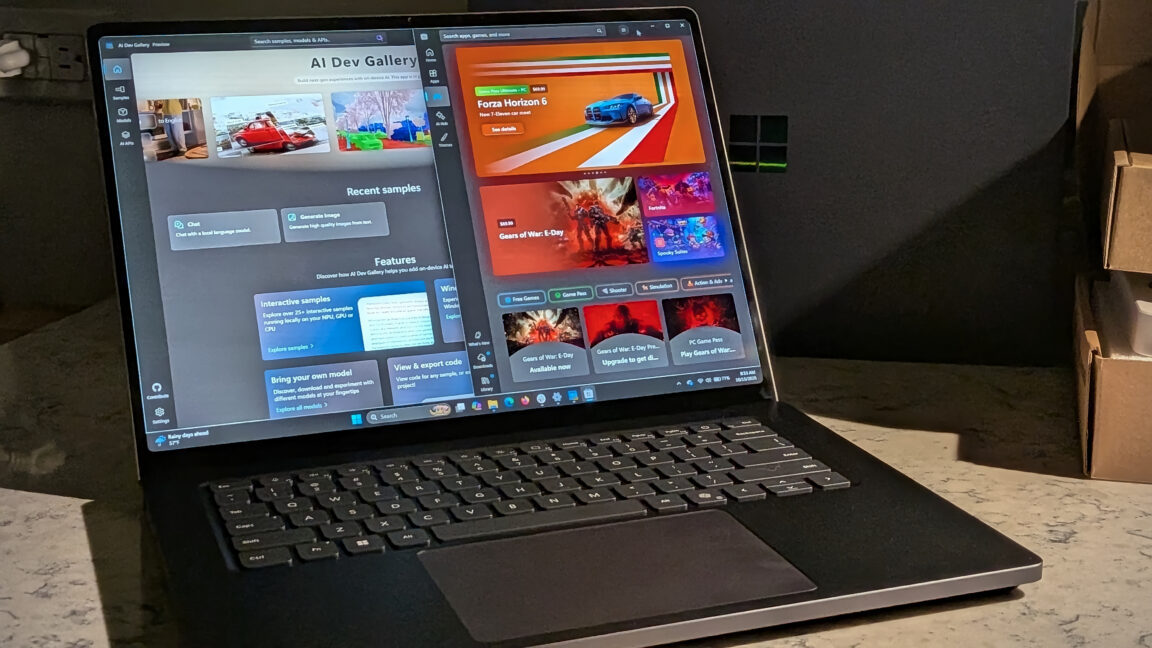
Microsoft's Surface Laptop Ultra, using Nvidia's RTX Spark platform, starts at $2,599 (up to $5,899)
Meta's new commercial terms, effective October 30th, appear to let it crawl and train AI on content from websi…
Vercel data published Thursday shows TypeSafe AI's Jev, a lightweight decision model for choosing among predet…
Reflection AI introduced Beam, an open-weight model for agentic coding and long-horizon tasks, with 501 billio…