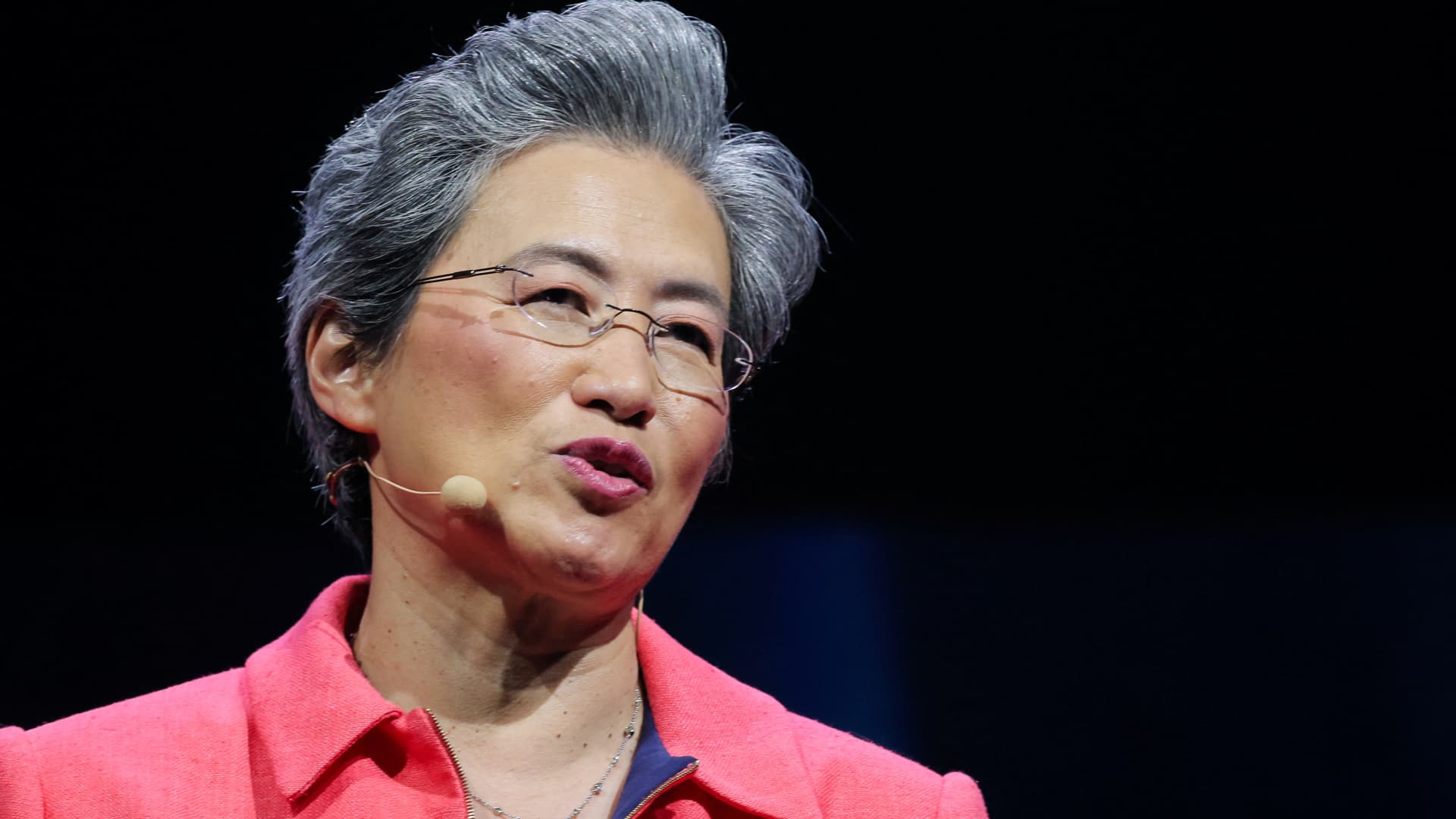
AMD has launched Helios, its first rack-scale AI system designed to compete with Nvidia's dominant offerings, and Microsoft has committed to deploying it in its data centers alongside Meta, OpenAI, Oracle, and Tata Consultancy Services. AMD holds only 4.5% of the data center GPU market today but analysts believe Helios could enable the company to reach 20–25% market share, representing hundreds of billions of dollars in potential revenue. Shipments to customers including Microsoft begin later this year.
Summaries like this, in your inbox every morning.
Sign up free →What happened
AMD announced its first rack-scale AI system, Helios, which will ship to customers including Microsoft, Meta, OpenAI, and Oracle later this year. Microsoft CEO Satya Nadella said the system will power frontier model inference and support Azure AI services. AMD stock climbed more than 4% on Monday following the announcement.
Why it matters
Helios is AMD's first real rival to Nvidia's dominant Grace Blackwell and Vera Rubin systems. Nvidia controls more than 95% of the data center GPU market, but analysts believe Helios could help AMD capture 20–25% of the market, which represents hundreds of billions of dollars of revenue. AMD plans to book tens of billions in data center AI revenue starting in 2027, with the majority coming from Helios.
What to watch
Meta will deploy 1 gigawatt of AMD GPUs on Helios racks later this year as part of a commitment to use up to 6 gigawatts over time. The Futurum Group estimates Helios will cost between $5 million(約8億円) and $5.5 million(約8.8億円), compared with $3.5 million(約5.6億円) to $4 million(約6.4億円) for Nvidia's Vera Rubin. AMD data center revenue grew 57% year over year in the first quarter of 2026.
AMD has introduced Helios, a rack-scale artificial intelligence system designed to compete with Nvidia's Grace Blackwell and Vera Rubin offerings, and secured commitments from multiple major technology companies to deploy it starting later this year. Microsoft announced Monday that it will integrate Helios into its Azure data center infrastructure to support frontier model inference, AI customer workloads, and Azure AI services. Microsoft CEO Satya Nadella stated in a press release: "We are expanding the Azure infrastructure portfolio with AMD Helios to give customers the performance, scale and choice they need to build and run the next generation of AI applications." Other customers committing to Helios deployments include Meta, OpenAI, Oracle, and India's Tata Consultancy Services. The announcement drove AMD stock up more than 4% on Monday, while Microsoft stock climbed more than 1%.
Helios is a fully integrated system that brings together GPU, CPU, networking, and software technologies, all developed or acquired by AMD in recent years. Each Helios system comprises 18 compute trays, with each tray housing four Instinct GPUs controlled by a single EPYC central processing unit. The system also incorporates up to 12 networking chips derived from Pensando, which AMD acquired in 2022. The system weighs up to 7,000 pounds and is wider and heavier than Nvidia's Vera Rubin. AMD data center chief Forrest Norrod described Helios as "our baby" and emphasized the company's focus on "providing the best total cost of ownership, the lowest cost per token, all in." In May, AMD CEO Lisa Su told CNBC that Helios offers "significant benefits" over Nvidia's rack-scale systems "when you're talking about inference and when you're talking about memory bandwidth and memory capabilities."
Financial details of the deployments were not disclosed, but the Futurum Group estimates that Helios will cost between $5 million(約8億円) and $5.5 million(約8.8億円) per rack, compared with Futurum's estimate of $3.5 million(約5.6億円) to $4 million(約6.4億円) for Nvidia's Vera Rubin. Helios comes in four customizable configurations; Meta will deploy the configuration shown in the Texas data center lab where the system is being developed and tested. Meta committed to using up to 6 gigawatts of AMD GPUs over time, with 1 gigawatt deployed on Helios racks later this year. OpenAI and Oracle also made major commitments to deploy Helios this year.
Helios' competitive positioning reflects AMD's broader resurgence in data center infrastructure. Nvidia currently controls more than 95% of the data center GPU market, while AMD holds approximately 4.5%. However, analyst Daniel Newman of the Futurum Group stated: "I think there's a serious case in which AMD does great and can get to 20% and 25%. And by the way, this is hundreds of billions of dollars of revenue." AMD plans to book tens of billions in data center AI revenue starting in 2027, with the majority coming from Helios. In the first quarter of 2026, data center made up the majority of AMD's revenue, which grew 57% year over year. Counterpoint Research analyst Neil Shah noted that AMD's Helios chips are "on par" with Nvidia GPUs and CPUs, but identified "the secret sauce is in the software and optimization," adding that Nvidia's CUDA software ecosystem remains "quite ahead versus AMD." AMD's ROCm open-source software alternative and investments in software companies aim to narrow this gap.
AMD's launch of Helios marks a watershed moment in its decade-long effort to reclaim leadership in the data center market. The company lost ground after 2003, when it held nearly a quarter of the data center CPU market but then suffered years of delays and missteps. Under CEO Lisa Su's leadership for the last 12 years, AMD charted a detailed three-generation roadmap for its EPYC server CPUs starting in 2017, and the company has steadily recovered market share. Helios integrates four core capabilities AMD now controls in-house: GPUs, CPUs, networking, and software. The system combines 18 compute trays, each powered by four Instinct GPUs and a single EPYC central processing unit, plus up to 12 networking chips sourced from Pensando, which AMD acquired in 2022. This vertical integration, coupled with AMD's ROCm open-source software stack (built through acquisitions of ZT systems and several software companies), positions Helios as a credible alternative to Nvidia's vertically integrated and proprietary CUDA ecosystem.
The timing of Helios' entry is critical. Nvidia presently commands more than 95% of the data center GPU market, and Helios faces a steep climb in a market where customers have already invested heavily in Nvidia infrastructure and developers have optimized for CUDA. Analysts acknowledge that AMD's competitive advantage lies not just in hardware parity with Nvidia but in the depth of software optimization and the overall total cost of ownership. AMD data center chief Forrest Norrod has emphasized "lowest cost per token" as the system's key value proposition. The Futurum Group estimates Helios will cost $5 million(約8億円) to $5.5 million(約8.8億円) per rack, slightly higher than Vera Rubin, but AMD claims efficiency gains in inference, memory bandwidth, and memory capabilities will justify the investment for large-scale deployments. If early customers like Microsoft and Meta validate these claims, the addressable opportunity is enormous: analysts project that capturing 20–25% of the data center GPU market would represent hundreds of billions of dollars in revenue.
AI-summarized, only the topics you pick — one digest a day via Email, Slack, or Discord.
Free · takes 30 seconds · unsubscribe anytime
No comments yet. Be the first to share your thoughts!
Log in to join the discussion
Get curated AI news from 200+ sources delivered daily to your inbox. Free to use.
Get Started FreeFree · takes 30 seconds · unsubscribe anytime
1 minute a day. The AI essentials.
200+ sources · Email / LINE / Slack
