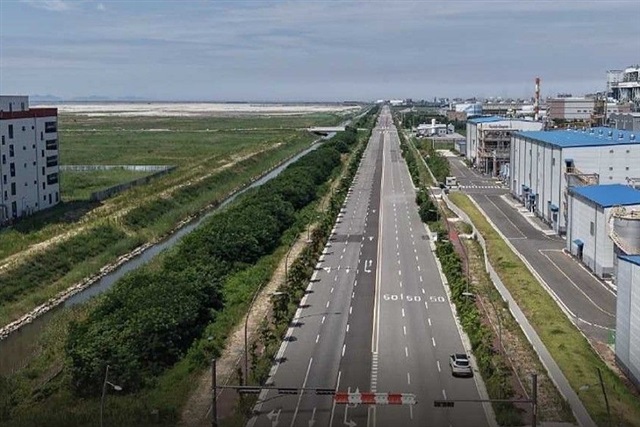
Hyundai Motor Group is accelerating its 'Physical AI+' robot strategy by establishing Saemangeum in North Jeolla Province as its main robotics manufacturing base and opening robot training and learning centers in South Korea, the US, and China.
The expansion suggests the industrial group is aiming for a larger global role in robotics, potentially reshaping competition in South Korea's manufacturing sector.
What happened
Hyundai Motor Group is accelerating its 'Physical AI+' robot strategy, with Saemangeum in North Jeolla Province designated as its main manufacturing base for robots. The group plans to establish robot training and learning centers in South Korea, the US, and China.
Why it matters
By building dedicated manufacturing and training infrastructure for robotics, Hyundai is positioning itself to compete more directly in the global robotics market, extending beyond its traditional automotive focus. For South Korea's industrial sector, this represents a major conglomerate's commitment to advance manufacturing automation within the country.
What to watch
The rollout of the training and learning centers across the three regions (South Korea, US, and China) will signal how quickly Hyundai can scale its robotics capabilities and attract talent to support the strategy.
Hyundai Motor Group is executing an accelerated strategy centered on what it calls 'Physical AI+' robotics, reflecting the company's ambition to move beyond traditional automotive manufacturing. Saemangeum in North Jeolla Province has been designated as the primary manufacturing base for this effort, serving as the physical anchor for the group's robotics production. To support this manufacturing hub and build broader capabilities, Hyundai is establishing robot training and learning centers across three critical regions: South Korea, the United States, and China. These training centers are intended to develop both technical talent and research capabilities needed to advance the group's robotics offerings. The multi-geography approach reflects Hyundai's intention to secure a larger share of the global robotics market, positioning the company to compete with specialized robotics firms and other conglomerates investing heavily in automation technologies. For South Korea's industrial base, the strategy signals that a major manufacturing player is betting on robotics as a core business segment, potentially influencing broader industrial policy and investment patterns across the sector.
Hyundai Motor Group's accelerated investment in robotics marks a strategic pivot toward advanced manufacturing technologies. The choice of Saemangeum as the primary manufacturing hub, combined with a multi-region training infrastructure spanning South Korea, the US, and China, suggests the company is building both production capacity and talent pipelines to compete in the global robotics sector. By anchoring manufacturing in its home market while establishing learning centers in the world's largest robotics markets (China and the US) and domestically, Hyundai appears to be hedging regional exposure while tapping into distributed expertise. This move carries implications for South Korea's industrial competitiveness, as a leading conglomerate's commitment to robotics could elevate the country's standing in automation and manufacturing technology.
AI-summarized, only the topics you pick — one digest a day via Email, Slack, or Discord.
Free · takes 30 seconds · unsubscribe anytime
Ask AI anything about this article. Q&As are published on this page for other readers too.
Nvidia announced a partnership with BlackRock, Goldman Sachs, Blackstone, and other major Wall Street firms to…

Google's Gemini dropped from 12 percent to 1.9 percent market share in July 2026 according to Pangram's analys…

Norway's sovereign wealth fund reported an all-time high gain of 1.4 trillion kroner ($150 billion) in the fir…

CoreWeave Inc., an Nvidia-powered AI cloud infrastructure provider, rose more than 18% in premarket trading af…

OpenAI data shows the disparity between heavy and moderate AI users among its business customers has grown sha…

ClearJet, an AI-enabled logistics startup, raised $25 million in Series B funding led by Edison Partners, brin…

The AI news that matters, in one minute each morning.
Sign up free