What happened
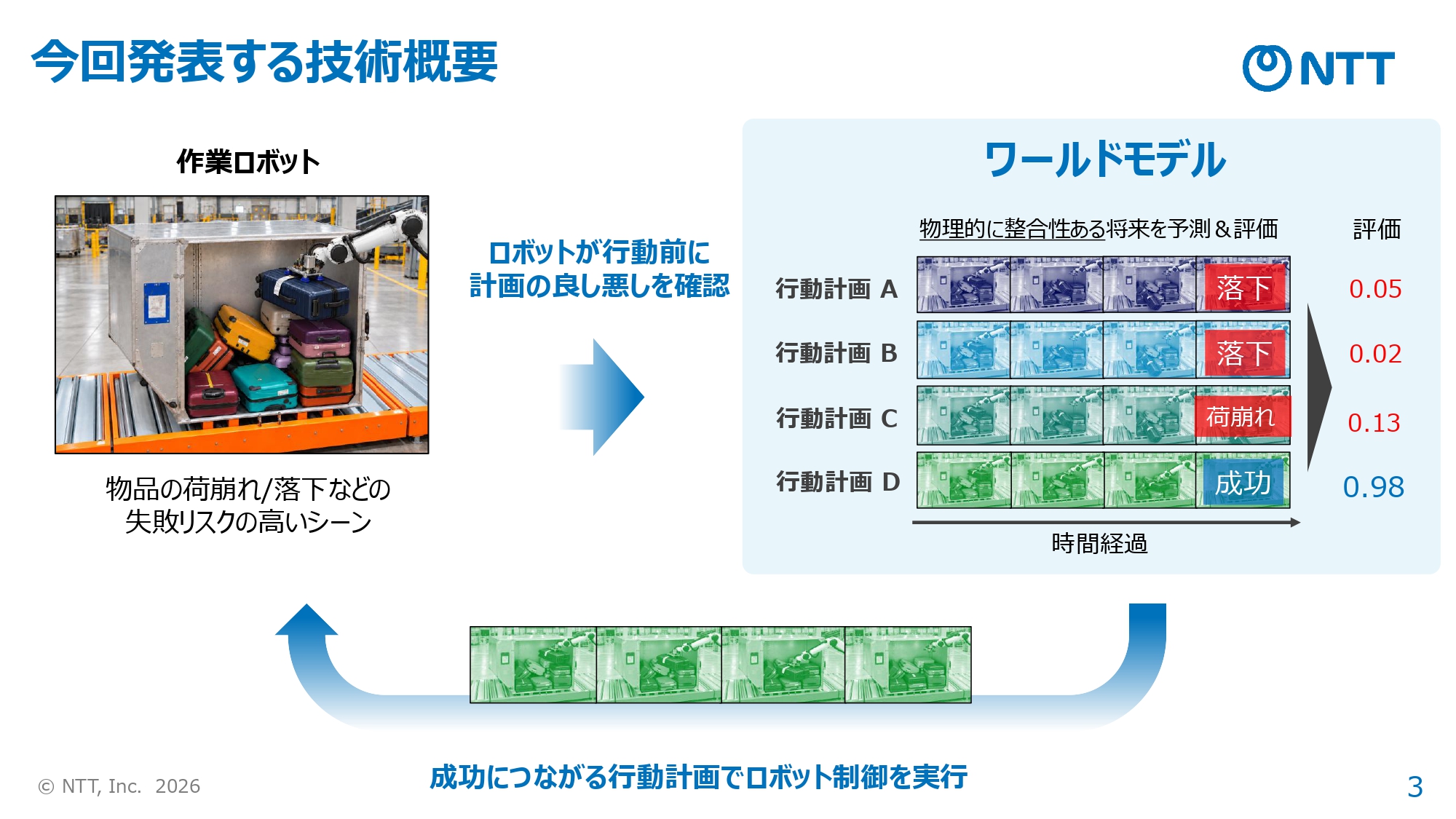
NTT unveiled a physical AI that combines its NTT World Model with a 'physics control adapter' to score action candidates before execution; in shelf-stacking tests with the open-source π0.5 VLA model, success rose from 73.1% to 92.3%.
Why it matters
Conventional world models learn from video and can produce physics-violating predictions in unseen situations, a problem for items of varying shape and weight; NTT's physics-based approach aims to keep predictions consistent.
WHO IT HITSRobotics and automation teams in logistics, warehousing and manufacturing that handle irregularly shaped or weighted items may gain a way to pre-check actions before execution.
Summaries like this, every morning.
NTT's announcement addresses a known weakness in world models: systems that learn future changes empirically from large amounts of video data can generate predictions that violate physical laws in situations they have not learned. That is especially problematic at sites handling airport baggage or parcel deliveries, where shapes, weights and placements vary and collecting training data for every situation is difficult. NTT's approach pairs a video-generation model with a proprietary 'physics control adapter' that estimates object position, orientation, velocity and mass and predicts state changes based on equations of motion. By integrating the experience-based generator with the physics-based adapter, NTT says it suppresses unnatural predictions such as objects disappearing or deforming. The technology also works with existing robot control software, predicting post-execution situations in video for multiple action candidates from VLA models and motion planners and scoring each action's success, so a robot can compare options before moving. Beyond the shelf-stacking result, NTT reported a LPIPS score of 7.81 on the OBJ3D benchmark, above OCK's 7.92 and NVIDIA Cosmos Predict 2.5's 21.90. The first intended application is airport baggage handling, with verification to proceed with Mujin and expansion targeted at logistics, warehousing, manufacturing, construction and retail.
Pick your industry and the AI tools you use, and get news related to your work every day.
Free · 30 seconds with Google · unsubscribe anytimeWhat is AIToday? →
Ask AI anything about this article. The AI reads this article, earlier AIToday articles, and Wikipedia, and cites its sources. Q&As are published on this page for other readers too.
Salesforce AI Research released SFR-AutoR&D, agents that form hypotheses, run controlled experiments and keep…

Interactive Brokers launched IBKR Autonomous Trading, which lets eligible clients connect AI platforms to a ri…
KWCH published guidance advising users to keep certain personal information out of AI chatbots to protect thei…
Honeywell Technologies unveiled AI-powered building intelligence, fire and life safety and security upgrades t…

J.P. Morgan Private Bank said it does not currently allow third-party AI agents to access client accounts or a…

Kora Systems, founded by Cyanogen co-founder Kirt McMaster, unveiled a Linux-based AI desktop operating system…