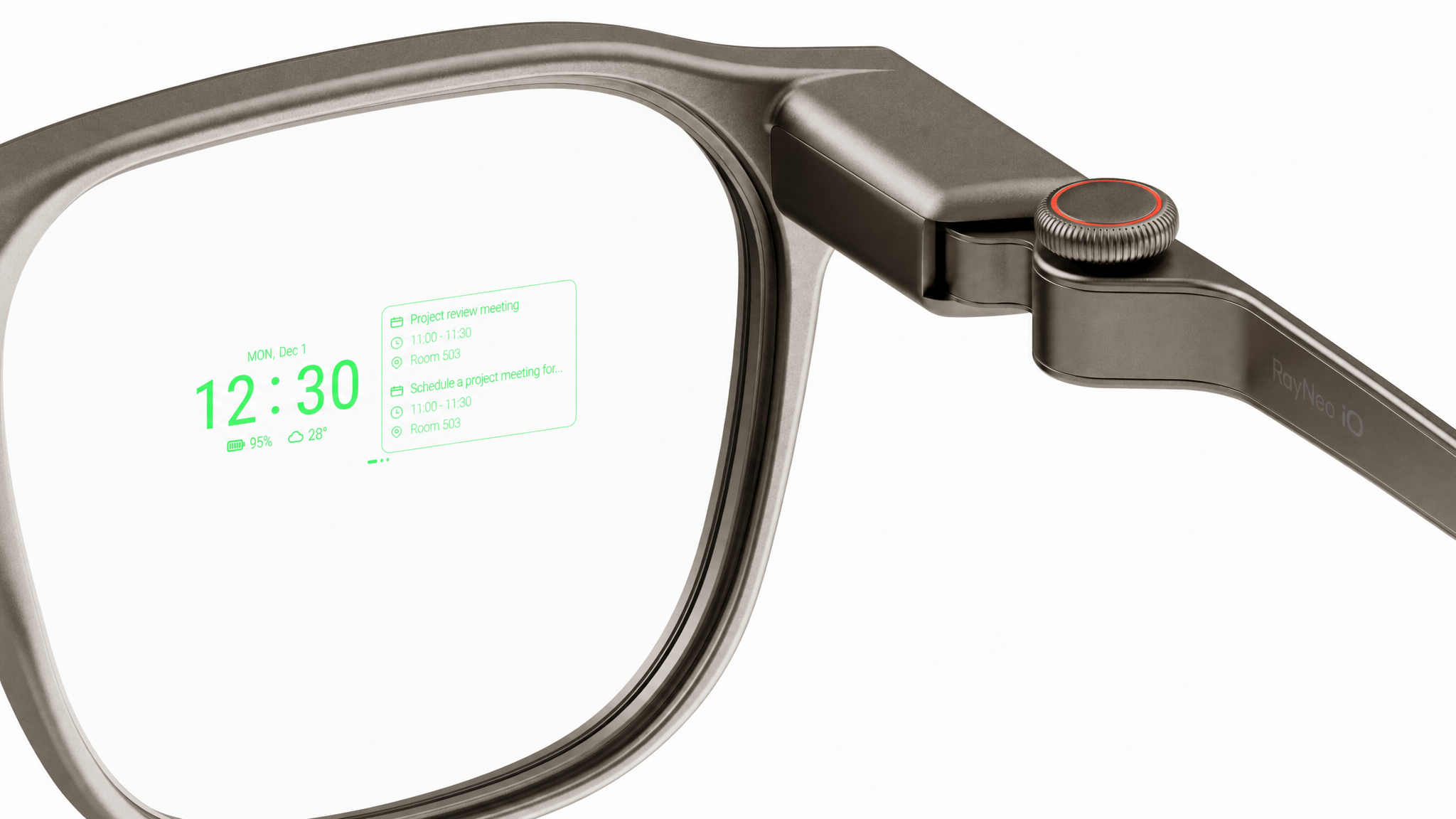
RayNeo released AR glasses without a camera, relying instead on microphones and bone conduction to listen to conversations.
The device overlays text summaries and meeting notes onto the wearer's field of view through a transparent green display.
A $9.99 monthly subscription adds access to ChatGPT, Gemini, Claude, and DeepSeek.
What happened
RayNeo launched AI glasses with no camera or speaker. The device overlays text via a green waveguide display (97% transparency, ~1,300 nits brightness) and listens to conversations through four microphones and a bone conduction sensor to summarize them, extract action items, and suggest calendar entries confirmed by head nod.
Why it matters
The camera-free design sidesteps privacy concerns that have dogged AR glasses, while the microphone-forward architecture lets the glasses function as a real-time meeting assistant and translator (40 languages) without recording video. An LED signals when the mic is active, adding transparency about when the device is listening.
What to watch
Out of the box, the glasses run RayNeo AI and Gemini 3.1 Flash Lite. A $9.99 monthly subscription unlocks ChatGPT 5.1, Gemini 2.5 Pro, Claude, and DeepSeek—though all of these AI models are already outdated.
Ask the AI about this article →
RayNeo's decision to exclude a camera marks a deliberate departure from the AR glasses trend established by competitors. Instead of visual recording, the device prioritizes audio capture and processing—four microphones and bone conduction sensing work together to pick up voices reliably even in loud settings. This trade-off addresses a major user hesitation: privacy during everyday wear. The glasses' core job is to turn conversations into actionable data—summaries, extracted to-dos, and calendar suggestions—delivered silently through text overlays on the wearer's eye. The 97% transparency of the green waveguide display allows the user to remain aware of their surroundings while reading the AI's output, and the always-on LED indicator for the microphone builds in a signal that the device is listening. The feature set (teleprompter mode, 40-language translation) suggests the glasses are aimed at professionals in meetings, presentations, and multilingual settings rather than general consumers.
For example, today's edition would include:
AI-summarized, only the topics you pick — one digest a day via Email, Slack, or Discord.
Free · takes 30 seconds · unsubscribe anytimeWhat is AIToday? →
Ask AI anything about this article. Q&As are published on this page for other readers too.
Israeli startup DataAgent Ltd

SK Hynix presented a custom HBM concept at SEMICON Taiwan 2026, where compute functions are placed in the base…

Nvidia reported earnings that were both remarkable and boring, reflecting its focus on avoiding a consolidated…

Anthropic has agreed to a $35bn cloud-computing contract with Lambda, a Nvidia-backed cloud provider

The Supreme Court of Japan has included about ¥60 million in its fiscal 2027 budget request for AI-related exp…

The Consumer Affairs Agency said Tuesday it will use generative AI to analyze about 900,000 annual consultatio…