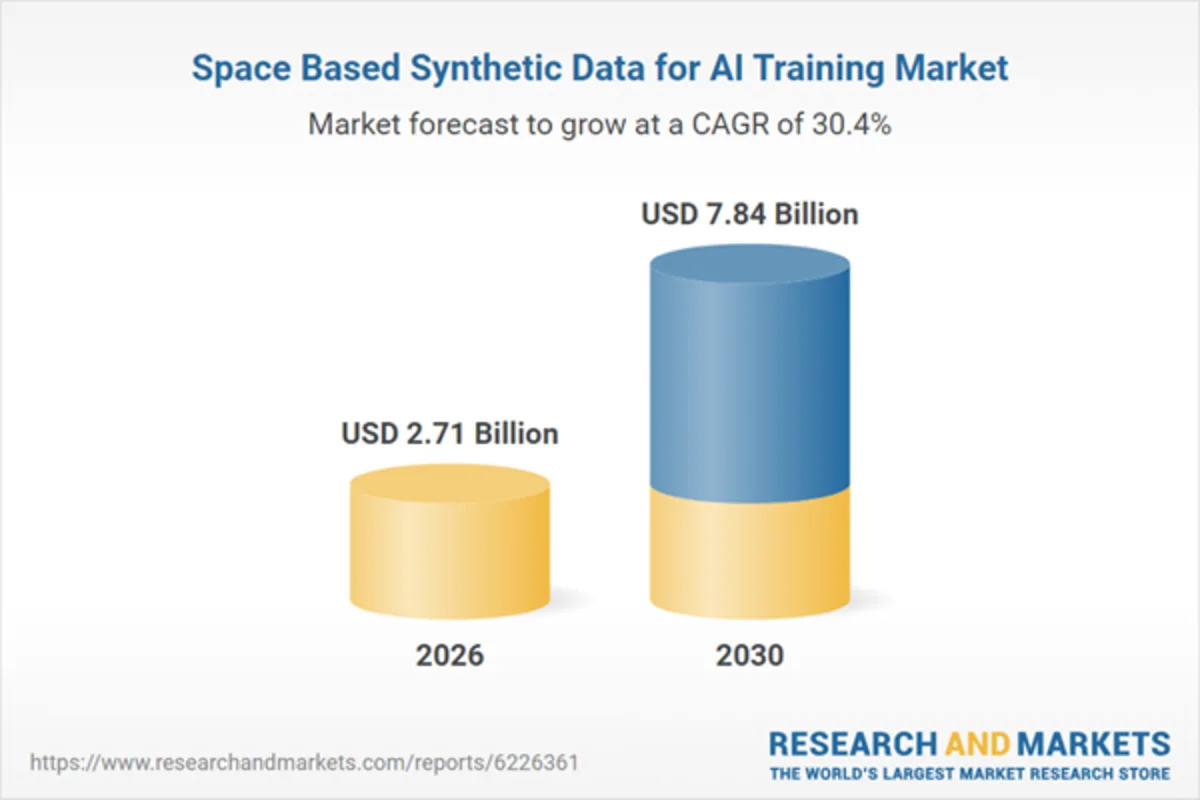
The space-based synthetic data for AI training market expanded from $2.08 billion(約3300億円) in 2025 to $2.71 billion(約4300億円) in 2026, reflecting a 30.7% compound annual growth rate. The market is expected to reach $7.84 billion(約1.3兆円) by 2030, fueled by increased satellite deployments and growing demand for AI training data derived from Earth observation technologies. North America leads current market share, though Asia-Pacific is anticipated to grow fastest.
Summaries like this, in your inbox every morning.
Sign up free →What happened
A market research report shows the space-based synthetic data for AI training market grew from $2.08 billion(約3300億円) in 2025 to $2.71 billion(約4300億円) in 2026, with a projected compound annual growth rate of 30.7%. The market is anticipated to reach $7.84 billion(約1.3兆円) by 2030, driven by satellite deployments, rising AI training data demand, and Earth observation technology adoption.
Why it matters
Synthetic data generated from satellite imagery helps optimize AI models and satellite system performance at scale. As satellite launches are projected to increase to 58,000 additional deployments by 2030 (beyond the nearly 5,500 active satellites as of September 2022), demand for scalable datasets to train AI systems will likely grow accordingly. Companies like Satellogic and NTT DATA are already commercializing these capabilities.
What to watch
North America currently holds the largest market share, but Asia-Pacific is anticipated to be the fastest-growing region. The market is driven by technological advancements in simulation models, innovations in space-based data generation, and AI-driven synthetic engines, with major players including Lockheed Martin, Northrop Grumman, and Thales Group.
The space-based synthetic data market represents a convergence of three technology trends: the proliferation of satellite launches, the intensifying demand for AI training data, and the commercial viability of generating high-fidelity synthetic datasets from orbit. The Government Accountability Office reported nearly 5,500 active satellites as of September 2022, with projections of 58,000 additional launches by 2030. This expansion creates both a supply opportunity and a demand catalyst: satellites themselves require synthetic data to optimize their systems and AI model performance, while the volume of satellite-generated imagery offers a natural source for creating training datasets at scale.
Companies are already capitalizing on this intersection. Satellogic released a dataset of six million images from unique locations worldwide in May 2024 to support Earth observation AI models, while NTT DATA partnered with Bifrost AI that same month to accelerate synthetic data development for satellite AI by combining systems integration expertise with generative AI capabilities. The market's projected 30.7% compound annual growth rate from 2026 to 2030—and the jump from $2.71 billion(約4300億円) to $7.84 billion(約1.3兆円)—reflects confidence that this cycle will persist as satellite deployments expand and AI workflows increasingly rely on synthetic training data. Geographic dispersion matters: while North America currently dominates, the fastest growth is expected in Asia-Pacific, where satellite infrastructure investment and AI adoption are both accelerating.
No comments yet. Be the first to share your thoughts!
Log in to join the discussion





Get curated AI news from 200+ sources delivered daily to your inbox. Free to use.
Get Started FreeFree · takes 30 seconds · unsubscribe anytime
1 minute a day. The AI essentials.
200+ sources · Email / LINE / Slack
