What happened
Nari Labs released NariQ-GGUF versions of Qwen3.8-27B on Nov 23, using trellis-coded post-training quantization calibrated on real coding-agent traces to reach 10.12GB at 3 bits per weight, down from 53.8GB BF16.
Why it matters
The 10.12GB package is roughly one-fifth the storage footprint of the 53.8GB BF16 build and is tuned for coding-agent workloads, which could make local deployment practical for teams with limited GPU memory.
WHO IT HITSAI engineers and teams running self-hosted models on limited GPU memory may find a smaller, coding-agent-calibrated build easier to fit, though they will need Nari's custom llama.cpp fork rather than stock llama.cpp.
Summaries like this, every morning.
Nari Labs' release on Nov 23 is notable for how the compression was tuned. Instead of generic post-training quantization, the company calibrated its trellis-coded approach on real coding-agent traces. That choice matters for anyone running agent workloads locally, because the build is optimized for the kind of input those systems actually process.
The headline result is the size reduction: from 53.8GB in BF16 to 10.12GB at 3 bits per weight. At the same time, the 3-bit build did not sacrifice benchmark scores. Across DeepSWE v1.1, Terminal-Bench 2.1, AIME 25+26, and RealWorldQA, it matched or edged out the BF16 baseline, suggesting the quantization preserved capability on these agent-oriented tests.
One practical catch is compatibility. The weights currently require Nari's custom llama.cpp fork, since stock llama.cpp cannot load the files yet. That means teams interested in the smaller build will need to adopt Nari's tooling rather than relying on standard runtimes, a factor that could slow adoption until upstream support arrives.
Pick your industry and the AI tools you use, and get news related to your work every day.
Free · 30 seconds with Google · unsubscribe anytimeWhat is AIToday? →
Ask AI anything about this article. The AI reads this article, earlier AIToday articles, and Wikipedia, and cites its sources. Q&As are published on this page for other readers too.
NEC won three Newsweek AI Impact Awards APAC & EMEA 2026 categories; its procurement AI reached a 95% automate…
Google said Personal Intelligence in AI Mode will link to Google Wallet, with Google Drive and the Gemini app…
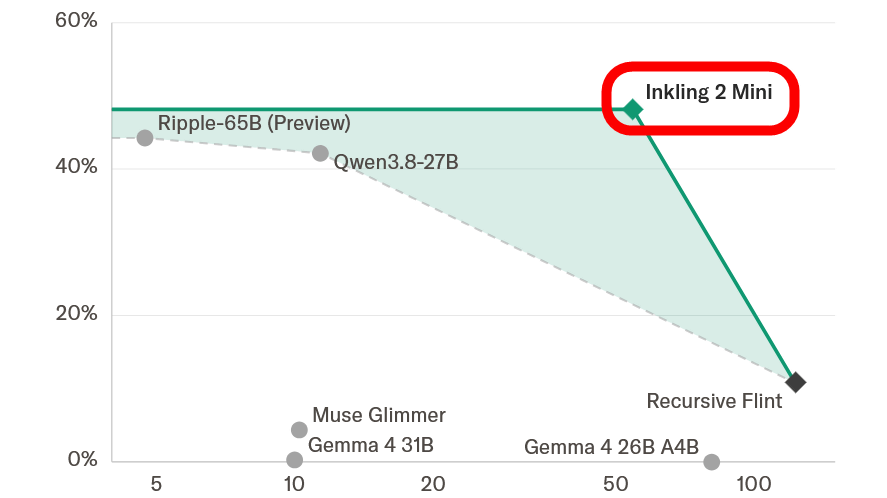
Thinking Machines Lab released Inkling 2 Mini, a 26.4B-parameter model with 3.4B active parameters and a 1M-to…
Anthropic's economics team interviewed 58 US firms using Claude; only two reported a role fully eliminated, wh…
Z.ai released GLM-5.4, its first model on a loop transformer, where weight-shared layers run for multiple iter…
Anthropic launched Claude Ship in beta for Claude Team and Enterprise plans on GitHub