What happened
HarnessRouter, an open-source server for UHP (Unified Harness Protocol), routes a task and harness_id from a product backend to a configured harness and streams progress and artifacts back through a gateway, runner and built-in tools.
Why it matters
The protocol makes your agent infrastructure fully interchangeable, so a product can run the same task across different harnesses and compare outputs, and add new harnesses as they emerge without rewrites.
Summaries like this, in your inbox every morning.
HarnessRouter is presented as the open-source server side of UHP, a standardized interface for running agent tasks across any agent harness. The flow described is simple: a product backend sends a task plus a harness_id to HarnessRouter, which routes it to whichever configured harness should run it, streams progress and artifacts back, and returns the output to the product.
Three components are said to handle this. A gateway holds the Responses API, harness configuration and your model keys. A runner provides isolated workspaces, one event stream and turn checkpoints. Built-in tools cover MCP servers, browser, database, GitHub and media. The result is fully interchangeable agent infrastructure — running the same task across different harnesses for comparison, and adding new harnesses as they emerge without rewrites.
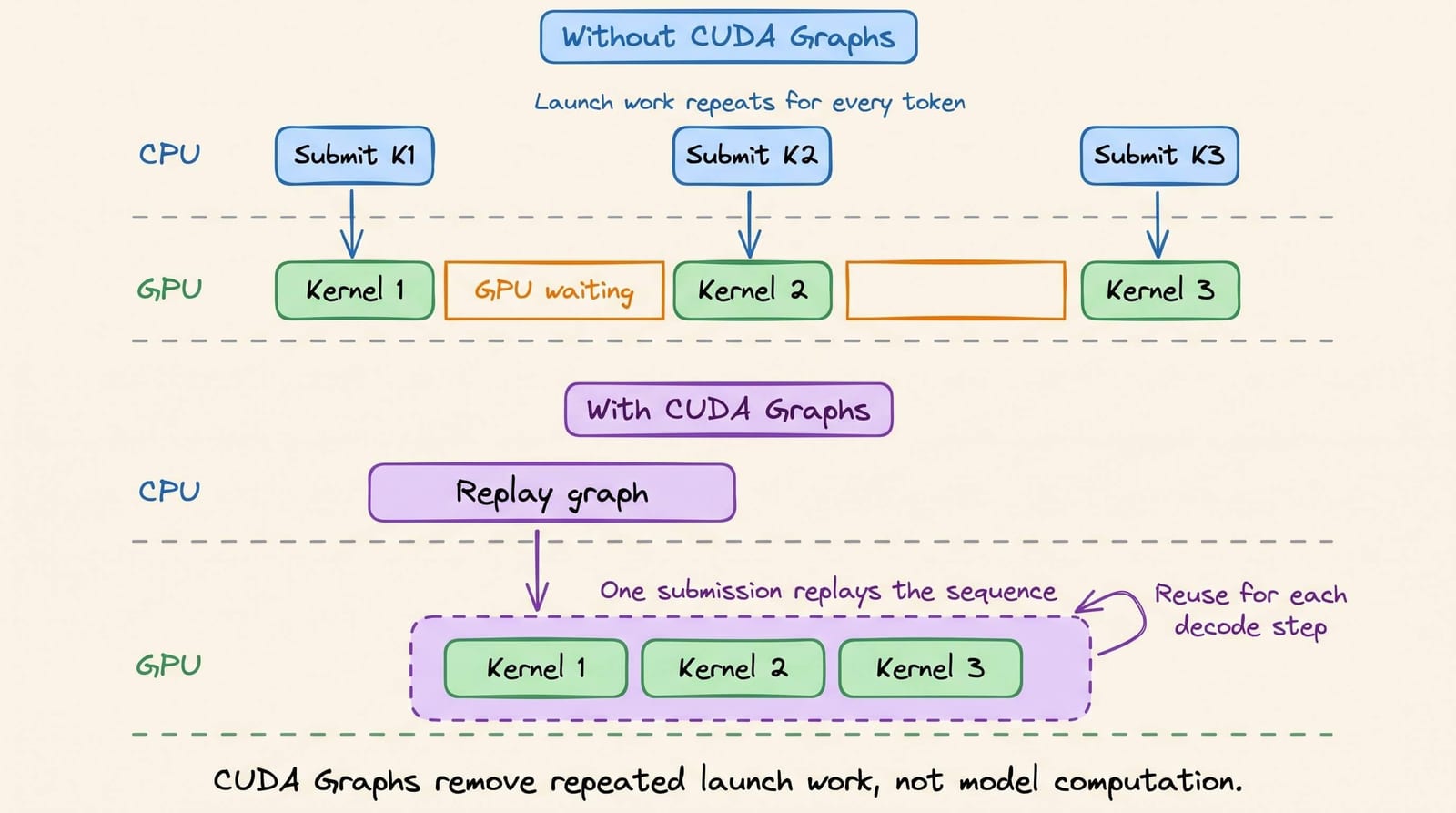
The rest of the piece is a separate explainer. It walks through a demo video of Multimodal Jev with a chapter list, and then turns to why moving an LLM to a faster GPU can leave the time between generated tokens barely changed. It attributes this to CPU launch overhead across many short kernels during decoding, and describes CUDA Graphs as capturing a repeatable sequence of operations once so later iterations replay it through one graph launch. This is especially useful during decoding, matters less when prefill already keeps the GPU busy, and comes with a tradeoff: engines such as vLLM and TensorRT-LLM capture graphs for several common execution cases and batch sizes, using eager execution or padding when a live batch does not match. CUDA Graphs are not a universal inference speed switch, and LLM inference needs a specialized serving engine rather than a standard prediction API.
Pick your industry and the AI tools you use, and get news related to your work every day.
Free · 30 seconds with Google · unsubscribe anytimeWhat is AIToday? →
Ask AI anything about this article. The AI reads this article, earlier AIToday articles, and Wikipedia, and cites its sources. Q&As are published on this page for other readers too.

