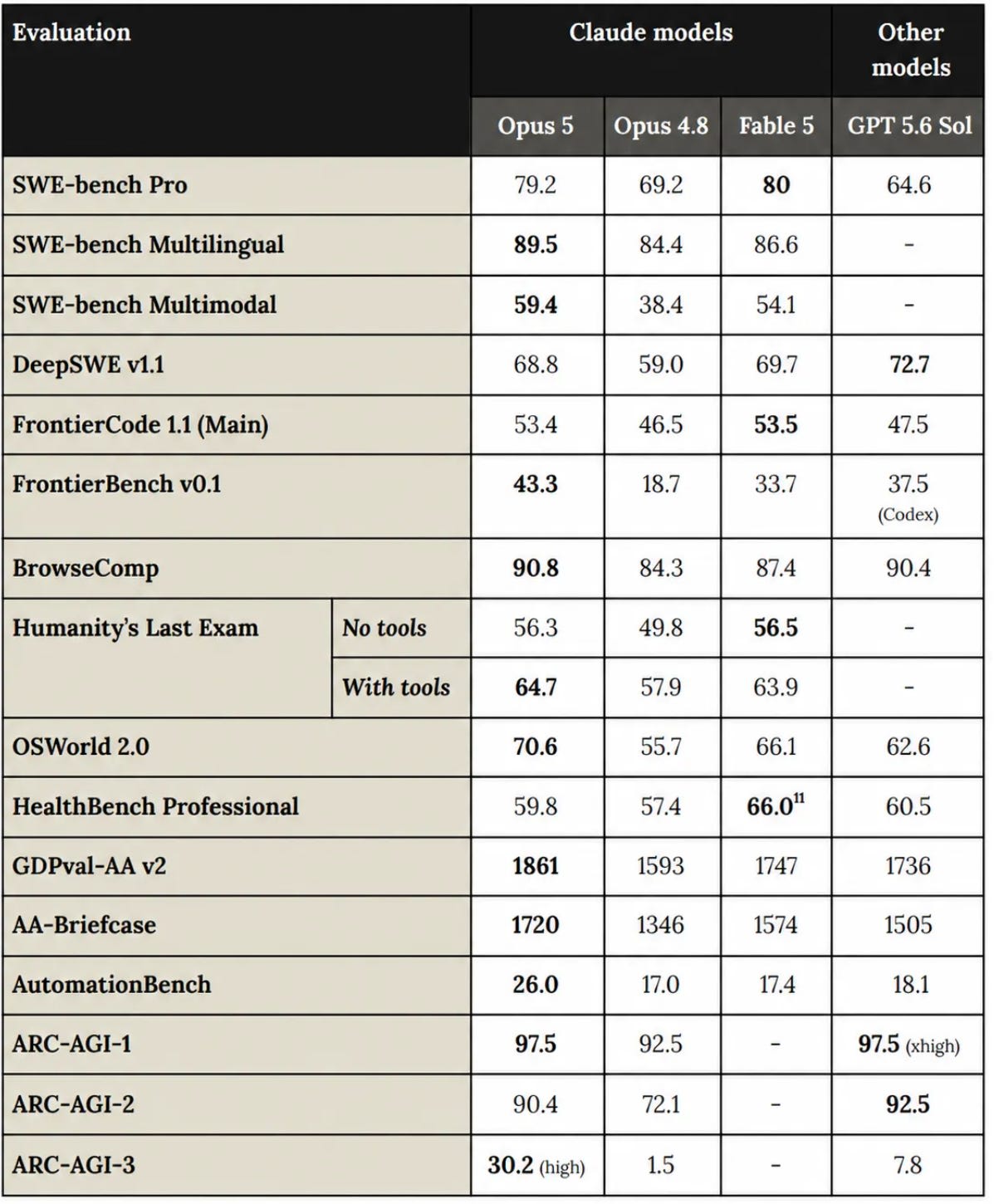
Anthropic has released Claude Opus 5, a new AI model designed to match Fable's performance at substantially lower cost—half the price per token on the API and cheaper still via subscriptions. Rather than positioned as a frontier breakthrough, Opus 5 targets practical use cases like subagent work and bounded tasks, with more permissive content classifiers than its predecessor. The model's training strategy reflects a deliberate choice to avoid cyber capability risks while delivering cost efficiency for businesses and developers.
Summaries like this, in your inbox every morning.
Sign up free →What happened
Anthropic released Claude Opus 5, positioned not as the most advanced AI model but as a lower-cost alternative to Fable that matches its performance at half the price per token via API and significantly cheaper through subscriptions, with more permissive content policies.
Why it matters
The release reflects a shift in strategy—rather than chasing frontier performance, Anthropic is offering a practical middle-ground model for developers and businesses seeking capable AI at lower cost. Opus 5 was trained to excel at subagent tasks and bounded work, partly to avoid potential cyber capability risks.
What to watch
Performance on medium-effort settings; Opus 5 can be inefficient at high effort levels, spinning in circles with marginal returns on many benchmarks. Users may see best value by using Medium rather than higher effort configurations.
Anthropic has released Claude Opus 5, an AI model that breaks from the typical pattern of pushing toward frontier performance. Instead, Opus 5 is pitched as a cost-efficient alternative that achieves performance parity with Fable, the company's existing top-tier model, while undercutting its price significantly. At the API level, Opus 5 costs half what Fable does per token; subscriptions offer even greater savings. The model comes with more permissive content classifiers, reflecting a less restrictive approach to safety guidelines. Opus 5's development strategy departs from conventional wisdom in several ways. The model was trained to excel at subagent work and bounded, well-defined tasks rather than open-ended frontier capabilities. This choice was made partly to avoid developing advanced cyber capabilities—a risk mitigation tied to the narrower use case. Benchmarks reveal that Opus 5 often consumes more than half of Fable's compute resources, a gap the article attributes to suboptimal effort settings in evaluation. The model exhibits a curious inefficiency: when pushed to higher effort levels, it can spiral and loop without meaningful improvement, suggesting that Medium effort provides the sweet spot for most practical applications. This design—pairing capability with cost efficiency and safety guardrails suited to bounded work—positions Opus 5 as a pragmatic tool for developers seeking capable AI without the price tag or frontier-model risks of its predecessor.
Claude Opus 5 represents a deliberate repositioning by Anthropic away from the frontier-model race. Rather than competing with Fable on raw capability, the company has designed Opus 5 to deliver comparable performance at a fraction of the cost—a shift that signals maturation in the AI market where price and practical utility matter as much as headline benchmarks. The article notes that Opus 5 often costs more than half of Fable to run on benchmarks, suggesting the model is not simply a scaled-down version but one optimized for different constraints. The emphasis on subagent roles and bounded tasks reflects both a commercial strategy and a safety consideration: by steering the model away from general-purpose frontier capabilities, Anthropic aims to reduce potential cyber-related risks while still delivering useful functionality. The permissive content classifiers indicate a willingness to relax some safety guardrails compared to predecessors, likely reflecting confidence in the model's narrower deployment context.
AI-summarized, only the topics you pick — one digest a day via Email, Slack, or Discord.
Free · takes 30 seconds · unsubscribe anytime
No comments yet. Be the first to share your thoughts!
Log in to join the discussion


Get curated AI news from 200+ sources delivered daily to your inbox. Free to use.
Get Started FreeFree · takes 30 seconds · unsubscribe anytime