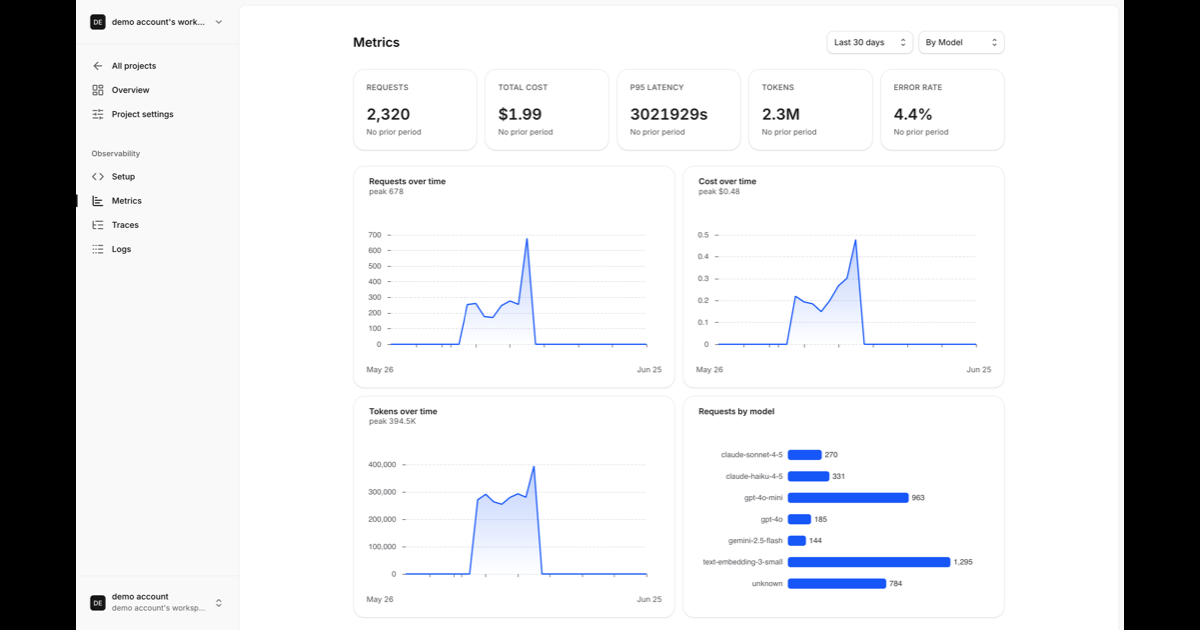
telemetry.dev launched as an observability platform designed to help developers monitor AI and large language model applications. The platform captures every model call, tool step, and data retrieval as standardized traces and attaches token counts, cost, latency, and error information, enabling developers to debug failures and track spending across multiple AI providers and environments. A free tier offers 10k spans per month with no credit card required, and setup takes approximately five minutes.
Summaries like this, in your inbox every morning.
Sign up free →What happened
telemetry.dev, a new observability platform, launched to help developers monitor AI and LLM applications by capturing model calls, tool steps, and retrievals as OpenTelemetry traces, then attaching token counts, cost, latency, and errors.
Why it matters
Developers building with AI can now track spend across 4,700+ models and debug failures across different frameworks and languages in one place—addressing a practical gap for anyone managing multiple AI service providers or environments.
What to watch
The free plan includes 10k spans a month with 7-day retention and requires no credit card; setup takes about five minutes with a single SDK package and API key. First-party SDKs exist for TypeScript and Python, and integrations with Vercel AI SDK and LangChain are already connected.
telemetry.dev is an observability platform built specifically for AI and large language model applications. The core function is to capture every model call, tool step, and data retrieval as standardized OpenTelemetry traces, then automatically enrich those traces with metadata: token counts (input, output, cached, and reasoning), cost, latency, and errors. This lets developers answer two immediate questions when something goes wrong: why did it fail, and how much did it cost.
The platform accepts traces from multiple frameworks and languages through a single endpoint. TypeScript and Python developers can use first-party SDKs; the Vercel AI SDK has a built-in drop-in integration; and anything else that emits standard OpenTelemetry Protocol (OTLP) over HTTP—including LangChain and custom instrumented applications—connects through the same endpoint. This "any framework, any language, one endpoint" design means developers do not have to choose between different observability platforms or manually translate between tracing formats.
Cost calculation happens server-side using actual token usage from each API call, cross-referenced against real-time per-model pricing for over 4,700 models. This eliminates the drift that occurs when client-side code estimates costs, and allows developers to override cost per span if needed. For data privacy, input and output capture can be toggled per environment—full prompts in development, none in production—and sensitive values like API keys are automatically redacted during ingestion. Developers can also define custom redaction patterns on a per-project basis.
Setup is minimal: install one package, add a project API key, and send a request. The free plan offers 10k spans per month, 7-day retention, one project, and two seats, with no credit card required. According to the product, it is free indefinitely, and developers upgrade only when their trace volume grows beyond the free tier limits.
telemetry.dev addresses a practical friction point for developers managing AI applications at scale. As companies integrate large language models and AI agents across multiple frameworks and cloud providers, monitoring spending and debugging failures across disparate systems has become fragmented—each platform typically provides its own tracing tools with different data models and formats. By standardizing on OpenTelemetry, an industry-standard observability framework, telemetry.dev allows developers to send traces from any language or framework to a single endpoint, where token counts and real per-model costs are computed server-side against pricing for over 4,700 models.
The platform's design choices reflect developer concerns: cost transparency (real token usage rather than client-side estimates), data privacy (per-environment controls on prompt storage, automatic secret redaction), and low friction (five-minute setup, free tier with no credit card). The free plan at 10k spans per month with 7-day retention is positioned as genuinely free indefinitely, suggesting the business model relies on developers upgrading when volume grows. First-party support for TypeScript and Python, coupled with integrations for Vercel AI SDK and LangChain, covers the most common entry points for AI application development.
AI-summarized, only the topics you pick — one digest a day via Email, Slack, or Discord.
Free · takes 30 seconds · unsubscribe anytime
No comments yet. Be the first to share your thoughts!
Log in to join the discussion





Get curated AI news from 200+ sources delivered daily to your inbox. Free to use.
Get Started FreeFree · takes 30 seconds · unsubscribe anytime
1 minute a day. The AI essentials.
200+ sources · Email / LINE / Slack
