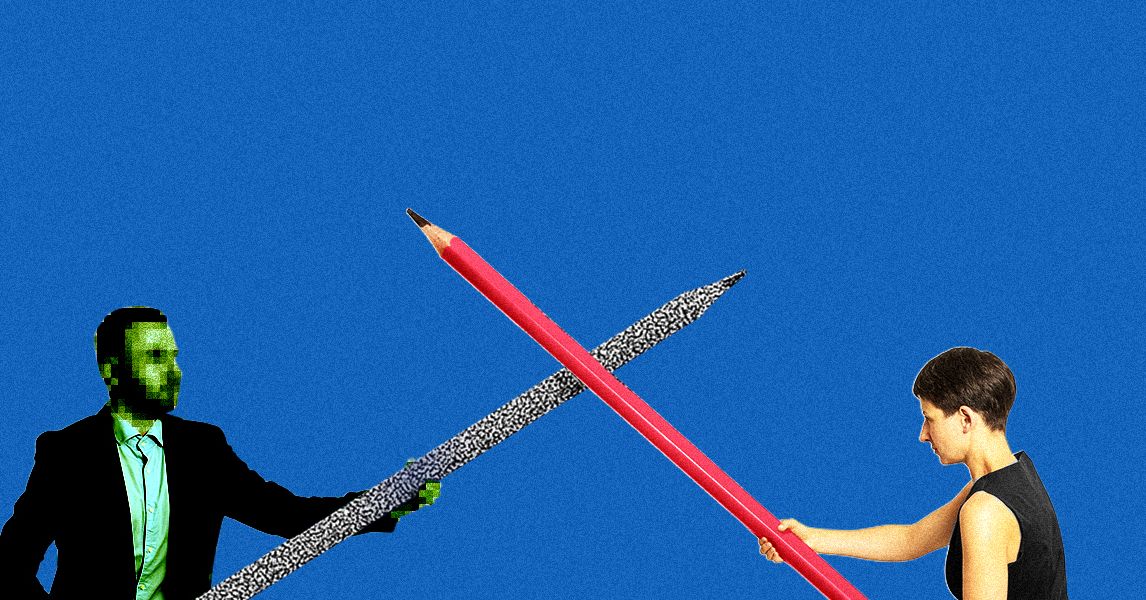
Writers across journalism, fiction, and social media are now deliberately adopting an "anti-AI" writing style characterized by typos, eccentric punctuation, first-person accounts, and resistance to formulaic patterns like em dashes and lists of three. The movement emerged as publishers and editors grew concerned about AI-generated content flooding inboxes and damaging author credibility—Playboy's editor received roughly 1,000 AI-generated pitches in May, and Hachette pulled a novel over AI fabrication allegations. Editors at major publications are now formally encouraging human-sounding, idiosyncratic prose; venture builder Ben Horwitz found that Fortune 500 CEOs opened only emails with misspelled subject lines when A/B-tested against polished ones, suggesting the shift reflects genuine market demand for authenticity.
Summaries like this, in your inbox every morning.
Sign up free →What happened
Across journalism, creative writing, and LinkedIn, writers are deliberately adopting a writing style that resists hallmarks of AI prose—avoiding em dashes, lists of three, passive voice, and mechanical phrasing in favor of typos, eccentric similes, first-person anecdotes, and idiosyncratic punctuation. Novelists like Laura Brooke Robson and editors at Pitchfork, Playboy, and Aeon have begun actively encouraging or enforcing this practice; venture builder Ben Horwitz launched an app called Sincerely (dubbed the "anti-Grammarly") that deliberately leaves typos and lowercase in emails, finding that Fortune 500 CEOs opened only the misspelled versions when A/B-tested.
Why it matters
The shift reflects growing industry anxiety about AI-generated content flooding publications and damaging authors' credibility. When Hachette pulled Mia Ballard's horror novel Shy Girl over AI fabrication suspicions and Philip Picardi received ~1,000 AI-generated pitches to Playboy in May, publishers realized they needed editorial signals of human authorship to stand out and maintain trust. The counterstyle may paradoxically reinstate the value of deliberate craft and good writing—something writing teacher John Warner argues AI might achieve by making poor writing detectable and creating incentive for improvement.
What to watch
As AI continues to improve, it may eventually be trained on the anti-AI writing patterns now emerging, forcing writers to invent new defensive styles. Jessye McGarry, a Clickhole writer, notes: "Whatever cosmetic counterstyle is created in response to AI, AI could mimic. The only true counterstyle is good writing."
The anti-AI writing movement began quietly among individual authors and editors but has now reshaped publishing practice across journalism, criticism, and social media. Novelist Laura Brooke Robson, who wrote *Love Is an Algorithm*—a love story between the cofounder of an AI dating app and a musician navigating the era of large language models—was an early exemplar of the shift. She deliberately crafted sentences she doubts she would have attempted before the widespread adoption of LLMs, avoiding what she calls "wishy-washy metaphors" and taking "a more winding path to avoid an em dash or a tripartite list." Robson describes the change as a deliberate inversion of what she perceives as AI's default lack of style: "I find myself writing less mechanically. I have this urge to make little mistakes, like winks to the reader, to show that there's a human behind the words. Like: What if I just invented a phrase? What if I did something unexpected with my punctuation?" She now predicts that "literary fiction will shift even further in the direction of the weird, the esoteric, while personalization takes hold of commercial fiction."
The shift gathered momentum as authors faced real credibility threats. In March, publisher Hachette pulled Mia Ballard's horror novel *Shy Girl* after online speculation that she had heavily used AI—a claim she rejected. Ballard has had to restrategize, emphasizing that "having my writing feel more real and authentic is my number one priority." She also claims she hired an editor who ran her book through AI software, contributing to her credibility crisis. Separately, Steven Rosenbaum's book *The Future of Truth*, which examined "how AI transforms reality," was accused of containing AI-generated quotations; Rosenbaum later admitted the allegations were true. These incidents created urgency in publishing. Philip Picardi, editor-in-chief of Playboy, opened the magazine's inbox to pitches in May and received roughly 1,000 submissions. After experimenting with Claude himself, he determined that the majority had been generated with AI. "The key thing from that experience that became really important to us at Playboy was that we needed first-person human experience," he says. He now encourages "more formally adventurous writing, thinking back to theorists like Foucault, or bell hooks, who challenged language just by refusing to capitalize her name. We want that kind of writing that AI can't replicate."
Editors across major publications have formalized the shift. Richard Fisher, an honorary professor at University College London and editor at online culture magazine Aeon, began encouraging writers "to be more human" and write more conversationally, noting that "AI cannot write prose as spiky or idiosyncratic as humans." Mano Sundaresan, who became Pitchfork's head of editorial content in July 2024 around the time LLMs became more mainstream, encouraged writers "towards their own voice" and since sent a memo stating that no AI may be used when filing review copy and encouraging first-person perspectives. The counterstyle has become most visible on LinkedIn and in experimental outlets like Clickhole, where writer Jessye McGarry published an article titled "5 Reasons to Love Summer (NO AI)" filled with typos and pleas that it was human-written—"When summer's here, you can finally shake off the winter blues and get out in the beaitiful sunshine!" McGarry later explained the misspelling was "a funny, exaggerated choice. It took more work to leave it in, because I had to undo the autocorrect."
Market evidence suggests the tactic works. Venture builder Ben Horwitz launched an app called Sincerely, which he dubs the "anti-Grammarly." The tool deliberately leaves typos in emails and signs messages off with "sent from my iPhone." When Horwitz A/B-tested standard emails against Sincerely-generated ones by sending them to Fortune 500 CEOs, only the emails with lowercase, misspelled subject lines were opened. "People now have a thirst for something different and for a lack of uniformity," Horwitz explains. Ray Slater Berry, founder of marketing agency dslx, now mandates first-person content across all projects and holds monthly meetings to recap AI trends and update an ever-expanding document ensuring their human-created copy never sounds like AI. Writing teacher John Warner's 2024 book *More Than Words: How to Think About Writing in the Age of AI* argues that rather than replacing writers, AI might reinstate the value of good writing and deliberate craft—the kind of excellence that makes poor AI-generated prose (like the typical five-paragraph student essay ChatGPT now produces) unmistakably inferior by comparison. Yet the counterstyle faces an inherent paradox: as anti-AI writing patterns proliferate and become identifiable, AI models may be trained on them, rendering the current defensive style obsolete. Jessye McGarry captures the tension: "Whatever cosmetic counterstyle is created in response to AI, AI could mimic. The only true counterstyle is good writing."
The emergence of anti-AI writing conventions reflects a broader reckoning in publishing and media about how to maintain human authenticity in an era of ubiquitous AI-generated text. The counterstyle developed not as a deliberate manifesto but as a gradual convergence of choices—writers like Laura Brooke Robson began making stylistic choices in inverse opposition to what they perceived as AI's mechanical defaults, while editors at outlets like Pitchfork and Playboy started issuing formal guidance to writers to embrace first-person perspectives and idiosyncratic voice. The movement crystallized around concrete incidents of credibility damage: Hachette's withdrawal of Mia Ballard's novel over AI fabrication speculation, Steven Rosenbaum's admission of AI-generated quotations in his book, and Playboy editor Philip Picardi's shock at receiving roughly 1,000 AI-generated pitches in a single month. These events created both urgency and a market signal—authenticity now carries competitive value. Ben Horwitz's finding that Fortune 500 CEOs opened only emails with deliberately misspelled subject lines suggests the market has begun to reward humanness precisely because AI optimizes away from it. At the same time, the counterstyle reveals a deeper tension: as writers and publications double down on quirk, typos, and idiosyncrasy as markers of human authorship, AI models may eventually be trained on these patterns themselves, rendering the current defensive style obsolete. Writing teacher John Warner's book argues that AI may inadvertently reinstate the value of good craft by making mediocre writing—the kind ChatGPT excels at—instantly recognizable and thus commercially weaker. The true risk, as Clickhole writer Jessye McGarry warns, is that "whatever cosmetic counterstyle is created in response to AI, AI could mimic."
AI-summarized, only the topics you pick — one digest a day via Email, Slack, or Discord.
Free · takes 30 seconds · unsubscribe anytime
No discussion yet for this article
Get curated AI news from 200+ sources delivered daily to your inbox. Free to use.
Get Started FreeFree · takes 30 seconds · unsubscribe anytime

