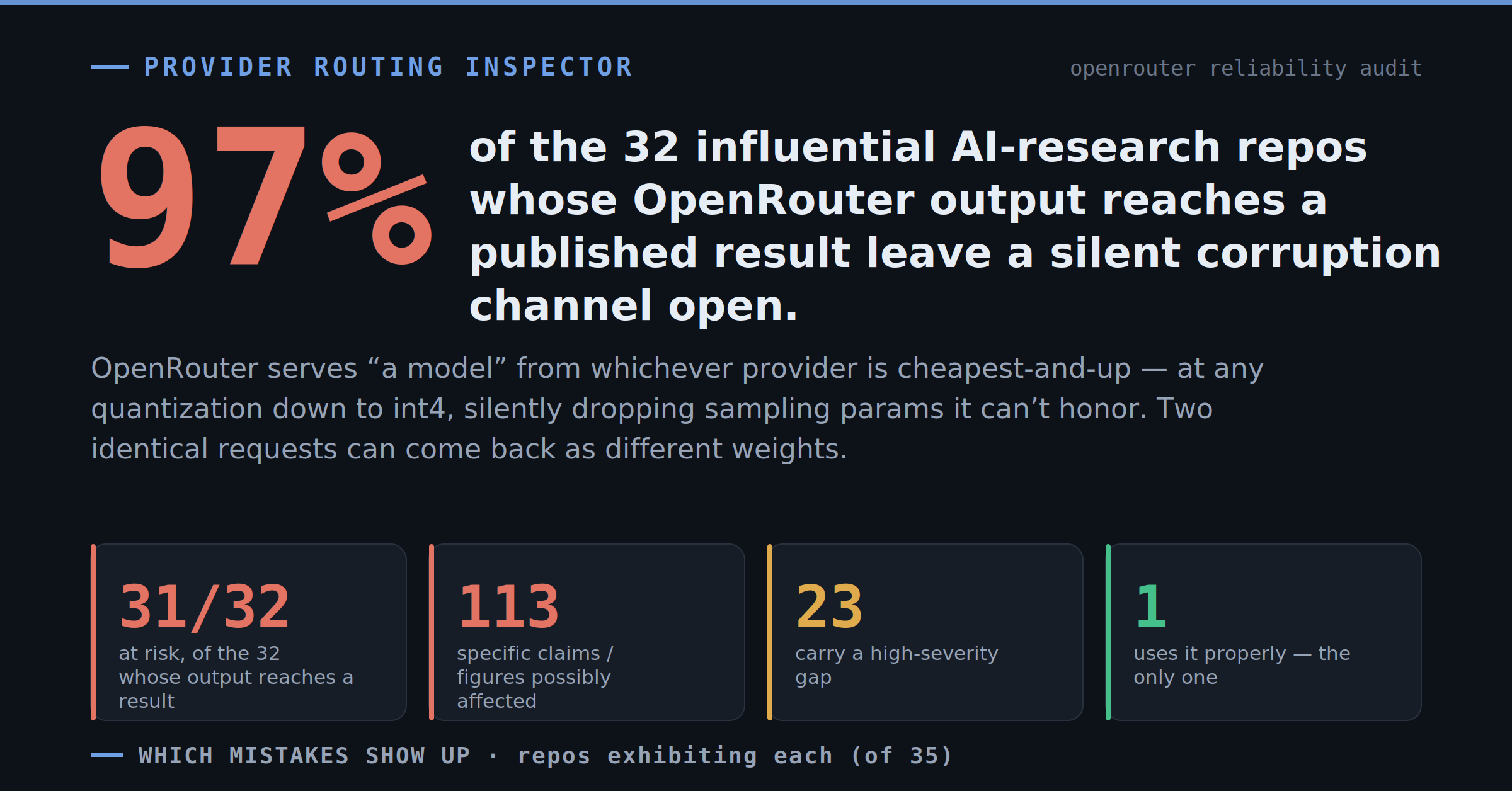
A review of 32 influential AI safety research codebases found that 97% use OpenRouter unsafely by not pinning to a specific provider, instead allowing requests to route randomly across providers of variable quality. This practice can corrupt results — prior NeurIPS work had its core findings entirely overturned by these issues. Researchers are urged to pin providers and fix this vulnerability in their codebases.
Summaries like this, in your inbox every morning.
Sign up free →What happened
A review of 32 influential AI safety research codebases found that 31 of them (97%) use OpenRouter without pinning their provider — meaning each API request is routed to a random available provider rather than a fixed, vetted one. OpenRouter providers vary in quality, and prior research shows this practice can corrupt results.
Why it matters
At least one NeurIPS-accepted AI safety paper had its core results entirely overturned by provider-quality issues. When researchers do not pin their provider, they risk their results being based on inconsistent or degraded model outputs, which threatens the integrity of safety research that often influences the field's technical direction.
What to watch
Researchers using OpenRouter or similar third-party providers are advised to pin a specific provider to minimize research risk, though the body notes current provider selection remains insufficient for ideal scientific reliability. Replicators should test whether reported results hold up once provider bugs are fixed.
OpenRouter is a third-party API broker that forwards model requests to multiple backend providers. When a researcher sends a request through OpenRouter without explicitly pinning a provider, the system routes that request to a random available provider. Because these providers operate with different infrastructure, update schedules, and quality levels, the same request can produce different outputs depending on which provider handles it on a given day. A comprehensive review of 32 influential AI safety research codebases that report results obtained through OpenRouter found that 31 of them (97%) do not pin their provider, leaving their reported results vulnerable to this variability. The stakes of this practice are high: the article cites precedent for an AI safety paper that was accepted to NeurIPS only to have its core results entirely overturned when provider-quality issues were identified. To protect research integrity, the article recommends that researchers using OpenRouter or similar third-party providers take precautions to ensure they pin to a specific, vetted provider rather than accepting random routing. However, the article notes that the current selection of providers is insufficient for ideal scientific reliability, meaning that pinning alone may not fully resolve the underlying risk. Replicators of published results are advised to test whether findings hold up once identified provider bugs are fixed, suggesting that some existing results may not replicate until this gap is addressed.
The review identifies a widespread methodological vulnerability in AI safety research: 31 of 32 influential codebases that rely on OpenRouter for their reported results fail to pin their provider choice. This matters because OpenRouter acts as a broker, routing each request to one of several backend providers without determinism. Since these providers exhibit variable quality, a research result obtained one day against Provider A may not replicate against Provider B, even if the model and prompt are nominally identical. The article notes that this risk is not theoretical — a prior NeurIPS-accepted paper in AI safety saw its core findings completely overturned when provider-quality issues were identified. The widespread nature of the gap (97% of codebases) suggests that many researchers may not be aware of the hazard or may underestimate its severity. The article acknowledges that while precautions are available, the current selection of providers is insufficient for ideal scientific reliability, indicating that even pinning a provider may not fully solve the underlying problem.
AI-summarized, only the topics you pick — one digest a day via Email, Slack, or Discord.
Free · takes 30 seconds · unsubscribe anytime
No comments yet. Be the first to share your thoughts!
Log in to join the discussion


Get curated AI news from 200+ sources delivered daily to your inbox. Free to use.
Get Started FreeFree · takes 30 seconds · unsubscribe anytime