What happened
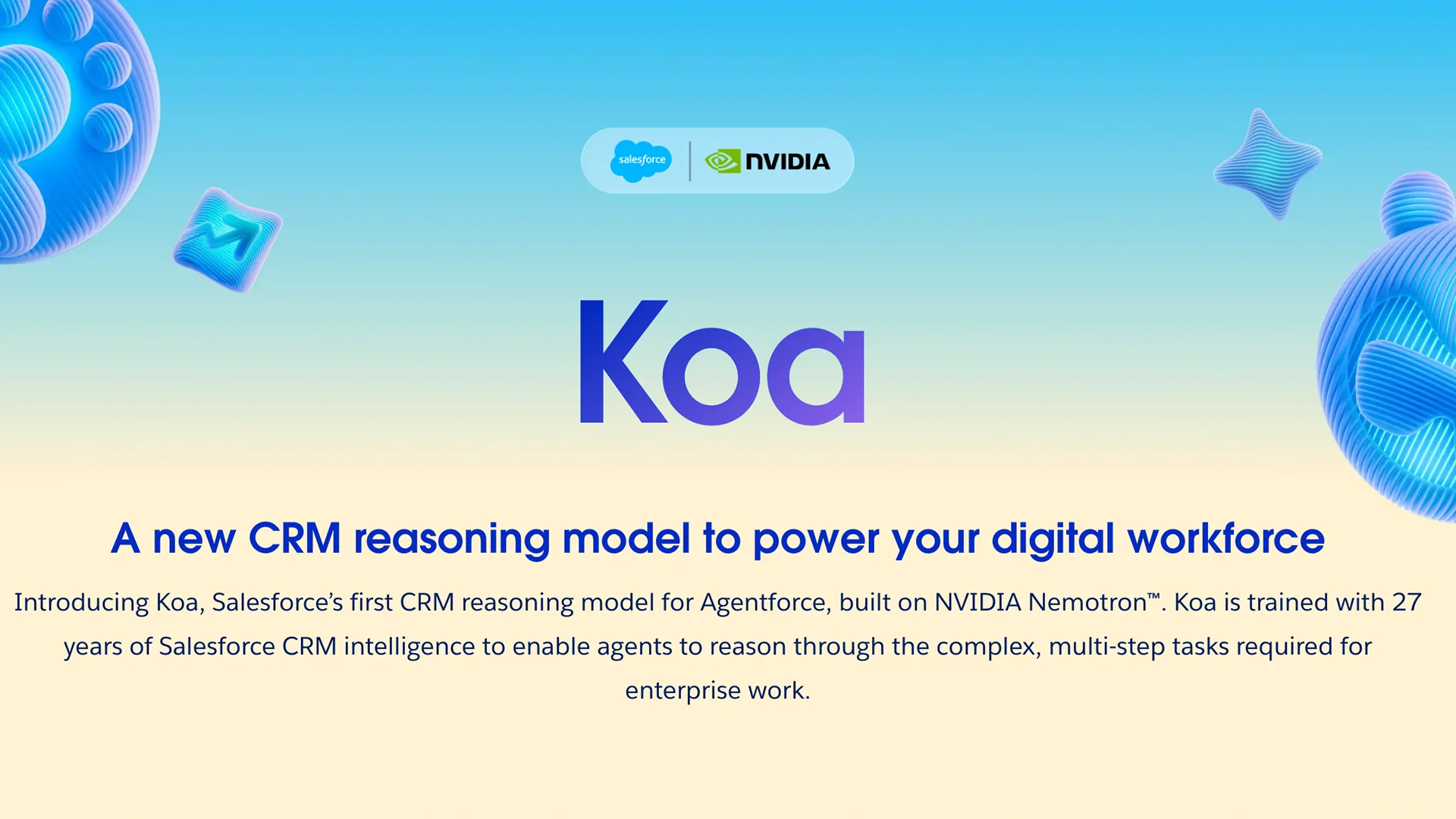
Salesforce introduced Koa on September 15, a reasoning model for sales and support agents built on Nvidia's open Nemotron 3 Super model. It already runs internally, is entering selected customer pilots, and is expected to reach U.S. general availability in winter 2026.
Why it matters
By serving Koa on its own systems, Salesforce may spend less on outside model capacity and gain leverage in negotiations with AI labs — but it also carries the serving cost, and the pilot leaves open how much agent reasoning it ultimately moves onto Koa.
What to watch
Salesforce's technical report gives Koa an average 0.86 on CRM Bench, below Claude Opus 4.8's 0.87 and GPT-5.5's 0.90, so the test is whether Koa completes deal updates and ticket routing correctly. Teams can compare response time, total serving cost, and permission failures before assigning it more work.
WHO IT HITSSales and support teams evaluating which agent handles deal updates and ticket routing are the first to test Koa, while Salesforce administrators gain model selection by organization or agent to run trials on selected workflows.
Ask the AI about this article →
Summaries like this, in your inbox every morning.
Salesforce's September 15 announcements place it on three sides of the same table. It sells AI software, it distributes rival models through its own products — Claude powers Agentforce Coworker and Slackbot by default — and now it fields its own reasoning model in Koa. The August 26 partnership announcement with Anthropic described the companies as strategic customers of each other, so the competitive framing coexists with a commercial one.
Koa is the piece that changes the arithmetic. Because Salesforce controls its version of the model and runs requests on its own systems, recurring sales and support reasoning can stay on infrastructure it governs, and its technical report benchmarks Koa at 0.86 on CRM Bench against 0.87 for Claude Opus 4.8 and 0.90 for GPT-5.5. AIforce pushes in the opposite direction, opening Salesforce's data, business logic, permissions, and actions to outside AI tools so a salesperson can work through Claude while Salesforce governs access and carries out changes to CRM records.
The near-tie on CRM Bench suggests the contest is less about raw capability than about cost and control. Whether Salesforce shifts more agent reasoning onto Koa likely hinges on how it performs on live deal updates, ticket routing, and handoffs, and on the total serving cost and permission-failure rates that selected customers record during the pilots — a question the winter 2026 general availability timeline leaves open.
For example, today's edition would include:
AI-summarized, only the topics you pick — one digest a day via Email, Slack, or Discord.
Free · 30 seconds with Google · unsubscribe anytimeWhat is AIToday? →
Ask AI anything about this article. Q&As are published on this page for other readers too.
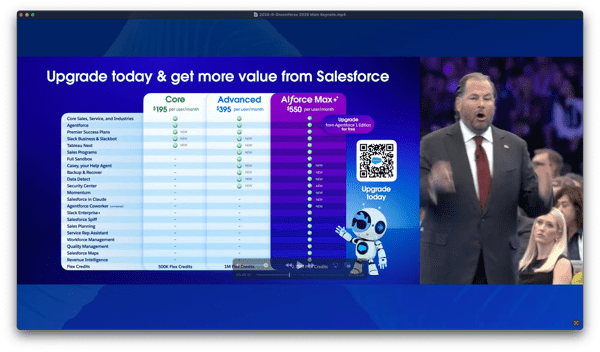
Salesforce is abandoning UI as a moat, per Stratechery
Nokia said its AI-RAN platform is advancing from evaluation to lab and live field trials at eight named operat…

Data Insights' August 2026 Crowding Report found no Magnificent Seven company saw long fund participation rise…

Diogo Almeida's TypeSafe launched Jev, a frontier model trained with RLCD that decides, classifies, routes and…
Flytrex introduced a rooftop docking system and AI-based fleet positioning in Dallas-Fort Worth and more than…

Thirty-five Chinese researchers, with authors tied to ByteDance, Tsinghua and Shanghai AI Lab, published "The…