What happened
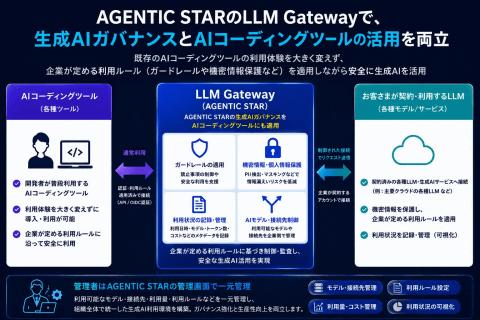
SoftBank announced on the 7th that it has begun deploying LLM Gateway as a standard feature in the SaaS version of AGENTIC STAR (its enterprise AI platform) starting in early August, with the feature being rolled out to existing customers as well.
Why it matters
LLM Gateway acts as a control point between AI coding tools that engineers use and the large language model (LLM) services companies subscribe to, letting enterprises apply governance rules—such as guardrails, restrictions on handling confidential or personal data, usage logging, and model access controls—without forcing developers to change how they work. This means companies can now enforce unified AI usage policies across departments instead of managing tools separately.
What to watch
LLM Gateway is included as a standard feature of AGENTIC STAR at no additional cost, so existing and new customers can apply these governance controls to AI coding tools immediately without purchasing extra options.
Summaries like this, in your inbox every morning.
AGENTIC STAR is SoftBank's platform designed to let enterprises safely deploy autonomous AI agents and generative AI tools. The core challenge for large organizations adopting AI coding assistants is balancing developer productivity with corporate governance—teams need consistent policies around data handling, cost control, and compliance, yet engineers want to keep using familiar tools without friction. LLM Gateway addresses this directly by inserting a managed control layer between the tools developers rely on and the underlying LLM services, decoupling the policy layer from the application layer. This is particularly important because AI coding tools have become widely adopted, but many enterprises lack visibility into which LLM services they connect to, how much they cost, and whether sensitive data is being transmitted properly. By making LLM Gateway standard rather than optional, SoftBank removes the friction of negotiating add-ons and signals that governance is a baseline expectation, not an afterthought. The announcement reflects a broader industry shift: as generative AI moves from experimentation to production use, the bottleneck is no longer capability but trust and control.
Pick your industry and the AI tools you use, and get news related to your work every day.
Free · 30 seconds with Google · unsubscribe anytimeWhat is AIToday? →
Ask AI anything about this article. The AI reads this article, earlier AIToday articles, and Wikipedia, and cites its sources. Q&As are published on this page for other readers too.
Google Deepmind's Gemini 4 Argon scored 97.5 percent on ARC-AGI-3 at a cost of $4,800, second only to GPT-6 As…

Cammarata reinterprets InceptionV1's cat-car neuron as a V-shape detector, not two unrelated concepts

Microsoft's Surface Laptop Ultra, using Nvidia's RTX Spark platform, starts at $2,599 (up to $5,899)

Meta's new commercial terms, effective October 30th, appear to let it crawl and train AI on content from websi…

Vercel data published Thursday shows TypeSafe AI's Jev, a lightweight decision model for choosing among predet…

Reflection AI introduced Beam, an open-weight model for agentic coding and long-horizon tasks, with 501 billio…


