What happened
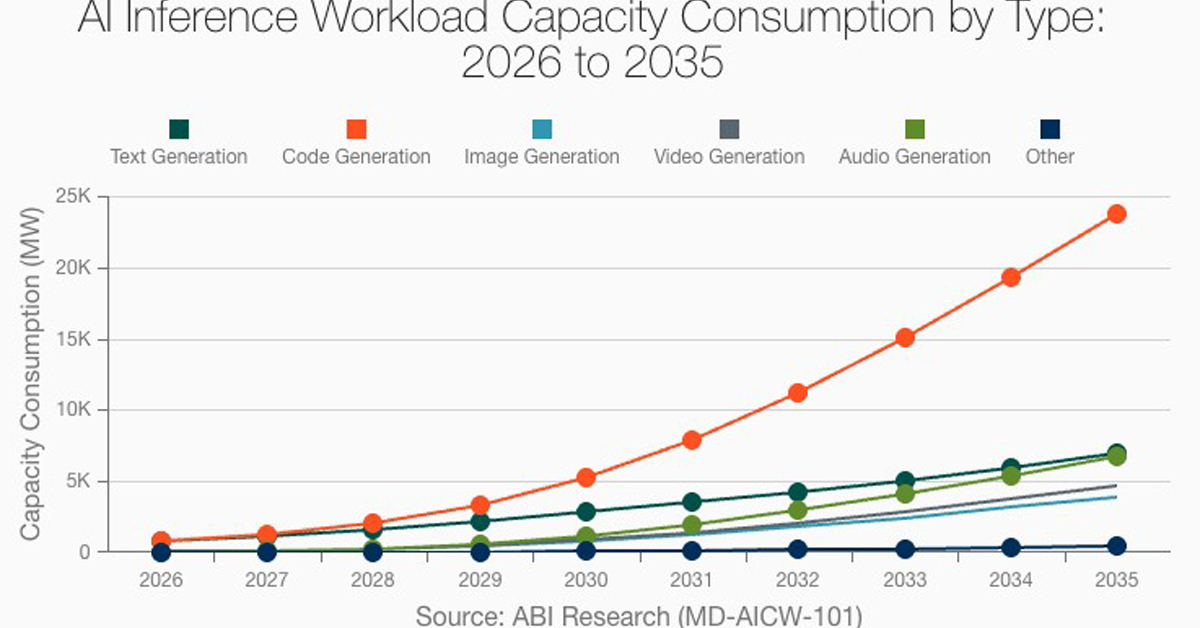
ABI Research projects that AI inference data center power demand will grow from 2GW in 2026 to 46GW by 2035, with code generation becoming the largest workload.
Why it matters
Code generation workloads are expected to grow at a 52% CAGR, reaching 23.6GW by 2035—over half of all AI inference power. This shift highlights the rapid expansion of inference-specific infrastructure.
What to watch
The market is consolidating, with players like CoreWeave and Qualcomm acquiring companies such as Weights & Biases and Modular. Open-source model adoption is projected to rise from 35% in 2025 to 55% by 2026.
Summaries like this, in your inbox every morning.
The report from ABI Research signals a fundamental shift in AI infrastructure: as models move from training to inference, power demand is expected to grow dramatically, from just 2GW in 2026 to 46GW by 2035. The rapid growth of code generation workloads, with a 52% CAGR, underscores the increasing reliance on AI for software development, a trend that will reshape data center planning and energy consumption.
The market is consolidating as major players seek to expand their capabilities. CoreWeave and Qualcomm, among others, have made acquisitions to strengthen their positions, while open-source model adoption is projected to rise from 35% in 2025 to 55% by 2026, driven by cost and flexibility concerns. These moves highlight the competitive dynamics as companies race to capture a growing market.
The report also points to challenges ahead, including the need for specialized hardware, the risk of over-reliance on AI-native startups, and the push toward edge computing to reduce costs and latency. As AI inference becomes a larger part of overall AI spending, these factors will shape the industry's evolution over the next decade.
Pick your industry and the AI tools you use, and get news related to your work every day.
Free · 30 seconds with Google · unsubscribe anytimeWhat is AIToday? →
Ask AI anything about this article. The AI reads this article, earlier AIToday articles, and Wikipedia, and cites its sources. Q&As are published on this page for other readers too.
The Motley Fool argues Amazon is the AI company of the two, since AWS was just 21% of first-half 2026 revenue…

Hewlett Packard Enterprise stock is down 5% at $55.87
Vercel data published Thursday shows TypeSafe AI's Jev, a lightweight decision model for choosing among predet…
Reflection AI introduced Beam, an open-weight model for agentic coding and long-horizon tasks, with 501 billio…
Chunghwa Telecom president Rong-shy Lin said the shift from conversational AI to autonomous AI agents is resha…
CoreWeave fell 5% in premarket trading Friday and was on track to finish the week down 15%, after rebounding f…