What happened
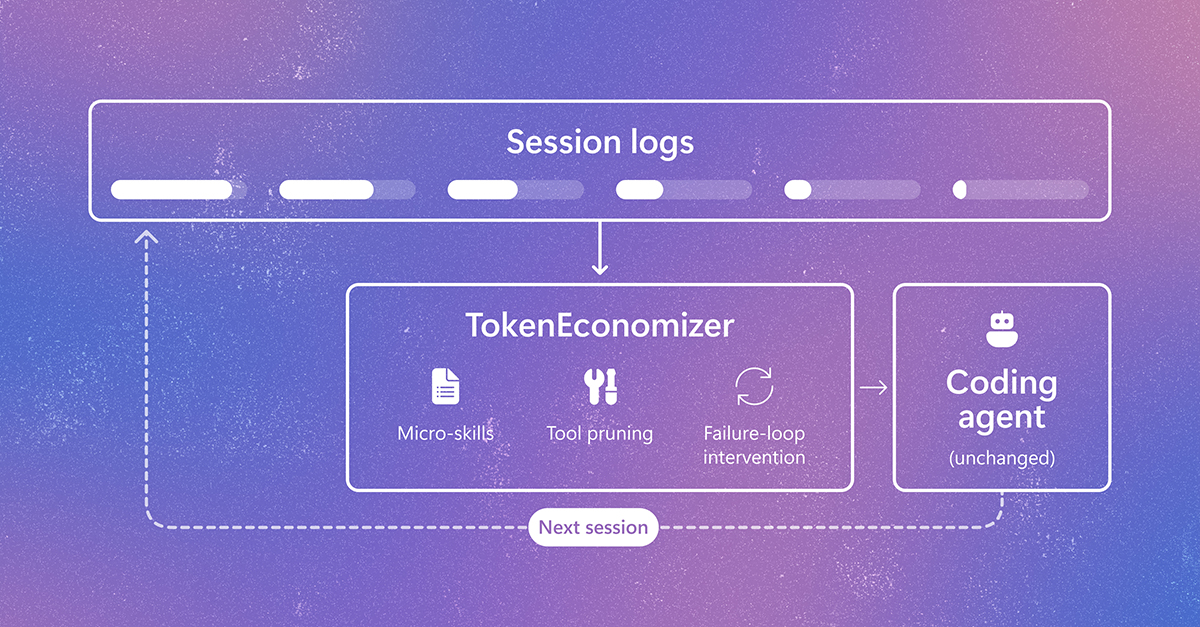
TokenEconomizer, an open-source plugin from UC Berkeley, Microsoft Research and Microsoft Security, lowered average cost per task by 18.4–30.9% across 277 SWE-Bench tasks and five agent–model combinations, saving the most in all 30 repository-combination pairs.
Why it matters
That range comes with task success rates described as broadly stable, so the savings do not appear to come at the expense of getting the bug fixes done — though the body notes early tasks can cost more while the plugin learns.
WHO IT HITSDevelopers and engineering teams running AI coding agents like Claude Code on recurring repositories stand to cut model-spend per task, with savings compounding as session history accumulates.
Summaries like this, every morning.
The plugin's design is a response to how AI coding agents actually spend tokens: repeatedly rediscovering the same repository facts, loading tool descriptions they never call, and burning turns on the same failure. Profiling Claude Code on 60 SWE-Bench tasks, the researchers found 30% of tool calls repeated an earlier action once a repository had at least five completed tasks, 16 of 23 tool descriptions were never called, and the 17% of tasks that failed accounted for 32% of spending.
Their conclusion was that a fixed cost-saving strategy does not travel well: three popular open-source plugins each lowered costs in some repositories but not others. TokenEconomizer instead adapts per repository, updating its knowledge after every session. Savings grew as experience accumulated, and the approach carried over to sequential web development (16.0–21.2% lower on Web-Bench) and to security auditing, where every task is in a new repository, at 6.4–19.6% lower.
The body also offers a comparison point for how the savings were achieved. Lowering the model's reasoning effort saved similar or larger amounts but led to substantial performance degradation, whereas TokenEconomizer reports no performance loss — which is likely why the team frames it as a way to make agents spend computation more effectively rather than simply spend less.
Pick your industry and the AI tools you use, and get news related to your work every day.
Free · 30 seconds with Google · unsubscribe anytimeWhat is AIToday? →
Ask AI anything about this article. The AI reads this article, earlier AIToday articles, and Wikipedia, and cites its sources. Q&As are published on this page for other readers too.
NSSOL announced on September 28, 2026 that it signed a strategic partnership with Anthropic on September 18 —…

Nikkei xTECH published a beginner-oriented, step-by-step tutorial on implementing an approval-request function…

Felix Rieseberg, who works on Claude at Anthropic, said on X that Claude can now build "bizarre & beautiful si…

The FSTab study analyzed 1,050 generated programs from six coding models using CodeQL and Semgrep, then predic…

A US university student studying with AI published a measured record of saving Claude Code quota within a mont…

The developer behind MultiRoleChat and MultiRoleStudio added Sakura's AI Engine to their app and ran a same-mo…