What happened
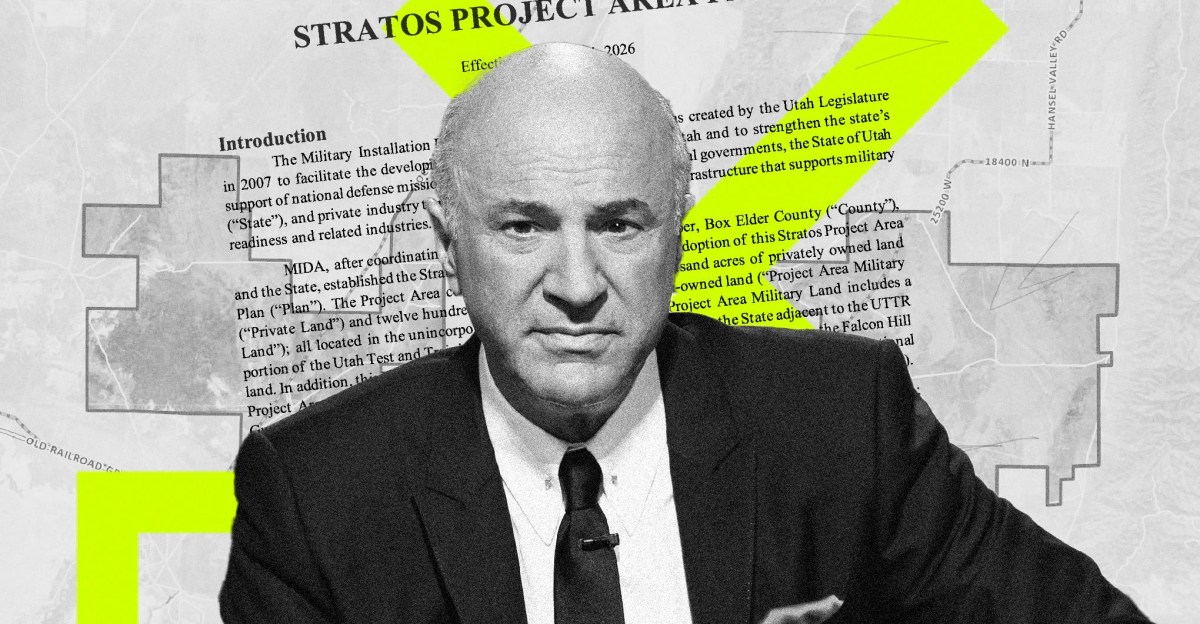
Kevin O'Leary announced Stratos, a 40,000-acre, nine-gigawatt AI campus in Utah, as the world's biggest data center. Residents only learned of it in late April, after the state agency MIDA approved it and the county consent came under fire.
Why it matters
The backlash was so severe it wounded the project, toppled local officials and the MIDA chair, and showed that local democracy is the one obstacle the AI infrastructure buildout cannot spend its way past.
What to watch
The project is not dead — activists' referendum was rejected and is now being litigated, with everyone paused until that resolves. Watch whether Stratos regains momentum, given the activated opposition and scrutiny it now faces.
WHO IT HITSCounty commissioners and state lawmakers now face activated local opposition to data center projects, and hyperscalers and speculative developers pursuing fast approvals may find residents and regulators increasingly unwilling to wave deals through.
Summaries like this, in your inbox every morning.
The Stratos story began months before most Utahns had any idea anything was happening. Only a handful of people — some property owners in the remote valley, a few state officials at the Military Installation Development Authority, and some real estate developers — knew about the plan. Kevin O'Leary began asking around at the state level in early January, and the project was passed from the governor's office to MIDA, a state development agency that can override local land use and act as the municipal government in whatever project area it establishes. But by the time O'Leary was talking about it on Fox in late April, MIDA had approved it while the county — whose consent was needed — had not even been told.
Dzieza's reporting draws a parallel to the Foxconn project in Mount Pleasant, Wisconsin, where residents' hopes for a giant LCD factory were never realized. In Utah, the reaction was the opposite: rather than hope, people brought anger and fear. Social media is full of data center backlash stories, so people heard "data center" and knew broadly what was coming. What made Stratos different, Dzieza found, was that there were no pros to weigh against the costs — no excitement about jobs in an agricultural community, and no nostalgia for manufacturing. An activist told him data centers are the most unifying issue in politics right now, because there is something for everybody to hate.
The project has been wounded but is not dead. After local activists filed a referendum to repeal the county's consent, the county rejected it and the matter is now being litigated, with everyone paused until it resolves. Because the data center race is all about speed, the project no longer has the momentum it once had. Whether Stratos recovers may hinge on that litigation and on whether an activated activist network, scrutinizing lawmakers and regulators, makes the project too unpopular for anyone to want to be associated with.
Pick your industry and the AI tools you use, and get news related to your work every day.
Free · 30 seconds with Google · unsubscribe anytimeWhat is AIToday? →
Ask AI anything about this article. The AI reads this article, earlier AIToday articles, and Wikipedia, and cites its sources. Q&As are published on this page for other readers too.
Arceus Legal disclosed a $17 million round led by Greycroft LP, with Craft Ventures Management and South Park…

Meta's rapid rollout of its Muse AI agent is serving as an early test of how agentic AI reshapes server infras…

In the Loop host Ejaaz Ahamadeen broke down what Anthropic's (ANTH.PVT) leaked S-1 filing actually covers, and…

The 2026 UK Business Data Survey shows just 12% of AI-using manufacturers have fully integrated AI into busine…

Anthropic launched Claude for Government for US federal and state civilian agencies
Halluminate raised $30 million in a Series A led by Oak HC/FT, bringing total funding to $38.5 million, and CE…