AIToday

Robot simulation becomes core to AI training as GPU physics engines scale

Hacker News11h agoSend on LINE
Robot simulation becomes core to AI training as GPU physics engines scale

Key takeaway

Robot simulation has become essential to training physical AI systems because robotics lacks the large internet-scale datasets that language models use. Modern GPU-accelerated simulation frameworks like NVIDIA Isaac Lab 3.0, MuJoCo Warp, and Newton now let developers generate thousands of hours of robot experience in parallel environments, replacing expensive and risky real-world data collection. This shift has turned simulation from a debugging tool into a foundational part of the AI training pipeline for robotics and embodied AI.

Summaries like this, in your inbox every morning.

Sign up free →

3 Key Points

  • What happened

    Simulation has shifted from a tool for debugging and visualization to a central part of training physical AI systems. Modern frameworks like NVIDIA Isaac Lab 3.0, MuJoCo Warp, and Newton now enable developers to generate thousands of hours of robot experience by running parallel simulated environments on GPUs, replacing costly and risky real-world data collection.

  • Why it matters

    Robotics and physical AI systems lack the internet-scale datasets available to language models. Simulation bridges this gap by allowing developers to generate photorealistic, physically grounded training data at a fraction of the cost of real-world collection. Teams now use simulation to train reinforcement learning policies, generate perception datasets, collect demonstrations, and test policies against rare scenarios—making it foundational rather than optional.

  • What to watch

    The ecosystem is fragmenting across specialized engines: MuJoCo excels at contact-rich physics and model accuracy; Isaac Lab and Isaac Sim focus on GPU-accelerated throughput and photorealistic rendering; Newton (developed by NVIDIA, Google DeepMind, and Disney Research) offers multiple solver backends for different physical systems. The open question for 2026 is which components will become shared infrastructure across engines rather than which engine runs fastest.

In Depth

Robotics simulation has undergone a quiet but fundamental transformation in recent years. Historically, simulators were peripheral tools—used to debug geometry, test controllers, or visualize robot motion before hardware deployment. Today, simulation is part of the core model development loop. Teams use it to generate perception datasets, train reinforcement learning policies, collect demonstrations, augment real-world data, benchmark models, and test policies against rare or adversarial scenarios.

This shift stems from a hard technical constraint: data availability. While large language models and vision-language models can be trained on internet-scale datasets, robotics and physical AI systems lack this advantage. A robot must learn the consequences of physical interaction—what happens when a cup slips, a cable bends, or a gripper contacts an object at the wrong angle. Collecting such data in the real world is slow, expensive, risky, and sometimes impractical due to task destructiveness. Simulation bridges this by enabling developers to generate large amounts of photorealistic, physically grounded data. By teleoperating robots in simulation and scaling data collection through GPU parallelism, developers can generate thousands of hours of robot experience at a fraction of the cost of real-world collection.

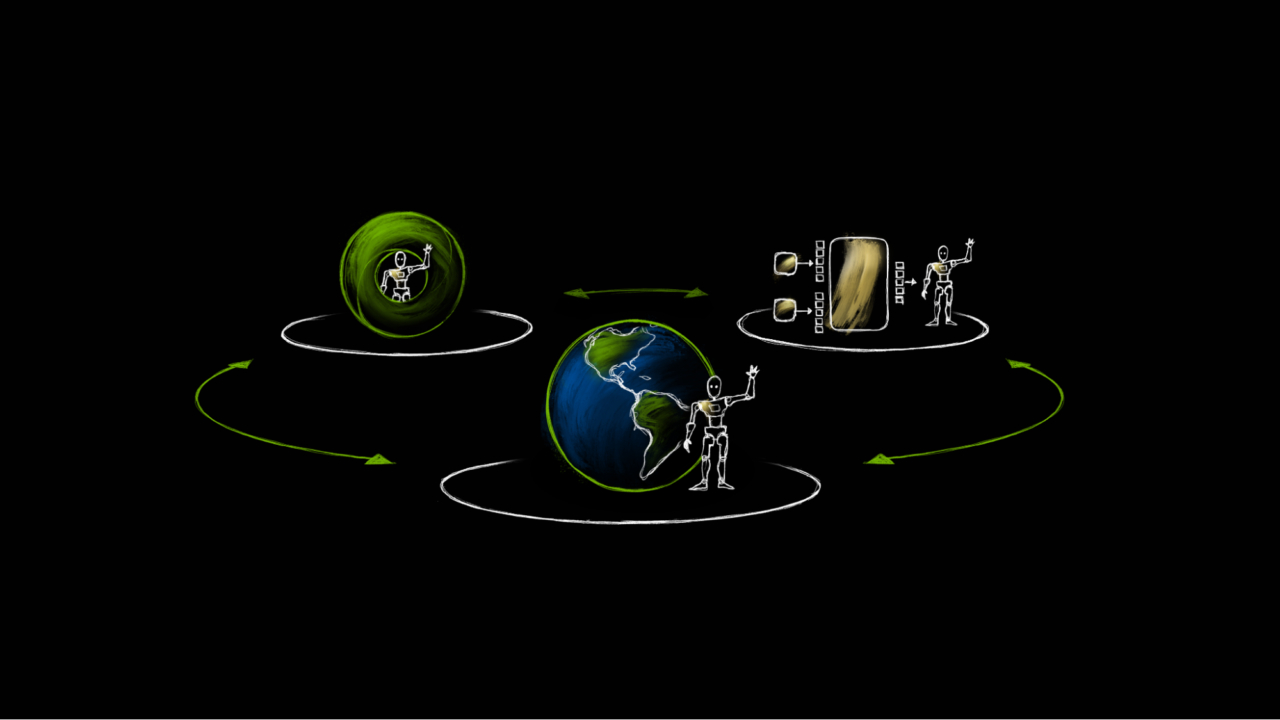
Modern simulation operates across a three-computer paradigm: a training computer (a large GPU cluster for processing data and training foundation AI models), a simulation computer (a GPU workstation or cluster using GPU-accelerated physics and RTX rendering to generate robot experience), and an on-robot computer (an edge device such as an NVIDIA Jetson AGX Thor-class system that runs the trained policy during deployment). Each computer plays a different role depending on the task's latency, throughput, accuracy, and deployment requirements.

The article surveys the major simulation engines available today. MuJoCo (Multi-Joint dynamics with Contact) is a fast, accurate, open-source physics engine designed for robotics, biomechanics, and reinforcement learning, emphasizing speed, accuracy, and modeling power where physical correctness matters. While not optimal for photorealistic rendering or massive GPU-parallel simulation, MuJoCo is known for a deterministic pipeline, well-defined inverse dynamics with contacts, strong contact modeling, and generalized-coordinate simulation. MuJoCo Warp (MJWarp) is a GPU-accelerated implementation written in NVIDIA Warp, a Python framework for high-performance CUDA-accelerated differentiable kernels. It brings MuJoCo-style physics into a batched GPU setting, suited for reinforcement learning and large-scale policy training. Compared with classic CPU MuJoCo, MJWarp prioritizes throughput over single-step latency and is designed to simulate many worlds in parallel, reduce CPU-GPU transfer bottlenecks, and scale contact-heavy robot tasks for learning workloads.

NVIDIA Isaac Sim is an open-source robotics simulation framework built on NVIDIA Omniverse, using OpenUSD as its core scene and data layer. It provides high-fidelity physics through PhysX, photorealistic RTX rendering, and robotics-focused sensor simulation for cameras, depth, lidar, radar, and segmentation, enabling synthetic data generation workflows. NVIDIA Isaac Lab 3.0 is a GPU-accelerated, agent-ready simulation framework for robot learning, supporting reinforcement learning, imitation learning, motion planning, data collection, and policy evaluation. Critically, Isaac Lab 3.0 decoupled from the Isaac Sim and Omniverse dependency, becoming a lightweight, multi-backend framework. Developers can select Isaac Sim with PhysX and RTX rendering for photorealistic, sensor-rich workflows, or run lightweight headless Newton physics for high-throughput simulation, and can add photorealistic sensors via a standalone OVRTX renderer or leverage Newton for vision-based reinforcement learning.

Newton is an open-source, GPU-accelerated, extensible, and differentiable physics engine developed by NVIDIA, Google DeepMind, and Disney Research, and managed through the Linux Foundation. Built on NVIDIA Warp and OpenUSD, it integrates MuJoCo Warp as a key physics backend. In the broader ecosystem, Newton acts as a modern physics layer for robot learning frameworks such as Isaac Lab and MuJoCo Playground, offering multiple solver implementations: SolverMuJoCo and SolverFeatherstone use generalized coordinates for articulated rigid-body systems; SolverSemiImplicit, SolverXPBD, and SolverKamino use maximal-coordinate formulations; SolverVBD is an implicit solver supporting rigid bodies, particles, cloth, and soft bodies; SolverImplicitMPM targets particle-based continuum materials; and SolverStyle3D specializes in cloth simulation. Capabilities differ between solvers in support for articulations, deformable bodies, contacts, and differentiation, so the appropriate solver depends on the physical system being modeled.

Other engines remain useful for specific niches: PyBullet serves as a CPU baseline for quick prototyping; DART and ODE remain Gazebo backends; Drake is the gold standard for contact-implicit trajectory optimization and rigorous numerics when throughput is not the primary goal. However, as the article notes, none of them answers the question "I need 4,096 humanoids on one GPU." The conversation in 2026 has shifted from "which engine performs fastest" to a deeper architectural question: which pieces of the stack are likely to become the shared infrastructure that different engines would build on top of. The article observes that the ecosystem is fragmenting as this question remains open, with candidates like OpenUSD and modular solver backends appearing plausible paths toward standardization.

Context & Analysis

The shift from real-world robot training to simulation-first development reflects a fundamental constraint in physical AI: data scarcity. Unlike large language models, which benefit from billions of internet texts, robotics systems must learn interaction dynamics that are expensive and dangerous to collect in physical form. Simulation removes this bottleneck by enabling parallel GPU execution—a single GPU can run thousands of virtual robot environments simultaneously, compressing months of real-world experimentation into days of computation.

The ecosystem's fragmentation across multiple engines reflects the diversity of robotics tasks. MuJoCo has long been the standard for physics accuracy and contact modeling because its design prioritizes correctness over visual realism. The emergence of GPU-accelerated alternatives like MuJoCo Warp and Newton reflects the new requirement: frameworks must scale to thousands of parallel simulations while maintaining physical fidelity. Isaac Lab's 2025 architectural split—separating physics backends from the learning framework—signals a maturation toward modularity: developers no longer choose one engine for all needs, but compose backends (PhysX for photorealism, Newton for throughput, MuJoCo for contact precision) depending on their task.

The open technical question for 2026 is standardization. As the article notes, the field is asking not "which engine is fastest" but "which components become shared infrastructure." This suggests convergence toward standards like OpenUSD (Pixar's scene description format) and abstraction layers that let different physics solvers plug into the same learning framework—a maturation pattern seen in graphics (where abstraction layers sit atop DirectX, Vulkan, Metal) and deep learning (where high-level frameworks abstract over CUDA, ROCm, etc.).

FAQ

Why can't robot AI be trained the same way as language models?
Robotics and physical AI systems lack the advantage of internet-scale datasets. To train a physical AI system, a robot must learn the consequences of interacting with the physical world—understanding what happens when a cup slips, a cable bends, or a gripper contacts an object at the wrong angle. Collecting this data in the real world is slow, expensive, risky, and sometimes impractical due to the destructive nature of the tasks.
What are the main simulation engines for robot learning?
Popular options include MuJoCo (emphasizing precise dynamics and contact modeling), MuJoCo Warp (GPU-accelerated for large-scale policy training), NVIDIA Isaac Sim (photorealistic rendering with PhysX physics), and Newton (an open-source GPU-accelerated engine developed by NVIDIA, Google DeepMind, and Disney Research with multiple solver implementations). Each targets different use cases and trade-offs between speed, accuracy, and visual fidelity.
What changed in Isaac Lab 3.0?
Isaac Lab 3.0 decoupled from the Isaac Sim and Omniverse dependency, becoming a lightweight, multi-backend robot learning framework. Developers can now choose Isaac Sim with PhysX and RTX rendering for photorealistic workflows, or run lightweight headless Newton physics for high-throughput simulation, and can add photorealistic sensors via a standalone OVRTX renderer or use the Newton renderer for vision-based reinforcement learning tasks.

Get the latest Robotics news every morning

AI-summarized, only the topics you pick — one digest a day via Email, Slack, or Discord.

Free · takes 30 seconds · unsubscribe anytime

Discussion

No comments yet. Be the first to share your thoughts!

Log in to join the discussion

Related Articles

Stay ahead with AI news

Get curated AI news from 200+ sources delivered daily to your inbox. Free to use.

Get Started Free

Free · takes 30 seconds · unsubscribe anytime