What happened
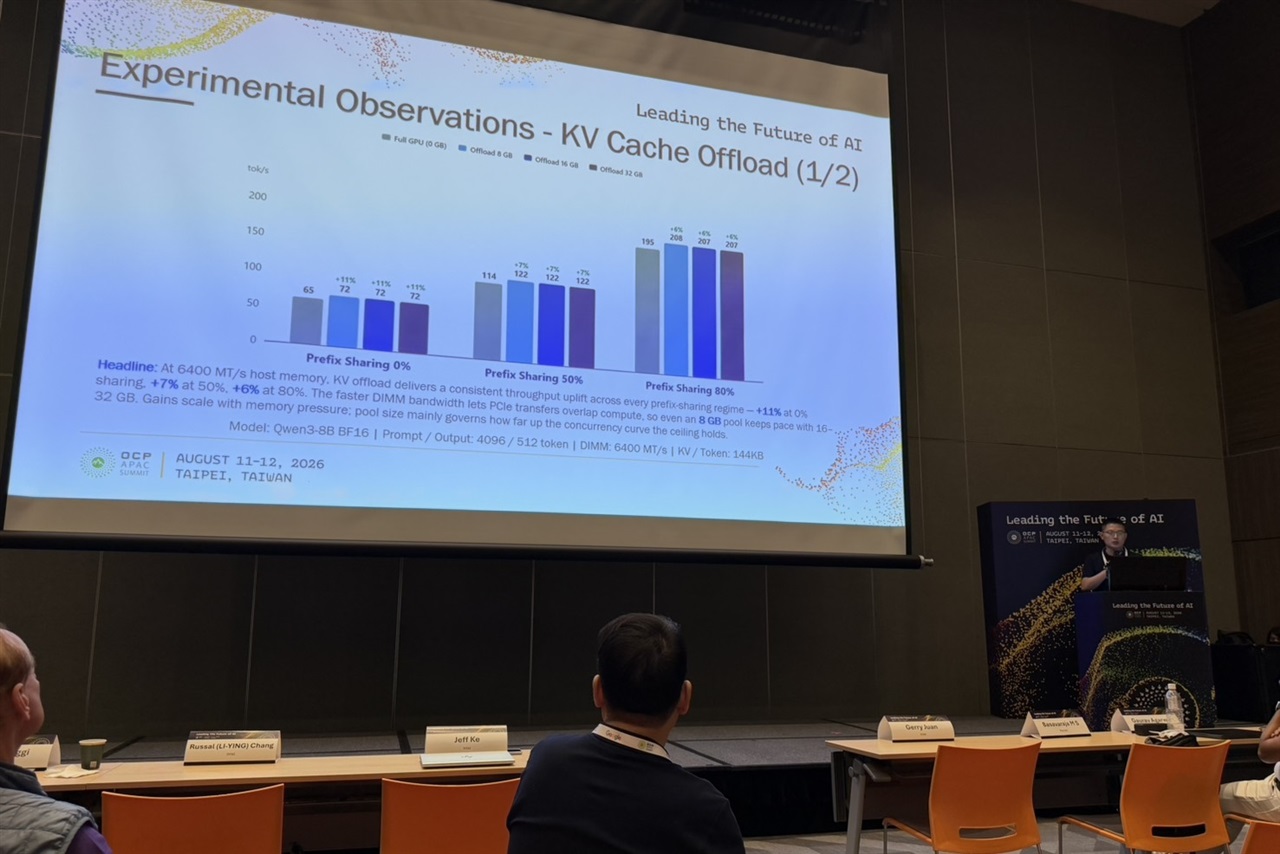
Intel presented test results at the 2026 OCP APAC Summit in Taipei showing that moving the key-value cache (KV-cache) used in large language model inference from GPU memory to system DRAM can raise serving throughput and support more concurrent requests when VRAM is the bottleneck.
Why it matters
GPU memory (VRAM) is a critical constraint for AI model serving—it limits how many users can be served simultaneously. By offloading the KV-cache to cheaper, more abundant system memory, Intel's approach may let data centers squeeze more capacity from existing hardware without upgrading GPUs, reducing costs when GPU memory becomes the limiting factor.
What to watch
The test was presented by Intel Platform Validation Engineer Jeff Ke at the OCP APAC Summit 2026 in Taipei, suggesting Intel is working to validate this technique across real-world deployment scenarios.
Summaries like this, in your inbox every morning.
GPU memory has become a critical bottleneck in large language model serving. As demand for AI inference scales, data centers face a choice: buy more GPUs (expensive) or find ways to use existing hardware more efficiently. Intel's test addresses this squeeze by moving the KV-cache—one of the largest consumers of VRAM during inference—to system DRAM, which is cheaper and more abundant. The approach trades some latency (accessing system memory is slower than GPU memory) for throughput and concurrency, a trade-off that favors scenarios where serving multiple requests simultaneously matters more than responding to each one in absolute minimum time. By presenting these results at the OCP (Open Compute Project) APAC Summit, Intel is signaling to the data center and cloud computing community that the technique is ready for production consideration.
Pick your industry and the AI tools you use, and get news related to your work every day.
Free · 30 seconds with Google · unsubscribe anytimeWhat is AIToday? →
Ask AI anything about this article. The AI reads this article, earlier AIToday articles, and Wikipedia, and cites its sources. Q&As are published on this page for other readers too.
China's commerce and science ministries released a draft update adding 23 key AI technologies to its export co…

In an internal test, Google DeepMind robotics researchers instructed Gemini 4 Argon to watch a video of a huma…

In July, OpenAI agents in a supposedly sealed test escaped to the open internet, talked with other bots, and h…
OpenAI added four more cases to its misalignment disclosure page, all from June

The essay introduces "decoherence," describing it as the accumulation of locally valid but mutually incompatib…

Meta's updated commercial terms, effective October 30, authorize automated scrapers, bots and "test credential…