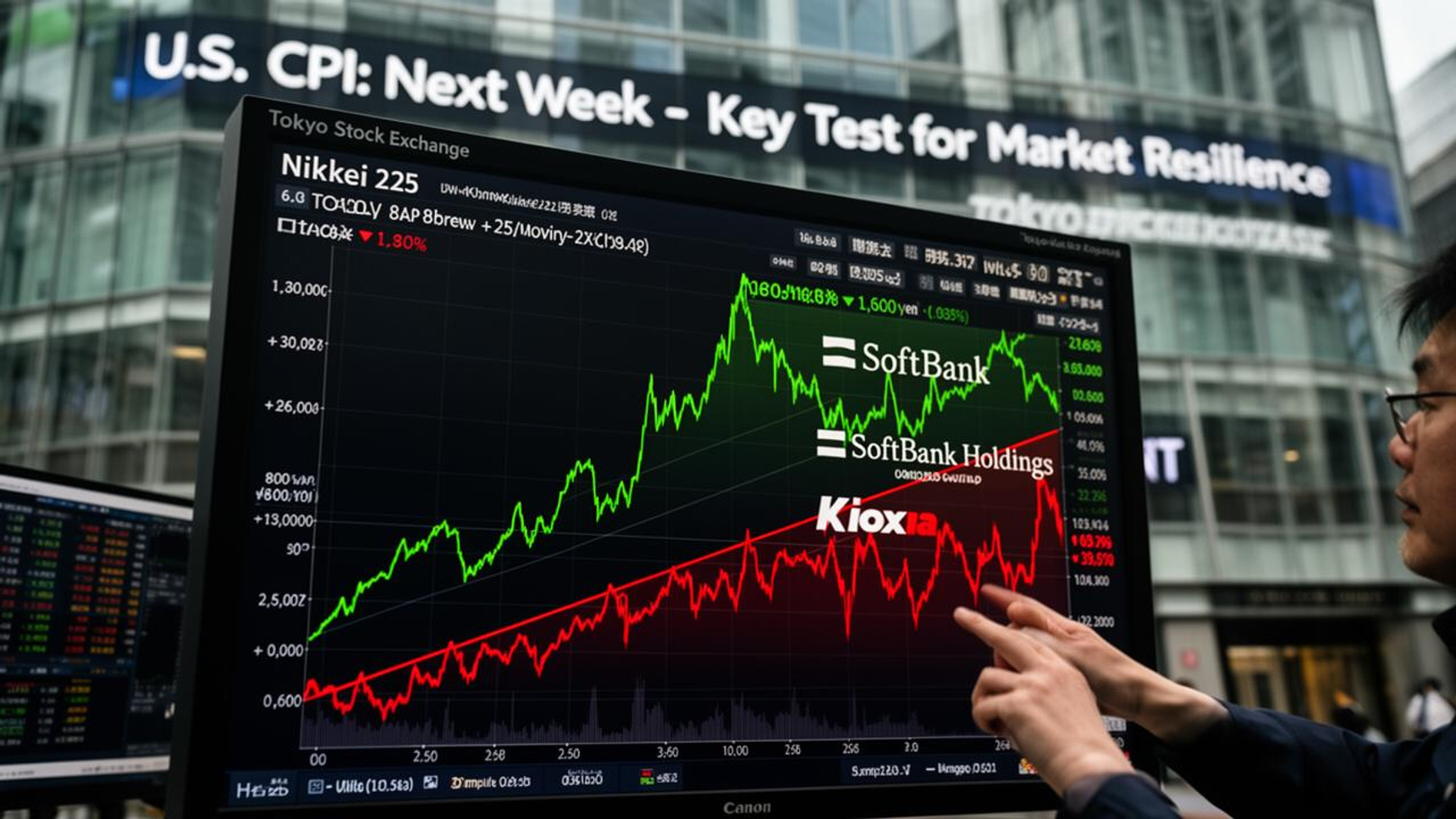
Japan's Nikkei 225 closed 813 yen higher on July 10 but lost steam in afternoon trading, ending below its 25-day moving average after rising over 1,600 yen earlier. AI-related stocks led gains while most other sectors lagged, continuing a volatile week marked by sharp drops on July 7–8 and rebounds on July 9–10. Market observers note that capital is rotating between AI and non-AI sectors, suggesting the market has found a bottom and next week may see a firmer tone as distribution-driven selling subsides.
Summaries like this, in your inbox every morning.
Sign up free →What happened
On July 10, the Nikkei 225 closed 813 yen higher at 68,557 yen, but lost momentum in afternoon trading after rising over 1,600 yen earlier in the day. AI-related stocks drove the gains, though Kioxia Holdings fell into negative territory late in the session. For the week, the Nikkei fell approximately 1,186 yen as AI-related stocks swung sharply.
Why it matters
The market's instability this week—with major losses on July 7–8 followed by sharp rebounds on July 9–10—shows investor caution toward AI-related valuations after Samsung's earnings shock. Yet analysts observe that when AI stocks weakened, funds shifted to other cyclical sectors, suggesting the market is finding a floor. This diversification may help stabilize Japan's broader stock market going forward.
What to watch
Next week's market is expected to move higher, supported by improved demand conditions after ETF distribution-driven selling subsides and a sense that correction is complete. The U.S. will report June CPI and retail sales on July 14–16; if AI stocks fall again, capital is likely to rotate into non-AI sectors, providing downside support for the overall market.
The Nikkei's performance this week reflects deepening bifurcation in investor sentiment around AI. The sharp losses on July 7–8 were triggered by Samsung Electronics' earnings results and the global reassessment of AI valuations, prompting the Nikkei to record four-digit declines on consecutive days. Yet the rebound on July 9–10, when U.S. tech stocks stabilized, demonstrates that demand for equities has not vanished—it has merely become more selective. Market participants note that capital flows have begun rotating away from pure-play AI stocks and into other sectors such as machinery and materials when sentiment sours, a pattern that may act as a stabilizer for the broader market.
The underlying demand picture remains supportive. Investors held back purchases ahead of known ETF distribution selling on July 8 and 10, according to market commentary, suggesting pent-up demand may emerge once these forced sales conclude. Additionally, the TOPIX climbed to an all-time high on July 6 despite AI volatility, indicating that breadth across non-AI sectors—including shipbuilding, chemicals, and materials—remains intact. Analysts describe the current environment as showing "adjustment has run its course," implying that the initial shock to AI-related holdings has priced in enough downside to attract renewed interest. Next week's scheduled U.S. economic data releases (June CPI, retail sales, and producer prices) will test this thesis; if they support the soft-landing narrative, rotation out of AI into cyclical stocks may accelerate, providing further ballast for Japan's overall market.
No comments yet. Be the first to share your thoughts!
Log in to join the discussion





Get curated AI news from 200+ sources delivered daily to your inbox. Free to use.
Get Started FreeFree · takes 30 seconds · unsubscribe anytime
1 minute a day. The AI essentials.
200+ sources · Email / LINE / Slack
