What happened
Black Lake founder Yuxiang Zhou ran an experiment giving salespeople a pin that recorded their conversations, which fed an AI agent trained to coach. Seven of 10 senior salespeople chose its advice over the human leader's.
Why it matters
Zhou said his decisions are now made by agents and large language models, not just executives — a shift from AI as a co-pilot for leaders to leaders co-piloting the AI. He still says agents are 'emotionless' and can't motivate teams.
What to watch
Zhou is still waiting for AI's 'Google moment,' which he says should come only when it restructures an industry rather than replaces people. Black Lake is testing an AI platform that could cut minimum orders for custom collectibles from 10,000 pieces to 100.
WHO IT HITSSales leaders and managers at companies experimenting with AI coaching tools, as well as executives deciding how much decision-making to delegate to AI agents, may find the 7-of-10 vote a signal about employee trust in machine advice.
Ask the AI about this article →
Summaries like this, in your inbox every morning.
Zhou's experiment at Black Lake began with a complaint familiar to many managers: his CRM software reduced a day of client conversations to 'a very subjective one paragraph' that a leader then read and analyzed. The fix was a pin that recorded salespeople's conversations and location, with the recordings fed into an AI agent trained to coach. The result — seven of 10 senior salespeople preferring the machine's advice — suggests that at least in this test, the AI's read on sales conversations was seen as more useful than the human leader's.
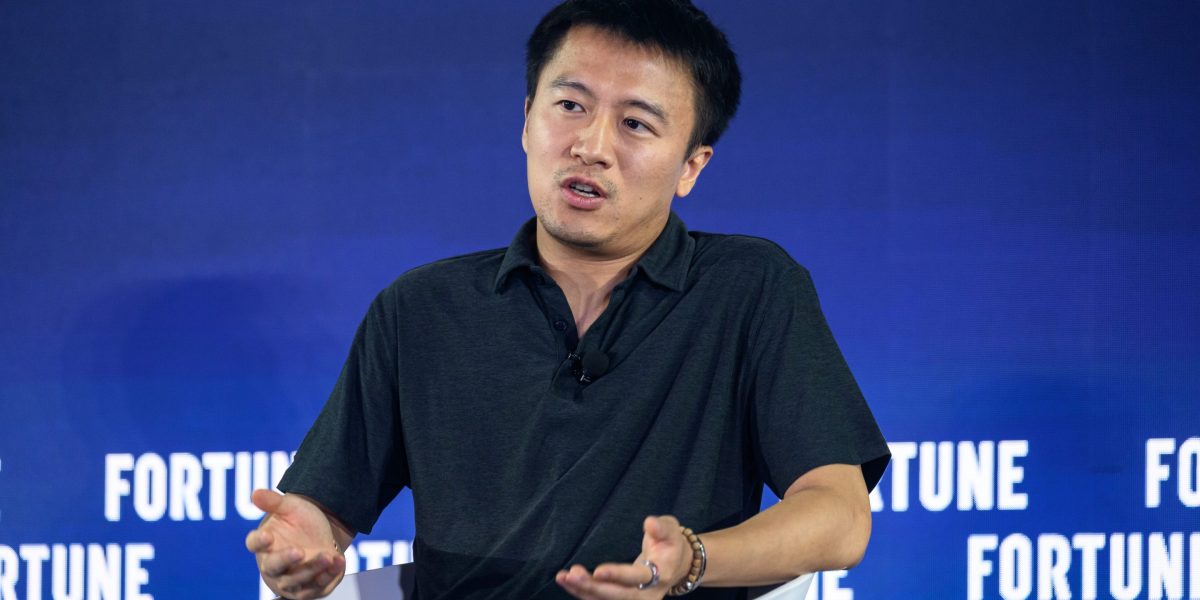
At the Fortune Leaders Forum in Macau, Zhou framed his approach as reversing the usual setup. 'A lot of people use AI as a way to co-pilot the leadership, but I'm trying to explore the way of me co-piloting the AI,' he said. He added that many of his decisions are now made by agents, large language models, and his executives. Yet he also noted that agents are 'emotionless' and that sales teams still need to be motivated by people — a limit on how far the delegation can go.
Other panelists described the same tension between what AI can do and whether organizations are ready. Becca Carroll of IDEO said speed alone isn't a durable advantage, and proposed a 'comb-shaped' person who can move between disciplines. James Arnett of Wipro said the shift is 'from directing to orchestrating,' and that the constraint isn't technology but people. Zhou, for his part, is still waiting for AI's true inflection point — a 'Google moment' he says should restructure an industry rather than replace humans. Whether Black Lake's order-size experiment points toward that moment, or whether trust remains the bottleneck, is likely to be the test.
For example, today's edition would include:
AI-summarized, only the topics you pick — one digest a day via Email, Slack, or Discord.
Free · 30 seconds with Google · unsubscribe anytimeWhat is AIToday? →
Ask AI anything about this article. Q&As are published on this page for other readers too.
Pichai said on the July 22, 2026 earnings call that Q2 Google Cloud revenue rose 82% year over year and its ba…
Chinese lab AllSpark released Iris-mini and Iris-pro, search agents with 35 billion and 397 billion parameters…

OpenAI's GPT-6 Astra averaged $15,515 in Andon Labs' Vending-Bench versus Claude Fable 5.1's $5,422
U.S. agencies on Tuesday accused DeepSeek, Moonshot and four other Chinese AI companies of extracting capabili…

The co-founder and executive director of Reimagine, a grief-support organization, writes that AI adoption is t…

Molly Taft reports that AI agents—systems that give themselves hundreds of small prompts—are now central to fr…